
终纹床核脑啡肽(PACAP)介导小鼠的重度酒精摄入。
Pituitary Adenylate Cyclase-Activating Polypeptide (PACAP) of the Bed Nucleus of the Stria Terminalis Mediates Heavy Alcohol Drinking in Mice.
机构信息
Laboratory of Addictive Disorders, Departments of Pharmacology and Psychiatry, Boston University Chobanian & Avedisian, School of Medicine, Boston, Massachusetts 02118.
Laboratory of Addictive Disorders, Departments of Pharmacology and Psychiatry, Boston University Chobanian & Avedisian, School of Medicine, Boston, Massachusetts 02118
出版信息
eNeuro. 2023 Dec 28;10(12). doi: 10.1523/ENEURO.0424-23.2023. Print 2023 Dec.
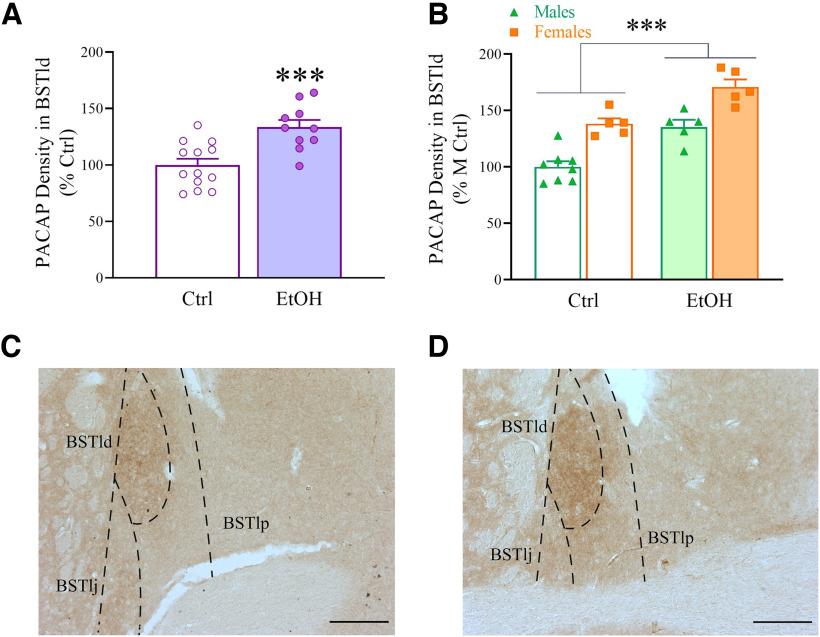
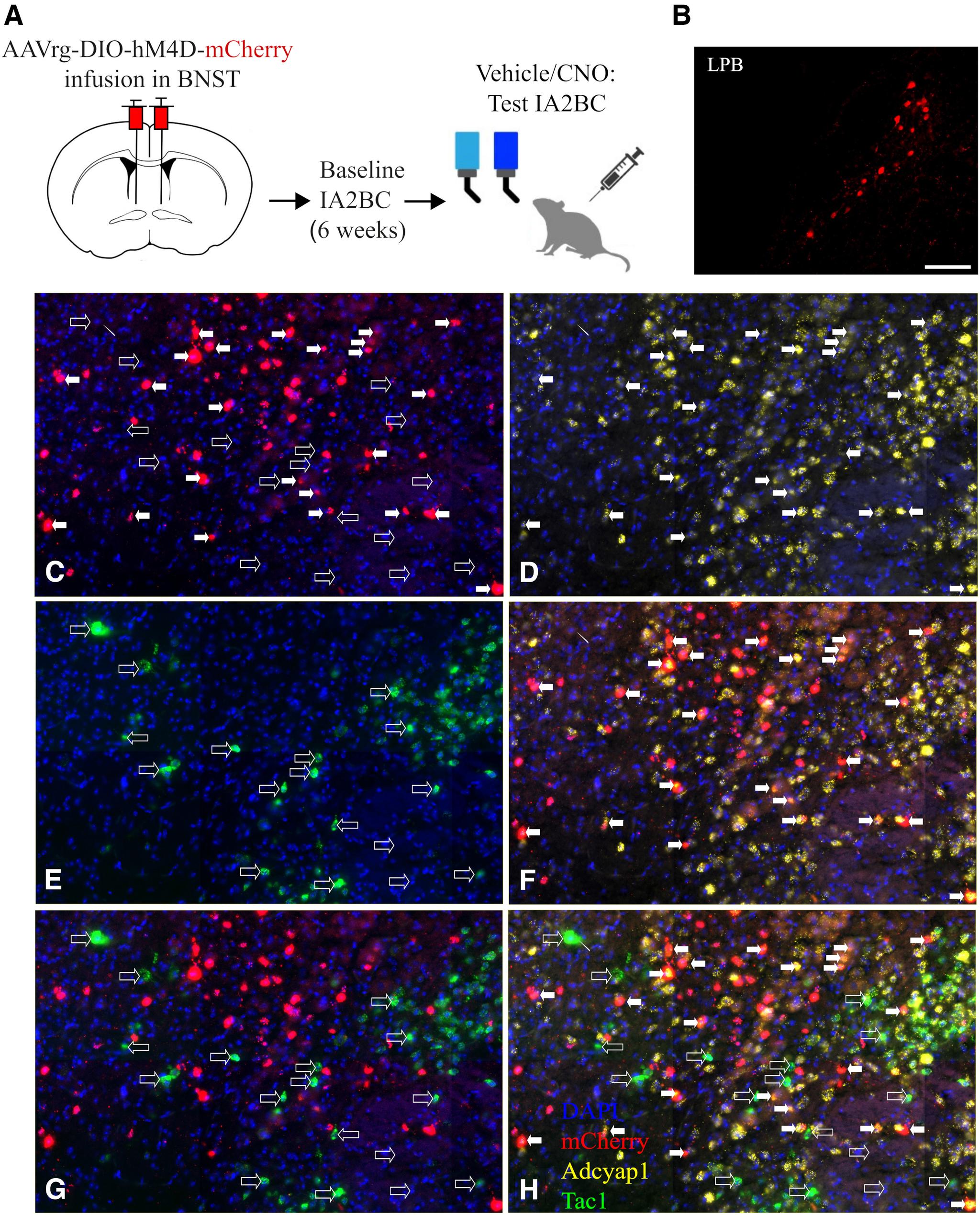
Alcohol use disorder (AUD) is a complex psychiatric disease characterized by periods of heavy drinking and periods of withdrawal. Chronic exposure to ethanol causes profound neuroadaptations in the extended amygdala, which cause allostatic changes promoting excessive drinking. The bed nucleus of the stria terminalis (BNST), a brain region involved in both excessive drinking and anxiety-like behavior, shows particularly high levels of pituitary adenylate cyclase-activating polypeptide (PACAP), a key mediator of the stress response. Recently, a role for PACAP in withdrawal-induced alcohol drinking and anxiety-like behavior in alcohol-dependent rats has been proposed; whether the PACAP system of the BNST is also recruited in other models of alcohol addiction and whether it is of local or nonlocal origin is currently unknown. Here, we show that PACAP immunoreactivity is increased selectively in the BNST of C57BL/6J mice exposed to a chronic, intermittent access to ethanol. While pituitary adenylate cyclase-activating polypeptide (PACAP) type 1 receptor-expressing cells were unchanged by chronic alcohol, the levels of a peptide closely related to PACAP, the calcitonin gene-related neuropeptide, were found to also be increased in the BNST. Finally, using a retrograde chemogenetic approach in PACAP-ires-Cre mice, we found that the inhibition of PACAP neuronal afferents to the BNST reduced heavy ethanol drinking. Our data suggest that the PACAP system of the BNST is recruited by chronic, voluntary alcohol drinking in mice and that nonlocally originating PACAP projections to the BNST regulate heavy alcohol intake, indicating that this system may represent a promising target for novel AUD therapies.
酒精使用障碍(AUD)是一种复杂的精神疾病,其特征是大量饮酒和戒断期。慢性暴露于乙醇会导致延伸杏仁核发生深刻的神经适应性变化,从而导致促进过度饮酒的适应性变化。终纹床核(BNST)是一个与过度饮酒和类似焦虑行为都有关的脑区,其显示出特别高水平的垂体腺苷酸环化酶激活肽(PACAP),这是应激反应的关键介质。最近,有人提出 PACAP 在酒精依赖大鼠的戒断诱导性饮酒和类似焦虑行为中起作用;BNST 的 PACAP 系统是否也被招募到其他酒精成瘾模型中,以及它是局部还是非局部起源,目前尚不清楚。在这里,我们表明,暴露于慢性间歇性乙醇的 C57BL/6J 小鼠的 BNST 中选择性地增加了 PACAP 免疫反应性。虽然慢性酒精对垂体腺苷酸环化酶激活肽(PACAP)1 型受体表达细胞没有影响,但与 PACAP 密切相关的降钙素基因相关神经肽的水平也发现 BNST 中增加。最后,通过 PACAP-ires-Cre 小鼠的逆行化学遗传方法,我们发现抑制 PACAP 神经元传入 BNST 可减少大量乙醇的摄入。我们的数据表明,BNST 的 PACAP 系统被小鼠慢性自愿饮酒所招募,并且源自非局部的 PACAP 投射到 BNST 调节大量酒精摄入,表明该系统可能代表新型 AUD 治疗的有希望的靶标。



 Zotero 插件