
基于18F-FDG PET/CT代谢参数构建非小细胞肺癌中PD-L1表达的列线图预测模型
[Construction of A Nomogram Prediction Model for PD-L1 Expression in Non-small Cell Lung Cancer Based on 18F-FDG PET/CT Metabolic Parameters].
作者信息
Hao Luoluo, Wang Lifeng, Zhang Mengyao, Yan Jiaming, Zhang Feifei
机构信息
Baotou Medical College, Inner Mongolia University of Science & Technology, Baotou 014040, China.
Nuclear Industry 417 Hospital, Xi'an 710600, China.
出版信息
Zhongguo Fei Ai Za Zhi. 2023 Nov 20;26(11):833-842. doi: 10.3779/j.issn.1009-3419.2023.101.32.
BACKGROUND
In recent years, immunotherapy represented by programmed cell death 1 (PD-1)/programmed cell death ligand 1 (PD-L1) immunosuppressants has greatly changed the status of non-small cell lung cancer (NSCLC) treatment. PD-L1 has become an important biomarker for screening NSCLC immunotherapy beneficiaries, but how to easily and accurately detect whether PD-L1 is expressed in NSCLC patients is a difficult problem for clinicians. The aim of this study was to construct a Nomogram prediction model of PD-L1 expression in NSCLC patients based on 18F-fluorodeoxy glucose (18F-FDG) positron emission tomography/conputed tomography (PET/CT) metabolic parameters and to evaluate its predictive value.
METHODS
Retrospective collection of 18F-FDG PET/CT metabolic parameters, clinicopathological information and PD-L1 test results of 155 NSCLC patients from Inner Mongolia People's Hospital between September 2016 and July 2021. The patients were divided into the training group (n=117) and the internal validation group (n=38), and another 51 cases of NSCLC patients in our hospital between August 2021 and July 2022 were collected as the external validation group according to the same criteria. Then all of them were categorized according to the results of PD-L1 assay into PD-L1+ group and PD-L1- group. The metabolic parameters and clinicopathological information of patients in the training group were analyzed by univariate and binary Logistic regression, and a Nomogram prediction model was constructed based on the screened independent influencing factors. The effect of the model was evaluated by receiver operating characteristic (ROC) curve, calibration curve and decision curve analysis (DCA) in both the training group and the internal and external validation groups.
RESULTS
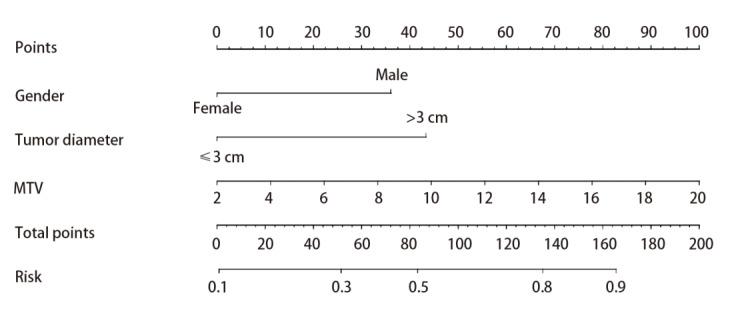
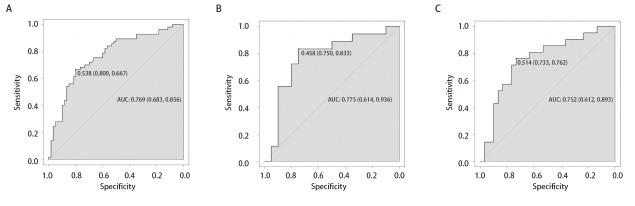
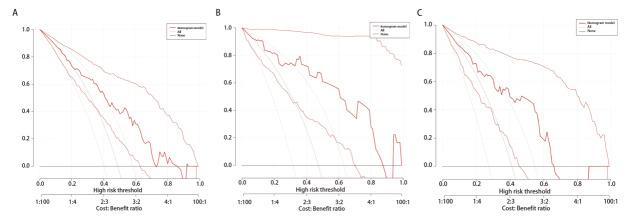
Binary Logistic regression analysis showed that metabolic tumor volume (MTV), gender and tumor diameter were independent influences on PD-L1 expression. Then a Nomogram prediction model was constructed based on the above independent influences. The ROC curve for the model in the training group shows an area under the curve (AUC) of 0.769 (95%CI: 0.683-0.856) with an optimal cutoff value of 0.538. The AUC was 0.775 (95%CI: 0.614-0.936) in the internal validation group and 0.752 (95%CI: 0.612-0.893) in the external validation group. The calibration curves were tested by the Hosmer-Lemeshow test and showed that the training group (χ2=0.040, P=0.979), the internal validation group (χ2=2.605, P=0.271), and the external validation group (χ2=0.396, P=0.820) were well calibrated. The DCA curves show that the model provides clinical benefit to patients over a wide range of thresholds (training group: 0.00-0.72, internal validation group: 0.00-0.87, external validation group: 0.00-0.66).
CONCLUSIONS
The Nomogram prediction model constructed on the basis of 18F-FDG PET/CT metabolic parameters has greater application value in predicting PD-L1 expression in NSCLC patients.
背景
近年来,以程序性细胞死亡蛋白1(PD-1)/程序性细胞死亡配体1(PD-L1)免疫抑制剂为代表的免疫疗法极大地改变了非小细胞肺癌(NSCLC)的治疗现状。PD-L1已成为筛选NSCLC免疫治疗受益人群的重要生物标志物,但如何简便、准确地检测NSCLC患者是否表达PD-L1是临床医生面临的难题。本研究旨在基于18F-氟脱氧葡萄糖(18F-FDG)正电子发射断层扫描/计算机断层扫描(PET/CT)代谢参数构建NSCLC患者PD-L1表达的列线图预测模型,并评估其预测价值。
方法
回顾性收集2016年9月至2021年7月内蒙古自治区人民医院155例NSCLC患者的18F-FDG PET/CT代谢参数、临床病理信息及PD-L1检测结果。将患者分为训练组(n=117)和内部验证组(n=38),并按照相同标准收集2021年8月至2022年7月我院另外51例NSCLC患者作为外部验证组。然后根据PD-L1检测结果将所有患者分为PD-L1阳性组和PD-L1阴性组。采用单因素和二元Logistic回归分析训练组患者的代谢参数和临床病理信息,并基于筛选出的独立影响因素构建列线图预测模型。通过受试者工作特征(ROC)曲线、校准曲线和决策曲线分析(DCA)在训练组以及内部和外部验证组中评估模型效果。
结果
二元Logistic回归分析显示,代谢肿瘤体积(MTV)、性别和肿瘤直径是影响PD-L1表达的独立因素。基于上述独立影响因素构建了列线图预测模型。训练组中该模型的ROC曲线下面积(AUC)为0.769(95%CI:0.683-0.856),最佳截断值为0.538。内部验证组的AUC为0.775(95%CI:0.614-0.936),外部验证组的AUC为0.752(95%CI:0.612-0.893)。通过Hosmer-Lemeshow检验对校准曲线进行检验,结果显示训练组(χ2=0.040,P=0.979)、内部验证组(χ2=2.605,P=0.271)和外部验证组(χ2=0.396,P=


 Zotero 插件