
视力障碍对语用障碍的影响:系统评价和荟萃分析。
Impacts of visual impairment on pragmatic impairment: A systematic review and meta-analysis.
机构信息
School of Foreign Studies, China University of Petroleum (East China), Qingdao, China.
Shanghai Center for Research in English Language Education, Shanghai International Studies University, Shanghai, China.
出版信息
PLoS One. 2023 Dec 8;18(12):e0294326. doi: 10.1371/journal.pone.0294326. eCollection 2023.
BACKGROUND
Consideration for patients with visual impairment, from low vision to blindness, is an important part of building a barrier-free society. Some authors have elaborated that visual impairment can indeed lead to delayed development in theory of mind, thereby causing pragmatic knowledge deficiency. Verifying whether those with eye conditions have pragmatic impairment is an essential way for their clinical evaluation, intervention and rehabilitation.
OBJECTIVE
We primarily carry out a meta-analysis of visual impairment from low vision to blindness and pragmatic impairment in people with low vision or blindness to verify visual impairment may cause pragmatic impairment.
DATA SOURCES
Electronic databases Pubmed, Medline, MesH, Psychinfo, Ovid, EBSCO and CNKI and the reference sections of previous reviews.
STUDY ELIGIBILITY CRITERIA
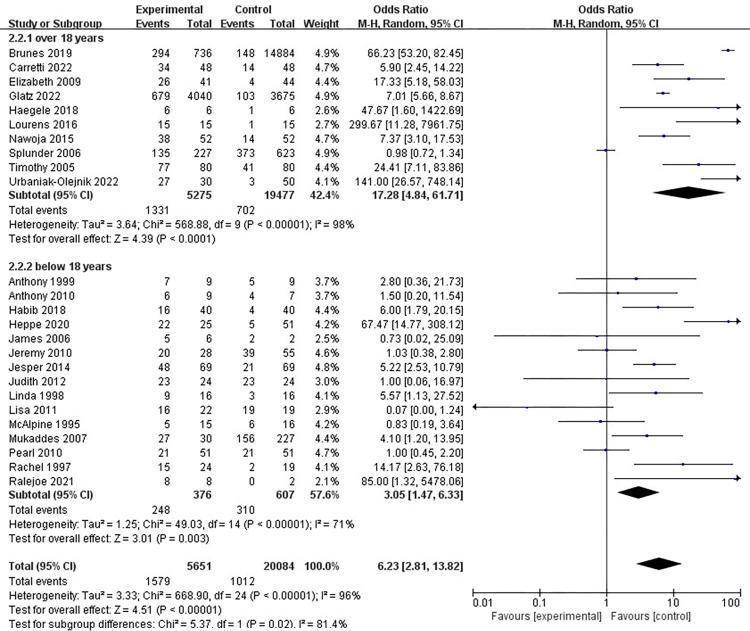
Studies were included when they built on primary data from clinical questionnaire surveys or field trials anywhere in the world, and when they reported impacts of visual impairment on social cognition, communication, skills, behavior and intelligence. In total, 25 original studies were included, in which 25735 people were evaluated.
RESULTS
Statistically, visual impairments and pragmatic impairment exist correlation due to the significant p value(p = 0.0005 < 0.05) in group and the subgroup sorted in the light of 18 years old (p < 0.0001 and p = 0.003 < 0.05). Psychologically, because people with visual impairment can not normally get non-verbal information, they can not get a complete pragmatic knowledge system. Pragmatic knowledge deficiency leads to abnormal in executive functions and development delay from the perspective of theory of mind, inducing pragmatic impairment. Therefore, visual impairment has an impact on pragmatic impairment.
CONCLUSION
The meta-analysis reveals robust evidence on the relationship of vision impairment and pragmatic impairment in children or adults. Such evidence may help to gradually improve the clinical evaluation, intervention and rehabilitation of these people.
背景
考虑到视力障碍患者(从低视力到失明),是建设无障碍社会的重要组成部分。一些作者详细阐述了视力障碍确实会导致心理理论发展延迟,从而导致语用知识缺陷。验证有眼部疾病的人是否存在语用障碍,是对他们进行临床评估、干预和康复的重要方法。
目的
我们主要对低视力到失明的视力障碍和低视力或失明人群的语用障碍进行荟萃分析,以验证视力障碍是否会导致语用障碍。
数据来源
电子数据库 PubMed、Medline、MesH、Psychinfo、Ovid、EBSCO 和中国知网(CNKI),以及以前综述的参考文献部分。
研究入选标准
包括基于世界各地临床问卷调查或现场试验的原始数据,以及报告视力障碍对社会认知、沟通、技能、行为和智力影响的研究。共纳入 25 项原始研究,共评估了 25735 人。
结果
统计学上,由于组间差异有统计学意义(p = 0.0005 < 0.05),以及根据 18 岁分组(p < 0.0001 和 p = 0.003 < 0.05)的亚组差异也有统计学意义,因此视力损害与语用障碍存在相关性。从心理上讲,由于视力障碍者无法正常获取非言语信息,因此无法获得完整的语用知识体系。语用知识缺陷导致执行功能异常和心理理论发展延迟,从而导致语用障碍。因此,视力障碍会对语用障碍产生影响。
结论
荟萃分析揭示了儿童或成人视力障碍与语用障碍之间关系的有力证据。这些证据可能有助于逐步改善这些人群的临床评估、干预和康复。


 Zotero 插件