
丝胶蛋白在D-半乳糖诱导小鼠模型中的抗氧化及抗衰老作用
Antioxidant and anti-aging role of silk sericin in D-galactose induced mice model.
作者信息
Mumtaz Shumaila, Ali Shaukat, Qureshi Muhammad Zahid, Muhammad Ali, Manan Abdul, Akbar Mughal Tafail
机构信息
Applied Entomology and Medical Toxicology and Laboratory, Department of Zoology, Government College University, Lahore, Pakistan.
Department of Zoology, University of Poonch, Rawlakot, Pakistan.
出版信息
Saudi J Biol Sci. 2023 Dec;30(12):103872. doi: 10.1016/j.sjbs.2023.103872. Epub 2023 Nov 14.
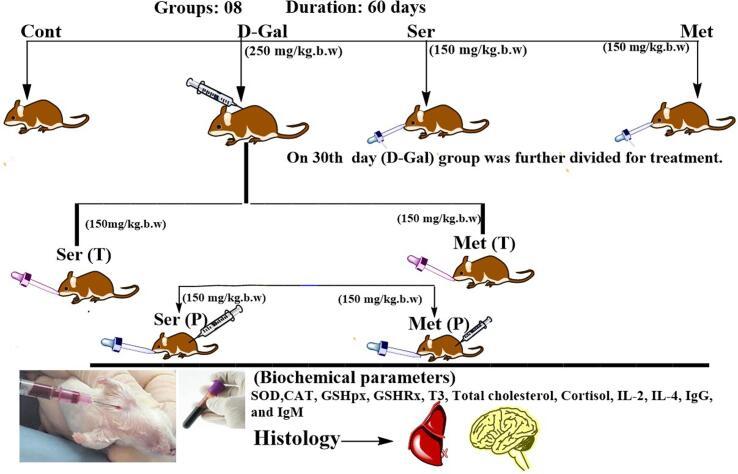
The main purpose was to elucidate the potential anti-aging impact of sericin, due to its anti-oxidant potential in D-galactose induced mice model. To induce natural aging in mice, a solution of 0.9 % saline containing D-galactose (250 mg/kg b.w.) was injected intraperitoneally for a period of 60 days. In this experiment, 56 male mice were arbitrarily categorized into 8 groups (1: control; 2: D-Galactose (250 mg/kg b.w), Group 3: Sericin (150 mg/kg b.w), Group 4: Metformin (150 mg/kg), Group 5: sericin (P), Group 6; sericin (T), Group 7; Met (P), Group 8; Met (T). The level of Glutathione reductase (2.1 ± 0.2 µmol/L), CAT (0.5 ± 0.0 mmol/mL), Superoxide dismutase (65.4 ± 1.7 U/mL), GSHPx (69.2 ± 1.7 U/l), T3 (3.1 ± 0.7 ng/mL), IL-2 (68.8 ± 1.5 Pg/mL), IL-4 (71.4 ± 4.2 Pg/mL), IgG (0.6 ± 0.0 mg/mL) and IgM (0.6 ± 0.0 mg/mL) were significantly (P < 0.05) decreased whereas the cortisol (22.0 ± 1.5 µg/L), and total cholesterol (229.4 ± 4.2 mg/dL)) were significantly elevated in D-galactose-treated /aged mice. However, administration of sericin significantly reduced the level of oxidative stress in aged mice. Real-time qPCR data showed that the level of telomere length- gene TERT significantly downregulated (10.43 ± 0.1) in the D-Gal-treated mice with respect to control (21.97 ± 0.5). The highest significant upregulation was found in the TERT gene when D-Gal-induced aged mice were treated with sericin (24.74 ± 0.3). Our outcomes showed that sericin gradually recovered the organ indices, and improved the histological changes of the brain, kidney, and liver in D-Gal-induced aging mice. Therefore, concluded that sericin possesses anti-aging effect against D-Gal-induced aging by diminishing oxidative stress, restoring the immune system, and enhancing the antioxidant defense system.
主要目的是阐明丝胶蛋白的潜在抗衰老作用,这是由于其在D-半乳糖诱导的小鼠模型中的抗氧化潜力。为诱导小鼠自然衰老,腹腔注射含D-半乳糖(250mg/kg体重)的0.9%生理盐水溶液,持续60天。在本实验中,56只雄性小鼠被随机分为8组(1:对照组;2:D-半乳糖(250mg/kg体重)组,3:丝胶蛋白(150mg/kg体重)组,4:二甲双胍(150mg/kg)组,5:丝胶蛋白(P)组,6:丝胶蛋白(T)组,7:二甲双胍(P)组,8:二甲双胍(T)组。D-半乳糖处理/衰老小鼠的谷胱甘肽还原酶水平(2.1±0.2μmol/L)、过氧化氢酶(0.5±0.0mmol/mL)、超氧化物歧化酶(65.4±1.7U/mL)、谷胱甘肽过氧化物酶(69.2±1.7U/L)、T3(3.1±0.7ng/mL)、IL-2(68.8±1.5Pg/mL)、IL-4(71.4±4.2Pg/mL)、IgG(0.6±0.0mg/mL)和IgM(0.6±0.0mg/mL)显著(P<0.05)降低,而皮质醇(22.0±1.5μg/L)和总胆固醇(229.4±4.2mg/dL)显著升高。然而,丝胶蛋白的给药显著降低了衰老小鼠的氧化应激水平。实时定量PCR数据显示,与对照组(21.97±0.5)相比,D-半乳糖处理小鼠的端粒长度基因TERT水平显著下调(10.43±0.1)。当用丝胶蛋白处理D-半乳糖诱导的衰老小鼠时,TERT基因出现最高的显著上调(24.74±0.3)。我们的结果表明,丝胶蛋白逐渐恢复了D-半乳糖诱导的衰老小鼠的器官指数,并改善了脑、肾和肝的组织学变化。因此,得出结论,丝胶蛋白通过减少氧化应激、恢复免疫系统和增强抗氧化防御系统,对D-半乳糖诱导的衰老具有抗衰老作用。




 Zotero 插件