
环境臭氧污染损害葡萄糖稳态并导致肾功能下降:基于人群的证据。
Ambient ozone pollution impairs glucose homeostasis and contributes to renal function decline: Population-based evidence.
机构信息
Department of Global Health, School of Public Health, Wuhan University, Wuhan 430071, Hubei, PR China; Global Health Institute, Wuhan University, Wuhan 430071, Hubei, PR China.
Department of Global Health, School of Public Health, Wuhan University, Wuhan 430071, Hubei, PR China.
出版信息
Ecotoxicol Environ Saf. 2024 Jan 1;269:115803. doi: 10.1016/j.ecoenv.2023.115803. Epub 2023 Dec 12.
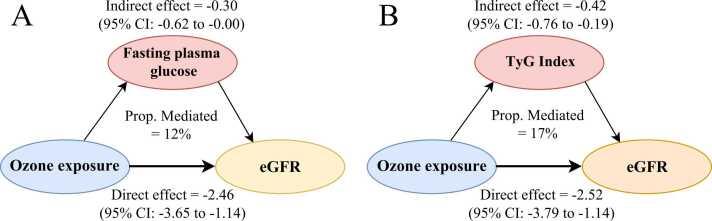
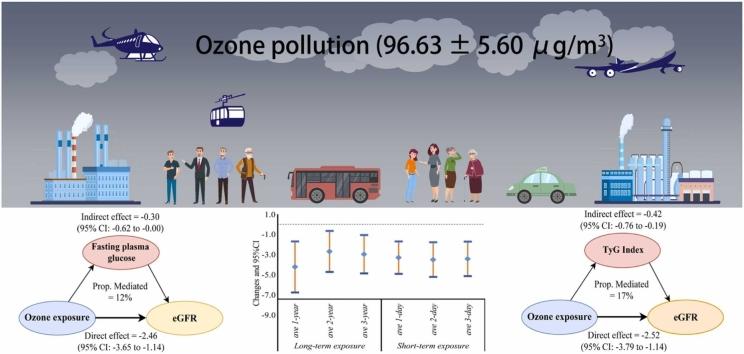
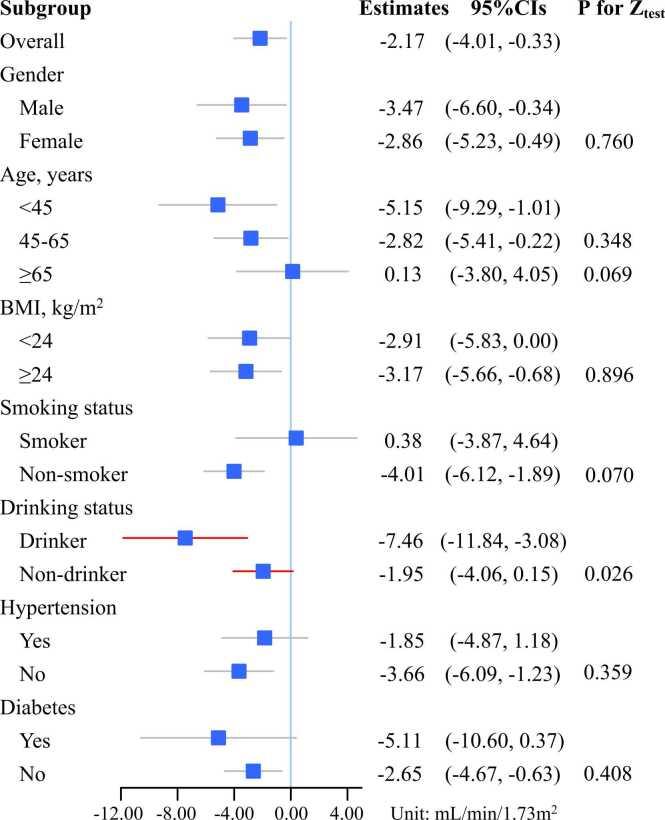
Particulate matter pollution could increase the risk of kidney disease, while evidence for ozone exposure is less well-established. Here, we aimed to evaluate the effect of ozone pollution on renal function and explore mechanisms. We first conducted a cross-sectional study based on Wuhan Chronic Disease Cohort Study baseline information. We recruited 2699 eligible participants, estimated their residential ozone concentrations, collected fasting peripheral blood samples for biochemical analysis and calculated the estimated glomerular filtration rate (eGFR). The linear regression model was applied to evaluate the long-term association between ozone pollution and eGFR. Then, we recruited another 70 volunteers as a panel with 8 rounds follow-up visits. We calculated the eGFR and measured fasting blood glucose and lipid levels. The linear mixed-effect model along with mediation analysis were performed to confirm the short-term association and explore potential mechanisms, respectively. For the long-term association, a 10.95 μg/m increment of 3-year ozone exposure was associated with 2.96 mL/min/1.73 m decrease in eGFR (95%CI: -4.85, -1.06). Furthermore, the drinkers exhibited a pronounced declination of eGFR (-7.46 mL/min/1.73 m, 95%CI: -11.84, -3.08) compared to non-drinkers in relation to ozone exposure. Additionally, a 19.02 μg/m increase in 3-day ozone concentrations was related to 2.51 mL/min/1.73 m decrease in eGFR (95%CI: -3.78, -1.26). Hyperglycemia and insulin resistance mediated 12.2% and 16.5% of the aforementioned association, respectively. Our findings indicated that higher ozone pollution could affect renal function, and the hyperglycemia and insulin resistance linked to ozone might be the underlying mechanisms.
颗粒物污染可能会增加患肾病的风险,而臭氧暴露的证据则不太明确。在这里,我们旨在评估臭氧污染对肾功能的影响,并探讨其机制。
我们首先进行了一项基于武汉慢性病队列研究基线信息的横断面研究。我们招募了 2699 名符合条件的参与者,估计了他们的居住臭氧浓度,采集了空腹外周血样进行生化分析,并计算了估算肾小球滤过率(eGFR)。线性回归模型用于评估臭氧污染与 eGFR 之间的长期关联。然后,我们招募了另外 70 名志愿者作为一个包含 8 轮随访的小组。我们计算了 eGFR,并测量了空腹血糖和血脂水平。线性混合效应模型和中介分析分别用于确认短期关联和探索潜在机制。
对于长期关联,3 年臭氧暴露增加 10.95μg/m,与 eGFR 下降 2.96mL/min/1.73m 相关(95%CI:-4.85,-1.06)。此外,与臭氧暴露相比,饮酒者的 eGFR 下降更为明显(-7.46mL/min/1.73m,95%CI:-11.84,-3.08)。此外,3 天臭氧浓度增加 19.02μg/m,与 eGFR 下降 2.51mL/min/1.73m 相关(95%CI:-3.78,-1.26)。高血糖和胰岛素抵抗分别介导了上述关联的 12.2%和 16.5%。
我们的研究结果表明,较高的臭氧污染可能会影响肾功能,而与臭氧相关的高血糖和胰岛素抵抗可能是其潜在机制。

 Zotero 插件