
非靶向血清代谢组学揭示了与胃食管腺癌进展相关的潜在生物标志物和代谢途径。
Untargeted serum metabolomics reveals potential biomarkers and metabolic pathways associated with the progression of gastroesophageal cancer.
机构信息
Department of Biostatistics, School of Public Health, Cheeloo College of Medicine, Shandong University, Jinan, 250012, Shandong, China.
Institute for Medical Dataology, Cheeloo College of Medicine, Shandong University, Jinan, 250012, China.
出版信息
BMC Cancer. 2023 Dec 15;23(1):1238. doi: 10.1186/s12885-023-11744-y.
BACKGROUND
Previous metabolic studies in upper digestive cancer have mostly been limited to cross-sectional study designs, which hinders the ability to effectively predict outcomes in the early stage of cancer. This study aims to identify key metabolites and metabolic pathways associated with the multistage progression of epithelial cancer and to explore their predictive value for gastroesophageal cancer (GEC) formation and for the early screening of esophageal squamous cell carcinoma (ESCC).
METHODS
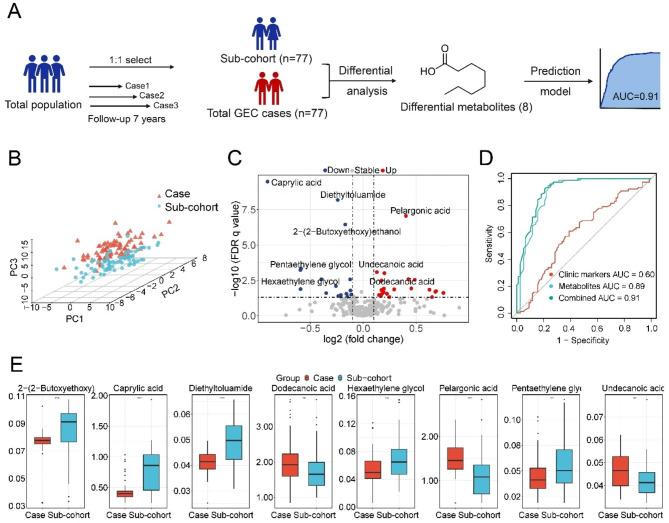
A case-cohort study within the 7-year prospective Esophageal Cancer Screening Cohort of Shandong Province included 77 GEC cases and 77 sub-cohort individuals. Untargeted metabolic analysis was performed in serum samples. Metabolites, with FDR q value < 0.05 and variable importance in projection (VIP) > 1, were selected as differential metabolites to predict GEC formation using Random Forest (RF) models. Subsequently, we evaluated the predictive performance of these differential metabolites for the early screening of ESCC.
RESULTS
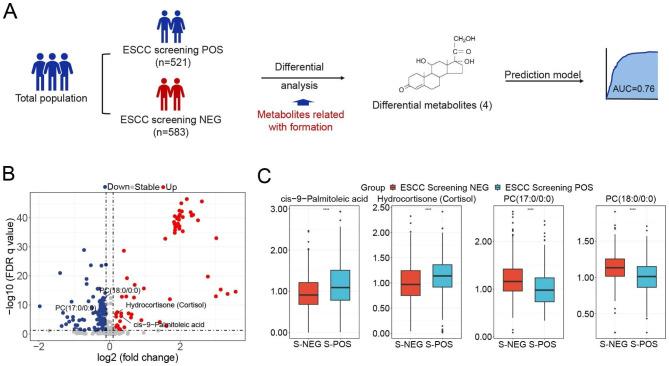
We found a distinct metabolic profile alteration in GEC cases compared to the sub-cohort, and identified eight differential metabolites. Pathway analyses showed dysregulation in D-glutamine and D-glutamate metabolism, nitrogen metabolism, primary bile acid biosynthesis, and steroid hormone biosynthesis in GEC patients. A panel of eight differential metabolites showed good predictive performance for GEC formation, with an area under the receiver operating characteristic curve (AUC) of 0.893 (95% CI = 0.816-0.951). Furthermore, four of the GEC pathological progression-related metabolites were validated in the early screening of ESCC, with an AUC of 0.761 (95% CI = 0.716-0.805).
CONCLUSIONS
These findings indicated a panel of metabolites might be an alternative approach to predict GEC formation, and therefore have the potential to mitigate the risk of cancer progression at the early stage of GEC.
背景
之前有关上消化道癌症的代谢研究大多局限于横断面研究设计,这阻碍了有效预测癌症早期阶段结果的能力。本研究旨在确定与上皮癌多阶段进展相关的关键代谢物和代谢途径,并探索它们对胃食管癌(GEC)形成和食管鳞状细胞癌(ESCC)早期筛查的预测价值。
方法
山东省 7 年前瞻性食管癌筛查队列中的病例-对照研究纳入了 77 例 GEC 病例和 77 例亚队列个体。对血清样本进行非靶向代谢分析。使用随机森林(RF)模型,选择 FDR q 值<0.05 和变量重要性投影(VIP)>1 的代谢物作为预测 GEC 形成的差异代谢物。随后,我们评估了这些差异代谢物对 ESCC 早期筛查的预测性能。
结果
我们发现 GEC 病例与亚队列相比存在明显的代谢谱改变,并鉴定出 8 种差异代谢物。通路分析显示,GEC 患者的 D-谷氨酰胺和 D-谷氨酸代谢、氮代谢、初级胆汁酸生物合成和甾体激素生物合成失调。一组 8 种差异代谢物对 GEC 形成具有良好的预测性能,ROC 曲线下面积(AUC)为 0.893(95%CI=0.816-0.951)。此外,在 ESCC 的早期筛查中验证了 4 种与 GEC 病理进展相关的代谢物,AUC 为 0.761(95%CI=0.716-0.805)。
结论
这些发现表明,一组代谢物可能是预测 GEC 形成的另一种方法,因此有可能在 GEC 的早期阶段降低癌症进展的风险。

 Zotero 插件