
大疱性类天疱疮细胞因子诱导免疫研究:最新进展。
Study of cytokine-induced immunity in bullous pemphigoid: recent developments.
机构信息
Department of Dermatology, The Second Affiliated Hospital of Kunming Medical University, Kunming, China.
出版信息
Ann Med. 2023;55(2):2280991. doi: 10.1080/07853890.2023.2280991. Epub 2023 Dec 18.
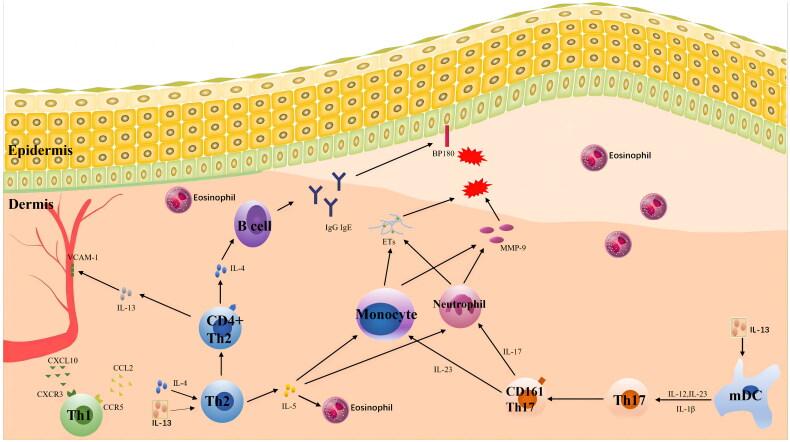
Bullous pemphigoid (BP) is an organ-specific disease. Its pathogenesis has not been clearly studied yet; However, studies in recent years have shown that its pathogenesis is related to T helper cells. The pathogenesis of BP is mainly related to Th2 and Th17-related cytokines. IL-4, IL-5 and IL-13 cause eosinophil recruitment, promote antibody production, trigger pruritus and promote blister formation and other symptoms. IL-17 and IL-23 promote the production of matrix metalloproteinase-9 (MMP-9) by related cells, which causes dermo-epidermal junction (DEJ) separation to form bullae and blisters, and can persist in BP inflammation. The serum concentrations of IL-17 and IL-23 are related to the prognosis of BP. In this paper, we focus on the role of related cytokines in the pathogenesis of bullous pemphigoid and the relationship between the related cytokine populations secreted by three major T helper cells-helper T lymphocytes 1 (Th1), Th2, and Th17. A better understanding of the biological and immunological functions of cytokines associated with BP patients will provide opportunities for therapeutic targets in BP.
大疱性类天疱疮(BP)是一种器官特异性疾病。其发病机制尚未得到明确研究;然而,近年来的研究表明,其发病机制与辅助性 T 细胞有关。BP 的发病机制主要与 Th2 和 Th17 相关细胞因子有关。IL-4、IL-5 和 IL-13 引起嗜酸性粒细胞募集,促进抗体产生,引发瘙痒并促进水疱形成和其他症状。IL-17 和 IL-23 促进相关细胞产生基质金属蛋白酶-9(MMP-9),导致表皮基底膜(DEJ)分离形成大疱和水疱,并能在 BP 炎症中持续存在。血清中 IL-17 和 IL-23 的浓度与 BP 的预后有关。本文重点介绍相关细胞因子在大疱性类天疱疮发病机制中的作用,以及三种主要辅助性 T 细胞-辅助性 T 淋巴细胞 1(Th1)、Th2 和 Th17 分泌的相关细胞因子群之间的关系。更好地了解与 BP 患者相关的细胞因子的生物学和免疫学功能,将为 BP 的治疗靶点提供机会。
 Zotero 插件