
术中血液吸附在心脏移植患者中的应用:一项概念验证随机试验。
Use of intraoperative haemoadsorption in patients undergoing heart transplantation: a proof-of-concept randomized trial.
机构信息
Heart and Vascular Center, Semmelweis University, Budapest, Hungary.
Department of Anaesthesiology and Intensive Therapy, Semmelweis University, Budapest, Hungary.
出版信息
ESC Heart Fail. 2024 Apr;11(2):772-782. doi: 10.1002/ehf2.14632. Epub 2023 Dec 19.
AIMS
The aim of this trial was to compare the clinical effects of intraoperative haemoadsorption versus standard care in patients undergoing orthotopic heart transplantation (OHT).
METHODS AND RESULTS
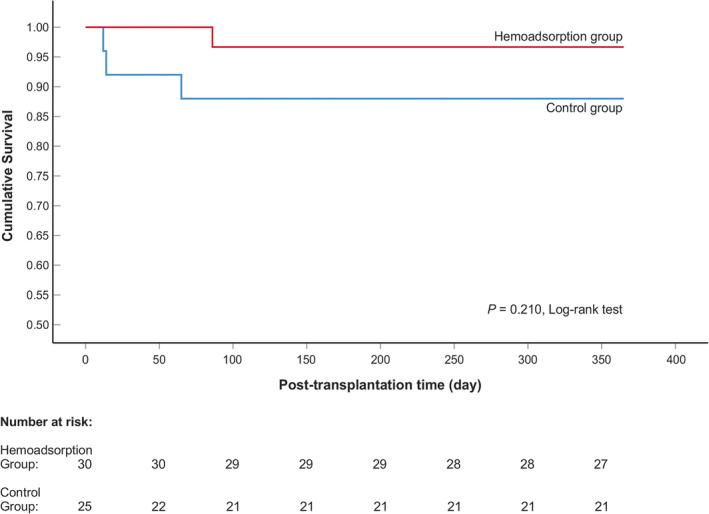
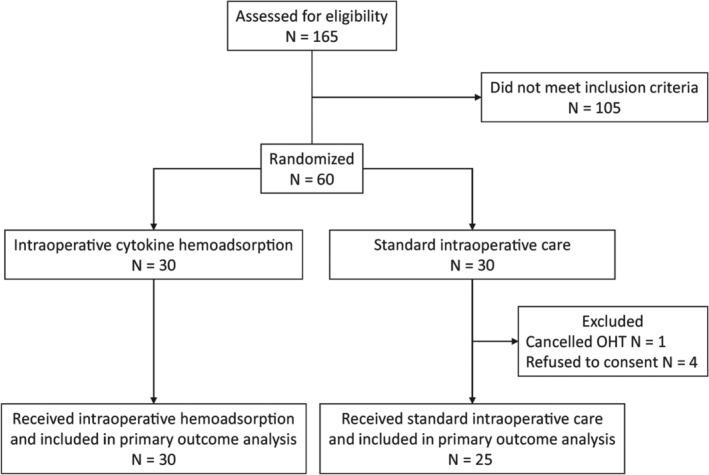
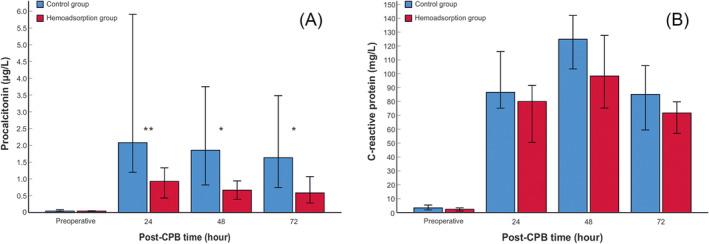
In a randomized, controlled trial, OHT recipients were randomized to receive intraoperative haemoadsorption or standard care. Outcomes were vasoactive-inotropic score (VIS), frequency of vasoplegic syndrome (VS) in the first 24 h; post-operative change in procalcitonin (PCT) and C-reactive protein (CRP) levels; intraoperative change in mycophenolic acid (MPA) concentration; frequency of post-operative organ dysfunction, major complications, adverse immunological events and length of in-hospital stay and 1-year survival. Sixty patients were randomized (haemoadsorption group N = 30, control group N = 25 plus 5 exclusions). Patients in the haemoadsorption group had a lower median VIS and rate of VS (VIS: 27.2 [14.6-47.7] vs. 41.9 [22.4-63.2], P = 0.046, and VS: 20.0% vs. 48.0%, P = 0.028, respectively), a 6.4-fold decrease in the odds of early VS (OR: 0.156, CI: 0.029-0.830, P = 0.029), lower PCT levels, shorter median mechanical ventilation (MV: 25 [19-68.8] hours vs. 65 [23-287] hours, P = 0.025, respectively) and intensive care unit stay (ICU stay: 8.5 [8.0-10.3] days vs. 12 [8.5-18.0] days, P = 0.022, respectively) than patients in the control group. Patients in the haemoadsorption versus control group experienced lower rates of acute kidney injury (AKI: 36.7% vs. 76.0%, P = 0.004, respectively), renal replacement therapy (RRT: 0% vs. 16.0%, P = 0.037, respectively) and lower median per cent change in bilirubin level (PCB: 2.5 [-24.6 to 71.1] % vs. 72.1 [11.2-191.4] %, P = 0.009, respectively) during the post-operative period. MPA concentrations measured at pre-defined time points were comparable in the haemoadsorption compared to control groups (MPA pre-cardiopulmonary bypass: 2.4 [1.15-3.60] μg/mL vs. 1.6 [1.20-3.20] μg/mL, P = 0.780, and MPA 120 min after cardiopulmonary bypass start: 1.1 [0.58-2.32] μg/mL vs. 0.9 [0.45-2.10] μg/mL, P = 0.786). The rates of cardiac allograft rejection, 30-day mortality and 1-year survival were similar between the groups.
CONCLUSIONS
Intraoperative haemoadsorption was associated with better haemodynamic stability, mitigated PCT response, lower rates of post-operative AKI and RRT, more stable hepatic bilirubin excretion, and shorter durations of MV and ICU stay. Intraoperative haemoadsorption did not show any relevant adsorption effect on MPA. There was no increase in the frequency of early cardiac allograft rejection related to intraoperative haemoadsorption use.
目的
本试验旨在比较原位心脏移植(OHT)术中血液吸附与标准治疗的临床效果。
方法与结果
在一项随机对照试验中,将 OHT 受者随机分为接受术中血液吸附或标准治疗。观察指标为血管活性-正性肌力评分(VIS)、术后 24 小时内血管麻痹综合征(VS)的发生率;术后降钙素原(PCT)和 C 反应蛋白(CRP)水平的变化;术中麦考酚酸(MPA)浓度的变化;术后器官功能障碍、主要并发症、免疫不良事件的发生率以及住院时间和 1 年生存率。60 例患者随机分组(血液吸附组 N=30,对照组 N=25 例加 5 例排除)。血液吸附组患者的中位 VIS 和 VS 发生率较低(VIS:27.2[14.6-47.7] vs. 41.9[22.4-63.2],P=0.046 和 VS:20.0% vs. 48.0%,P=0.028),早期 VS 的发生风险降低 6.4 倍(OR:0.156,95%CI:0.029-0.830,P=0.029),PCT 水平较低,机械通气时间(MV)较短(MV:25[19-68.8]小时 vs. 65[23-287]小时,P=0.025),重症监护病房(ICU)入住时间(ICU 入住时间:8.5[8.0-10.3]天 vs. 12[8.5-18.0]天,P=0.022)比对照组患者短。与对照组相比,血液吸附组患者的急性肾损伤(AKI)发生率(36.7% vs. 76.0%,P=0.004)、肾脏替代治疗(RRT)的发生率(0% vs. 16.0%,P=0.037)较低,术后胆红素水平的中位百分比变化(PCB)也较低(2.5[-24.6-71.1]% vs. 72.1[11.2-191.4]%,P=0.009)。与对照组相比,血液吸附组患者在心脏体外循环前(MPA 预 CPB:2.4[1.15-3.60]μg/mL vs. 1.6[1.20-3.20]μg/mL,P=0.780)和心脏体外循环后 120 分钟(MPA 120 分钟后:1.1[0.58-2.32]μg/mL vs. 0.9[0.45-2.10]μg/mL,P=0.786)的时间点测量的 MPA 浓度相当。心脏移植物排斥、30 天死亡率和 1 年生存率在两组之间相似。
结论
术中血液吸附可改善血流动力学稳定性,减轻 PCT 反应,降低术后 AKI 和 RRT 的发生率,使肝脏胆红素排泄更稳定,缩短 MV 和 ICU 入住时间。术中血液吸附对 MPA 没有显示出任何相关的吸附作用。使用术中血液吸附与早期心脏移植物排斥的发生频率增加无关。


 Zotero 插件