
使用惯性传感器验证评估健康个体和脑卒中个体的正常和异常步态的算法。
Validation of an algorithm to assess regular and irregular gait using inertial sensors in healthy and stroke individuals.
机构信息
Department of Research, Sint Maartenskliniek, Nijmegen, the Netherlands.
Department of Sensorimotor Neuroscience, Donders institute for Brain, Cognition and Behaviour, Radboud University, Nijmegen, the Netherlands.
出版信息
PeerJ. 2023 Dec 15;11:e16641. doi: 10.7717/peerj.16641. eCollection 2023.
BACKGROUND
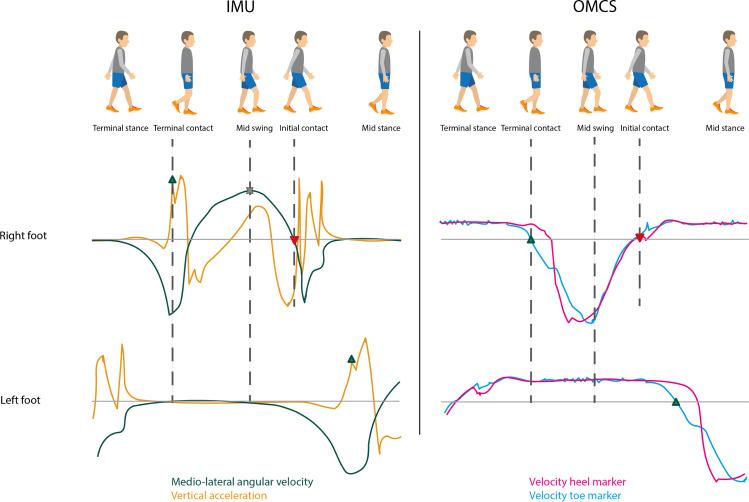
Studies using inertial measurement units (IMUs) for gait assessment have shown promising results regarding accuracy of gait event detection and spatiotemporal parameters. However, performance of such algorithms is challenged in irregular walking patterns, such as in individuals with gait deficits. Based on the literature, we developed an algorithm to detect initial contact (IC) and terminal contact (TC) and calculate spatiotemporal gait parameters. We evaluated the validity of this algorithm for regular and irregular gait patterns against a 3D optical motion capture system (OMCS).
METHODS
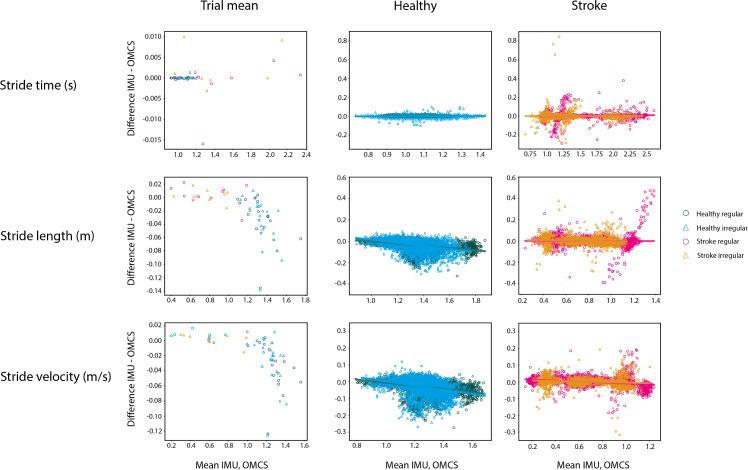
Twenty healthy participants (aged 59 ± 12 years) and 10 people in the chronic phase after stroke (aged 61 ± 11 years) were equipped with 4 IMUs: on both feet, sternum and lower back (MTw Awinda, Xsens) and 26 reflective makers. Participants walked on an instrumented treadmill for 2 minutes (i) with their preferred stride lengths and (ii) once with irregular stride lengths (±20% deviation) induced by light projected stepping stones. Accuracy of the algorithm was evaluated on stride-by-stride agreement of IC, TC, stride time, length and velocity with OMCS. Bland-Altman-like plots were made for the spatiotemporal parameters, while differences in detection of IC and TC time instances were shown in histogram plots. Performance of the algorithm was compared between regular and irregular gait with a linear mixed model. This was done by comparing the performance in healthy participants in the regular vs irregular walking condition, and by comparing the agreement in healthy participants with stroke participants in the regular walking condition.
RESULTS
For each condition at least 1,500 strides were included for analysis. Compared to OMCS, IMU-based IC detection in both groups and condition was on average 9-17 (SD ranging from 7 to 35) ms, while IMU-based TC was on average 15-24 (SD ranging from 12 to 35) ms earlier. When comparing regular and irregular gait in healthy participants, the difference between methods was 2.5 ms higher for IC, 3.4 ms lower for TC, 0.3 cm lower for stride length, and 0.4 cm/s higher for stride velocity in the irregular walking condition. No difference was found on stride time. When comparing the differences between methods between healthy and stroke participants, the difference between methods was 7.6 ms lower for IC, 3.8 cm lower for stride length, and 3.4 cm/s lower for stride velocity in stroke participants. No differences were found on differences between methods on TC detection and stride time between stroke and healthy participants.
CONCLUSIONS
Small irrelevant differences were found on gait event detection and spatiotemporal parameters due to irregular walking by imposing irregular stride lengths or pathological (stroke) gait. Furthermore, IMUs seem equally good compared to OMCS to assess gait variability based on stride time, but less accurate based on stride length.
背景
使用惯性测量单元(IMU)进行步态评估的研究表明,在步态事件检测和时空参数方面具有很高的准确性。然而,在不规则的行走模式下,例如在步态缺陷的个体中,这种算法的性能受到了挑战。基于文献,我们开发了一种算法来检测初始接触(IC)和终端接触(TC)并计算时空步态参数。我们使用 3D 光学运动捕捉系统(OMCS)对这种算法在规则和不规则步态模式下的有效性进行了评估。
方法
20 名健康参与者(年龄 59±12 岁)和 10 名处于中风慢性期的参与者(年龄 61±11 岁)配备了 4 个 IMU:双脚、胸骨和下背部(MTw Awinda,Xsens)和 26 个反光标记。参与者在带有仪器的跑步机上行走 2 分钟,(i)使用他们喜欢的步长,(ii)一次使用通过投射光的踏脚石诱导的不规则步长(偏差±20%)。通过与 OMCS 比较,逐步评估算法在 IC、TC、步长时间、长度和速度方面的准确性。制作了 Bland-Altman 类图来评估时空参数,而 IC 和 TC 时间点检测的差异则通过直方图显示。使用线性混合模型比较了规则和不规则步态的算法性能。这是通过比较健康参与者在规则和不规则行走条件下的性能来实现的,还通过比较健康参与者和中风参与者在规则行走条件下的一致性来实现的。
结果
对于每种条件,至少分析了 1500 多步。与 OMCS 相比,两组和条件下基于 IMU 的 IC 检测平均偏差为 9-17(SD 范围为 7 至 35)ms,而基于 IMU 的 TC 检测平均提前 15-24(SD 范围为 12 至 35)ms。当比较健康参与者的规则和不规则步态时,在不规则行走条件下,IC 方法之间的差异高 2.5ms,TC 方法之间的差异低 3.4ms,步长低 0.3cm,步速高 0.4cm/s。在步长时间上没有发现差异。当比较健康参与者和中风参与者之间的方法差异时,在中风参与者中,IC 方法之间的差异低 7.6ms,步长低 3.8cm,步速低 3.4cm/s。在 TC 检测和中风参与者的步长时间方面,在中风和健康参与者之间的方法差异没有差异。
结论
由于施加不规则步长或病理性(中风)步态,不规则行走导致步态事件检测和时空参数出现了一些微小的无关差异。此外,与 OMCS 相比,IMU 似乎同样可以用于评估基于步长时间的步态变异性,但基于步长的准确性较低。


 Zotero 插件