
KinomeMETA:基于元学习的激酶组泛药理学特征分析
KinomeMETA: meta-learning enhanced kinome-wide polypharmacology profiling.
机构信息
Nanjing University of Chinese Medicine, 138 Xianlin Road, Nanjing 210023, China.
Drug Discovery and Design Center, State Key Laboratory of Drug Research, Shanghai Institute of Materia Medica, Chinese Academy of Sciences, 555 Zuchongzhi Road, Shanghai 201203, China.
出版信息
Brief Bioinform. 2023 Nov 22;25(1). doi: 10.1093/bib/bbad461.
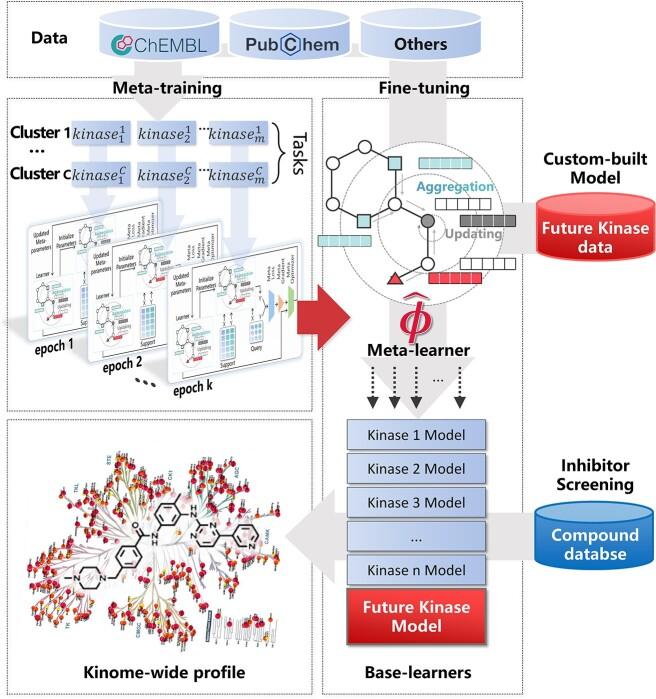
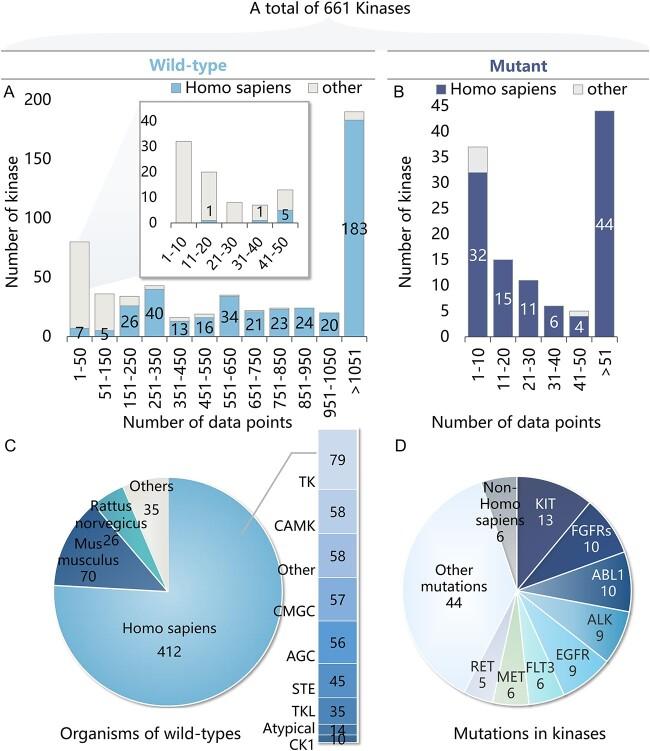
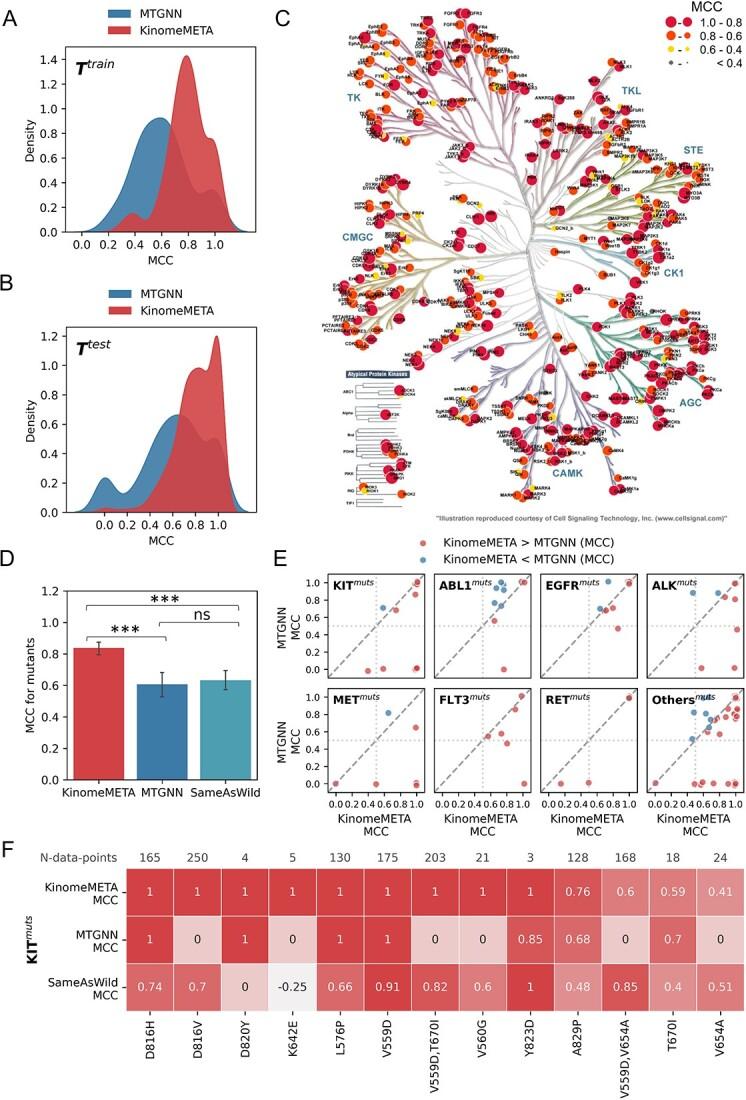
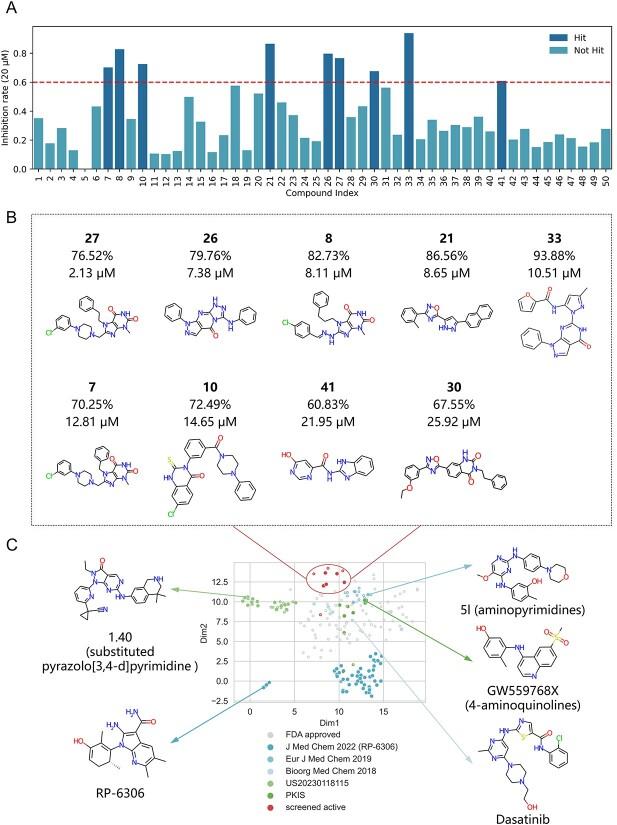
Kinase inhibitors are crucial in cancer treatment, but drug resistance and side effects hinder the development of effective drugs. To address these challenges, it is essential to analyze the polypharmacology of kinase inhibitor and identify compound with high selectivity profile. This study presents KinomeMETA, a framework for profiling the activity of small molecule kinase inhibitors across a panel of 661 kinases. By training a meta-learner based on a graph neural network and fine-tuning it to create kinase-specific learners, KinomeMETA outperforms benchmark multi-task models and other kinase profiling models. It provides higher accuracy for understudied kinases with limited known data and broader coverage of kinase types, including important mutant kinases. Case studies on the discovery of new scaffold inhibitors for membrane-associated tyrosine- and threonine-specific cdc2-inhibitory kinase and selective inhibitors for fibroblast growth factor receptors demonstrate the role of KinomeMETA in virtual screening and kinome-wide activity profiling. Overall, KinomeMETA has the potential to accelerate kinase drug discovery by more effectively exploring the kinase polypharmacology landscape.
激酶抑制剂在癌症治疗中至关重要,但药物耐药性和副作用阻碍了有效药物的开发。为了解决这些挑战,必须分析激酶抑制剂的多药理学,并确定具有高选择性特征的化合物。本研究提出了 KinomeMETA,这是一种用于在 661 种激酶的面板中对小分子激酶抑制剂的活性进行分析的框架。通过基于图神经网络训练元学习者,并对其进行微调以创建激酶特异性学习者,KinomeMETA 优于基准多任务模型和其他激酶分析模型。它为具有有限已知数据的研究较少的激酶提供了更高的准确性,并涵盖了更广泛的激酶类型,包括重要的突变激酶。对膜相关酪氨酸和苏氨酸特异性 cdc2 抑制性激酶的新型支架抑制剂和成纤维细胞生长因子受体的选择性抑制剂的发现案例研究表明,KinomeMETA 在虚拟筛选和全激酶活性分析中发挥了作用。总体而言,KinomeMETA 有可能通过更有效地探索激酶多药理学景观来加速激酶药物的发现。



 Zotero 插件