
解析根际中抑制病原体的微生物群落组装的关键因素。
Deciphering key factors in pathogen-suppressive microbiome assembly in the rhizosphere.
作者信息
Andargie Yohannes Ebabuye, Lee GyuDae, Jeong Minsoo, Tagele Setu Bazie, Shin Jae-Ho
机构信息
Department of Applied Biosciences, Kyungpook National University, Daegu, Republic of Korea.
Department of Plant Sciences, Bahir Dar University, Bahir Dar, Ethiopia.
出版信息
Front Plant Sci. 2023 Dec 5;14:1301698. doi: 10.3389/fpls.2023.1301698. eCollection 2023.
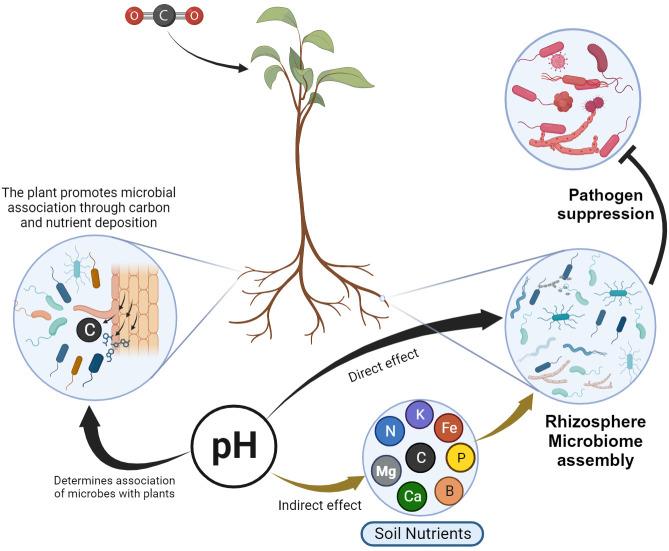
In a plant-microbe symbiosis, the host plant plays a key role in promoting the association of beneficial microbes and maintaining microbiome homeostasis through microbe-associated molecular patterns (MAMPs). The associated microbes provide an additional layer of protection for plant immunity and help in nutrient acquisition. Despite identical MAMPs in pathogens and commensals, the plant distinguishes between them and promotes the enrichment of beneficial ones while defending against the pathogens. The rhizosphere is a narrow zone of soil surrounding living plant roots. Hence, various biotic and abiotic factors are involved in shaping the rhizosphere microbiome responsible for pathogen suppression. Efforts have been devoted to modifying the composition and structure of the rhizosphere microbiome. Nevertheless, systemic manipulation of the rhizosphere microbiome has been challenging, and predicting the resultant microbiome structure after an introduced change is difficult. This is due to the involvement of various factors that determine microbiome assembly and result in an increased complexity of microbial networks. Thus, a comprehensive analysis of critical factors that influence microbiome assembly in the rhizosphere will enable scientists to design intervention techniques to reshape the rhizosphere microbiome structure and functions systematically. In this review, we give highlights on fundamental concepts in soil suppressiveness and concisely explore studies on how plants monitor microbiome assembly and homeostasis. We then emphasize key factors that govern pathogen-suppressive microbiome assembly. We discuss how pathogen infection enhances plant immunity by employing a strategy and examine how domestication wipes out defensive genes in plants experiencing Additionally, we provide insights into how nutrient availability and pH determine pathogen suppression in the rhizosphere. We finally highlight up-to-date endeavors in rhizosphere microbiome manipulation to gain valuable insights into potential strategies by which microbiome structure could be reshaped to promote pathogen-suppressive soil development.
在植物 - 微生物共生关系中,宿主植物通过微生物相关分子模式(MAMPs)在促进有益微生物的定殖以及维持微生物群落稳态方面发挥关键作用。相关微生物为植物免疫提供了额外一层保护,并有助于养分获取。尽管病原体和共生菌中存在相同的MAMPs,但植物能够区分它们,在抵御病原体的同时促进有益微生物的富集。根际是围绕活植物根系的狭窄土壤区域。因此,各种生物和非生物因素都参与塑造负责抑制病原体的根际微生物群落。人们已致力于改变根际微生物群落的组成和结构。然而,对根际微生物群落进行系统性调控一直具有挑战性,并且难以预测引入变化后产生的微生物群落结构。这是由于多种因素参与决定微生物群落的组装,导致微生物网络的复杂性增加。因此,对影响根际微生物群落组装的关键因素进行全面分析,将使科学家能够设计干预技术,以系统地重塑根际微生物群落的结构和功能。在本综述中,我们重点介绍了土壤抑制性的基本概念,并简要探讨了关于植物如何监测微生物群落组装和稳态的研究。然后,我们强调了控制抑制病原体的微生物群落组装的关键因素。我们讨论了病原体感染如何通过采用一种策略增强植物免疫力,并研究了驯化如何消除经历[此处原文似乎不完整]的植物中的防御基因。此外,我们深入探讨了养分有效性和pH如何决定根际中的病原体抑制作用。我们最后强调了根际微生物群落调控方面的最新研究成果,以期深入了解可重塑微生物群落结构以促进抑制病原体的土壤发育的潜在策略。


 Zotero 插件