
美国和加拿大边缘化人群中对新冠疫苗的犹豫态度及接种不足:一项范围综述
Covid-19 Vaccine Hesitancy and Under-Vaccination among Marginalized Populations in the United States and Canada: A Scoping Review.
作者信息
Newman Peter A, Dinh Duy A, Nyoni Thabani, Allan Kate, Fantus Sophia, Williams Charmaine C, Tepjan Suchon, Reid Luke, Guta Adrian
机构信息
Factor-Inwentash Faculty of Social Work, University of Toronto, Toronto, ON, Canada.
Faculty of Health Sciences, Queen's University, Kingston, ON, Canada.
出版信息
J Racial Ethn Health Disparities. 2025 Feb;12(1):413-434. doi: 10.1007/s40615-023-01882-1. Epub 2023 Dec 20.
BACKGROUND
Amid persistent disparities in Covid-19 vaccination and burgeoning research on vaccine hesitancy (VH), we conducted a scoping review to identify multilevel determinants of Covid-19 VH and under-vaccination among marginalized populations in the U.S. and Canada.
METHODS
Using the scoping review methodology developed by the Joanna Briggs Institute, we designed a search string and explored 7 databases to identify peer-reviewed articles published from January 1, 2020-October 25, 2022. We combine frequency analysis and narrative synthesis to describe factors influencing Covid-19 VH and under-vaccination among marginalized populations.
RESULTS
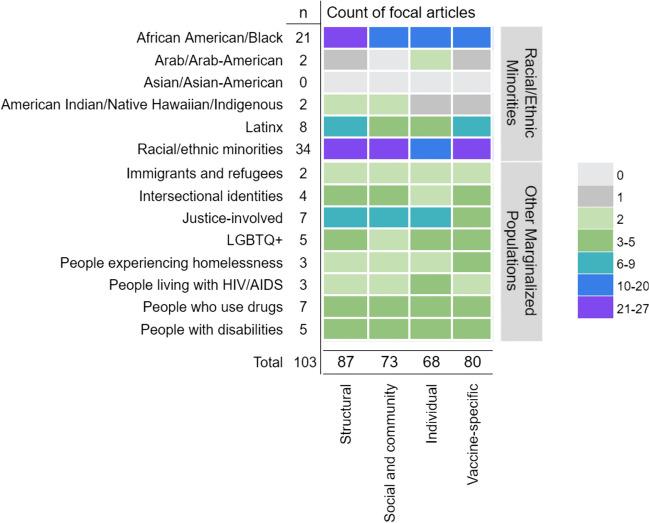
The search captured 11,374 non-duplicated records, scoped to 103 peer-reviewed articles. Among 14 marginalized populations identified, African American/Black, Latinx, LGBTQ+, American Indian/Indigenous, people with disabilities, and justice-involved people were the predominant focus. Thirty-two factors emerged as influencing Covid-19 VH, with structural racism/stigma and institutional mistrust (structural)(n = 71) most prevalent, followed by vaccine safety (vaccine-specific)(n = 62), side effects (vaccine-specific)(n = 50), trust in individual healthcare provider (social/community)(n = 38), and perceived risk of infection (individual)(n = 33). Structural factors predominated across populations, including structural racism/stigma and institutional mistrust, barriers to Covid-19 vaccine access due to limited supply/availability, distance/lack of transportation, no/low paid sick days, low internet/digital technology access, and lack of culturally- and linguistically-appropriate information.
DISCUSSION
We identified multilevel and complex drivers of Covid-19 under-vaccination among marginalized populations. Distinguishing vaccine-specific, individual, and social/community factors that may fuel decisional ambivalence, more appropriately defined as VH, from structural racism/structural stigma and systemic/institutional barriers to vaccination access may better support evidence-informed interventions to promote equity in access to vaccines and informed decision-making among marginalized populations.
背景
在新冠病毒疫苗接种方面持续存在差异以及疫苗犹豫(VH)研究不断涌现的背景下,我们开展了一项范围综述,以确定美国和加拿大边缘化人群中新冠病毒疫苗犹豫和接种不足的多层次决定因素。
方法
我们采用乔安娜·布里格斯研究所开发的范围综述方法,设计了一个检索式,并检索了7个数据库,以识别2020年1月1日至2022年10月25日发表的同行评议文章。我们结合频率分析和叙述性综合分析来描述影响边缘化人群中新冠病毒疫苗犹豫和接种不足的因素。
结果
检索共获取11374条非重复记录,筛选出103篇同行评议文章。在确定的14个边缘化人群中,非裔美国人/黑人、拉丁裔、 LGBTQ+群体、美国印第安人/原住民、残疾人以及受司法影响的人群是主要关注对象。共有32个因素被确定为影响新冠病毒疫苗犹豫,其中结构性种族主义/污名化和对机构的不信任(结构性因素)(n = 71)最为普遍,其次是疫苗安全性(疫苗特异性因素)(n = 62)、副作用(疫苗特异性因素)(n = 50)、对个体医疗服务提供者的信任(社会/社区因素)(n = 38)以及感知感染风险(个体因素)(n = 33)。结构性因素在各人群中占主导地位,包括结构性种族主义/污名化和对机构的不信任、由于供应/可及性有限导致的新冠病毒疫苗接种障碍、距离/缺乏交通、无薪/低薪病假、互联网/数字技术接入率低以及缺乏文化和语言适宜的信息。
讨论
我们确定了边缘化人群中新冠病毒接种不足的多层次和复杂驱动因素。区分可能加剧决策矛盾心理(更恰当地定义为疫苗犹豫)的疫苗特异性、个体和社会/社区因素,与结构性种族主义/结构性污名化以及疫苗接种获取方面的系统性/机构性障碍,可能会更好地支持基于证据的干预措施,以促进疫苗获取的公平性,并推动边缘化人群做出明智的决策。


 Zotero 插件