
钠-葡萄糖协同转运蛋白2抑制剂治疗对心脏能量代谢的影响
The changes of cardiac energy metabolism with sodium-glucose transporter 2 inhibitor therapy.
作者信息
Su Sha, Ji Xiang, Li Tong, Teng Yu, Wang Baofu, Han Xiaowan, Zhao Mingjing
机构信息
Key Laboratory of Chinese Internal Medicine of Ministry of Education and Beijing, Dongzhimen Hospital Affiliated to Beijing University of Chinese Medicine, Beijing, China.
Department of Cardiology, Dongzhimen Hospital Affiliated to Beijing University of Chinese Medicine, Beijing, China.
出版信息
Front Cardiovasc Med. 2023 Dec 6;10:1291450. doi: 10.3389/fcvm.2023.1291450. eCollection 2023.
BACKGROUND/AIMS: To investigate the specific effects of s odium-glucose transporter 2 inhibitor (SGLT2i) on cardiac energy metabolism.
METHODS
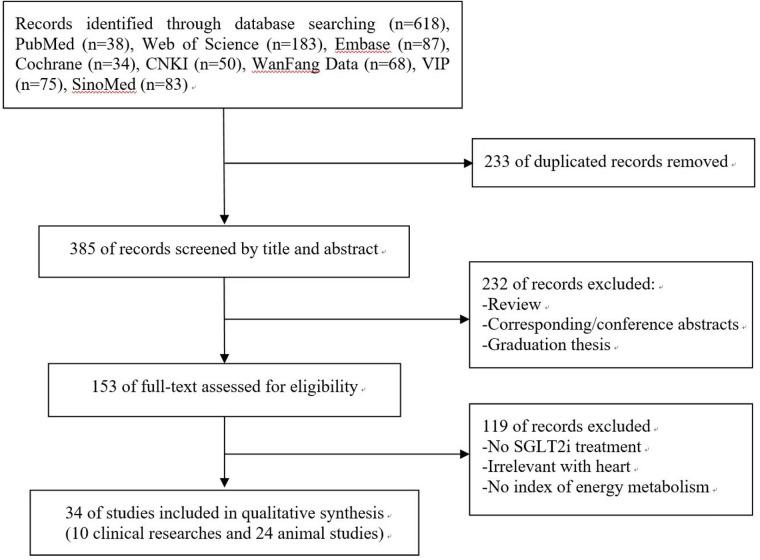
A systematic literature search was conducted in eight databases. The retrieved studies were screened according to the inclusion and exclusion criteria, and relevant information was extracted according to the purpose of the study. Two researchers independently screened the studies, extracted information, and assessed article quality.
RESULTS
The results of the 34 included studies (including 10 clinical and 24 animal studies) showed that SGLT2i inhibited cardiac glucose uptake and glycolysis, but promoted fatty acid (FA) metabolism in most disease states. SGLT2i upregulated ketone metabolism, improved the structure and functions of myocardial mitochondria, alleviated oxidative stress of cardiomyocytes in all literatures. SGLT2i increased cardiac glucose oxidation in diabetes mellitus (DM) and cardiac FA metabolism in heart failure (HF). However, the regulatory effects of SGLT2i on cardiac FA metabolism in DM and cardiac glucose oxidation in HF varied with disease types, stages, and intervention duration of SGLT2i.
CONCLUSION
SGLT2i improved the efficiency of cardiac energy production by regulating FA, glucose and ketone metabolism, improving mitochondria structure and functions, and decreasing oxidative stress of cardiomyocytes under pathological conditions. Thus, SGLT2i is deemed to exert a benign regulatory effect on cardiac metabolic disorders in various diseases.
SYSTEMATIC REVIEW REGISTRATION
https://www.crd.york.ac.uk/, PROSPERO (CRD42023484295).
背景/目的:研究钠-葡萄糖协同转运蛋白2抑制剂(SGLT2i)对心脏能量代谢的具体影响。
方法
在八个数据库中进行系统的文献检索。根据纳入和排除标准对检索到的研究进行筛选,并根据研究目的提取相关信息。两名研究人员独立筛选研究、提取信息并评估文章质量。
结果
34项纳入研究(包括10项临床研究和24项动物研究)的结果表明,在大多数疾病状态下,SGLT2i抑制心脏葡萄糖摄取和糖酵解,但促进脂肪酸(FA)代谢。SGLT2i上调酮体代谢,改善心肌线粒体的结构和功能,在所有文献中均减轻心肌细胞的氧化应激。SGLT2i增加糖尿病(DM)时的心脏葡萄糖氧化以及心力衰竭(HF)时的心脏FA代谢。然而,SGLT2i对DM时心脏FA代谢和HF时心脏葡萄糖氧化的调节作用因疾病类型、阶段以及SGLT2i的干预持续时间而异。
结论
SGLT2i通过调节FA、葡萄糖和酮体代谢,改善线粒体结构和功能,并减轻病理条件下心肌细胞的氧化应激,从而提高心脏能量产生的效率。因此,SGLT2i被认为对各种疾病中的心脏代谢紊乱发挥良性调节作用。
系统评价注册
 Zotero 插件