
南海深水沉积颗粒中的持久性卤代有机污染物
Persistent Halogenated Organic Pollutants in Deep-Water-Deposited Particulates from South China Sea.
作者信息
Lee Jia-De, Chiou Tsyr-Huei, Zhang Hong-Jie, Chao How-Ran, Chen Kuang-Yu, Gou Yan-You, Huang Chien-Er, Lin Sheng-Lun, Wang Lin-Chi
机构信息
Department of Environmental Science and Engineering, National Pingtung University of Science and Technology, Neipu, Pingtung 91201, Taiwan.
Department of Life Sciences, National Cheng Kung University, Tainan 701, Taiwan.
出版信息
Toxics. 2023 Nov 29;11(12):968. doi: 10.3390/toxics11120968.
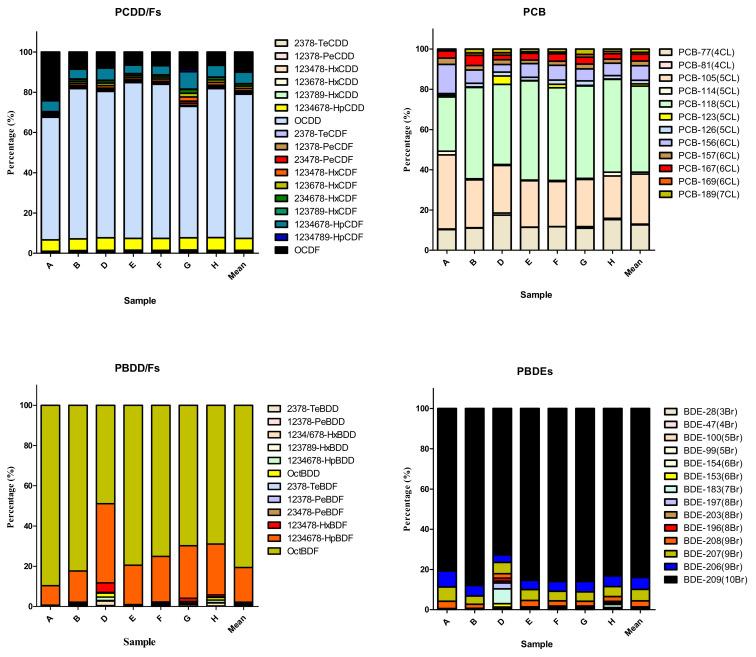
POP data are limited in the marine environment; thus, this study aimed to investigate background persistent organic pollutant (POP) levels in oceanic deep-water-deposited particulates in the South China Sea (SCS). Six POPs, including polychlorinated dibenzo--dioxins/dibenzofurans (PCDD/Fs), dioxin-like polychlorinated biphenyls (DL-PCBs), polybrominated diphenyl ethers (PBDEs), polybrominated dibenzo--dioxins/dibenzofurans (PBDD/Fs), polychlorinated diphenyl ethers (PCDEs), and polybrominated biphenyls (PBBs), were investigated in eight pooled samples from the SCS from 20 September 2013 to 23 March 2014 and 15 April 2014 to 24 October 2014 at depths of 2000 m and 3500 m. PBDEs were the most predominant compounds, with the highest mean ΣPBDE of 125 ± 114 ng/g dry weight (d.w.), followed by ΣPCDD/F, ΣPBDD/F, and ΣDL-PCB (275 ± 1930, 253 ± 216, and 116 ± 166 pg/g d.w., respectively). Most PBDD/F, PBB, and PCDE congeners were below the detection limits. PCDDs had the highest toxic equivalency (TEQ), followed by PBDDs and DL-PCBs. Among the six POPs, PBDEs were the major components of the marine-deposited particles, regarding both concentrations and mass fluxes. Compared to 3500 m, PBDE levels were higher at a depth of 2000 m. PBDE mass fluxes were 20.9 and 14.2 ng/m/day or 68.2 and 75.9 ng/m/year at deep-water 2000 and 3500 m, respectively. This study first investigated POP levels in oceanic deep-water-deposited particles from existing global data.
持久性有机污染物(POP)在海洋环境中的数据有限;因此,本研究旨在调查南海(SCS)海洋深水沉积颗粒物中持久性有机污染物(POP)的背景水平。对2013年9月20日至2014年3月23日以及2014年4月15日至2014年10月24日期间从南海采集的8个混合样本进行了研究,这些样本采集于2000米和3500米深度,调查的六种持久性有机污染物包括多氯二苯并 - 对二恶英/二苯并呋喃(PCDD/Fs)、类二恶英多氯联苯(DL - PCBs)、多溴二苯醚(PBDEs)、多溴二苯并 - 对二恶英/二苯并呋喃(PBDD/Fs)、多氯二苯醚(PCDEs)和多溴联苯(PBBs)。多溴二苯醚是最主要的化合物,平均总多溴二苯醚含量最高,为125±114纳克/克干重(d.w.),其次是总PCDD/F、总PBDD/F和总DL - PCB(分别为275±1930、253±216和116±166皮克/克干重)。大多数PBDD/F、PBB和PCDE同系物低于检测限。PCDDs的毒性当量(TEQ)最高,其次是PBDDs和DL - PCBs。在这六种持久性有机污染物中,就浓度和质量通量而言,多溴二苯醚是海洋沉积颗粒的主要成分。与3500米深度相比,2000米深度处的多溴二苯醚水平更高。在2000米和3500米深水区,多溴二苯醚的质量通量分别为20.9和14.2纳克/平方米/天或68.2和75.9纳克/平方米/年。本研究首次根据现有全球数据调查了海洋深水沉积颗粒中的持久性有机污染物水平。


 Zotero 插件