
基于家庭的远程康复与基于医院的门诊康复在初次全膝关节置换术后疼痛和功能恢复方面的比较:系统评价和荟萃分析。
Home-based tele-rehabilitation versus hospital-based outpatient rehabilitation for pain and function after initial total knee arthroplasty: A systematic review and meta-analysis.
机构信息
Department of Orthopedics, Orthopedic Research Institute and National Clinical Research Center for Geriatrics, West China Hospital, West China Medical School, Sichuan University, Chengdu, Sichuan Province, China.
West China Biomedical Big Data Center, Sichuan University West China Hospital, Chengdu, Sichuan Province, China.
出版信息
Medicine (Baltimore). 2023 Dec 22;102(51):e36764. doi: 10.1097/MD.0000000000036764.
BACKGROUND
This systematic review and meta-analysis aims to compare the effectiveness of home-based tele-rehabilitation programs with hospital-based rehabilitation programs in improving pain and function at various time points (≤6 weeks, ≤14 weeks, and ≤ 52 weeks) following the initial total knee arthroplasty.
METHODS
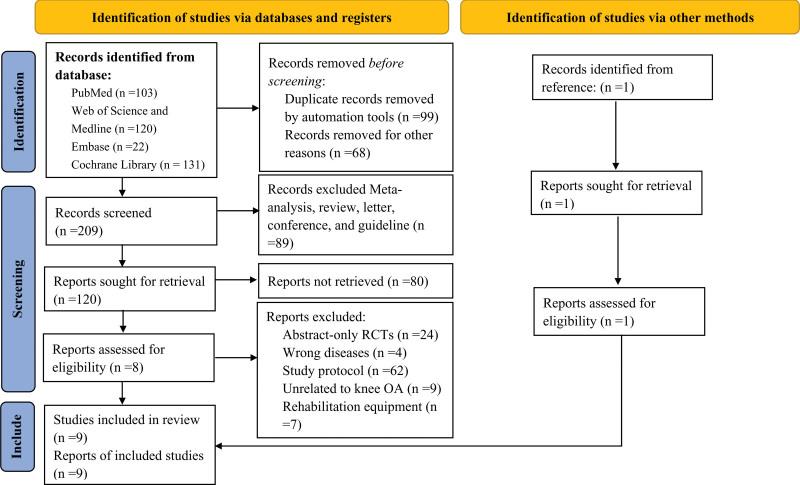
This study used PRISMA and AMSTAR reporting guidelines. We systematically searched 5 databases (PubMed, Embase, Web of Science, Cochrane Library, and Medline) to identify randomized controlled trials published from January 1, 2019, to January 1, 2023. The primary outcomes were pain, knee injury and osteoarthritis outcome score, and mobility (knee range of motion).
RESULTS
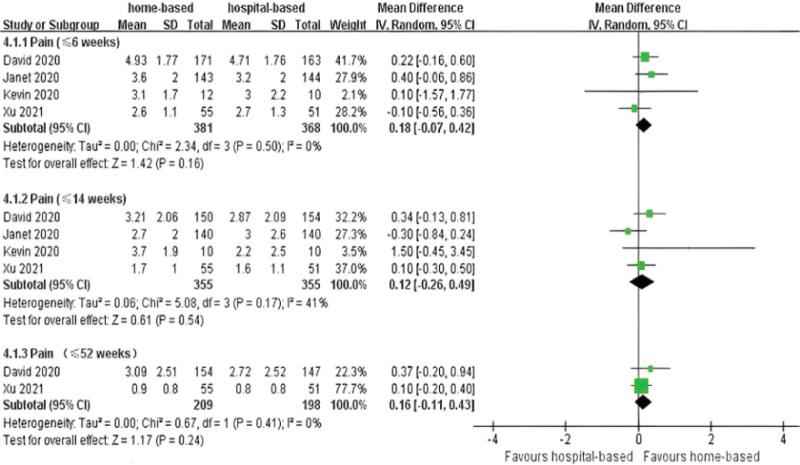
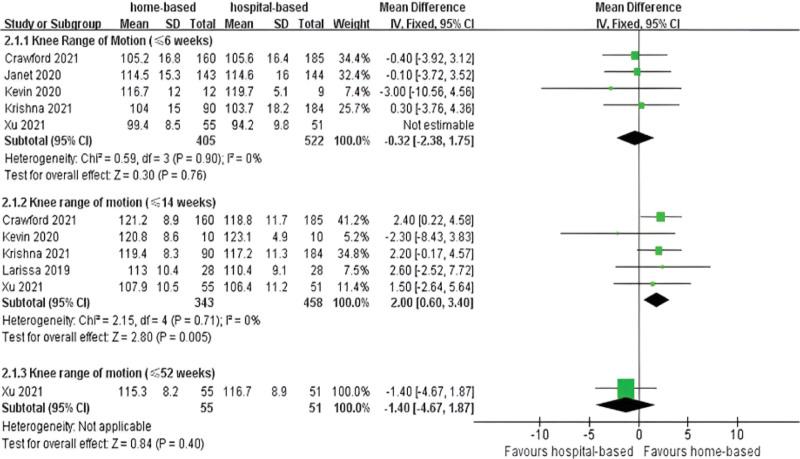
We included 9 studies involving 1944 patients. Low-quality evidence showed hospital-based rehabilitation was better than home-based tele-rehabilitation in knee injury and osteoarthritis outcome score (mean difference [MD], -2.62; 95% confidence interval [CI], -4.65 to -0.58; P = .01) at ≤ 14 weeks after total knee arthroplasty. Based on low-quality evidence, home-based tele-rehabilitation was better than hospital-based rehabilitation in knee range of motion (MD, 2.00; 95% CI, 0.60 to 3.40; P = .005). There was no significant difference between hospital-based rehabilitation and home-based tele-rehabilitation in knee pain at ≤ 6 weeks (MD, 0.18; 95% CI, -0.07 to 0.42; P = .16), 14 weeks (MD, 0.12; 95% CI, -0.26 to 0.49; P = .54), and ≤ 52 weeks (MD, 0.16; 95% CI, -0.11 to 0.43; P = .24).
CONCLUSION
Home-based tele-rehabilitation and hospital-based rehabilitation programs showed comparable long-term outcomes in pain, mobility, physical function, and patient-reported health status after primary total knee arthroplasty. Considering the economic costs, home-based tele-rehabilitation programs are recommended as a viable alternative to hospital-based rehabilitation programs.
背景
本系统评价和荟萃分析旨在比较家庭远程康复计划与医院康复计划在初次全膝关节置换后不同时间点(≤6 周、≤14 周和≤52 周)对疼痛和功能的改善效果。
方法
本研究使用 PRISMA 和 AMSTAR 报告指南。我们系统地检索了 5 个数据库(PubMed、Embase、Web of Science、Cochrane Library 和 Medline),以确定 2019 年 1 月 1 日至 2023 年 1 月 1 日期间发表的随机对照试验。主要结局指标为疼痛、膝关节损伤和骨关节炎结局评分以及活动度(膝关节活动范围)。
结果
我们纳入了 9 项研究,共涉及 1944 名患者。低质量证据表明,在初次全膝关节置换后≤14 周时,医院康复优于家庭远程康复,在膝关节损伤和骨关节炎结局评分方面(平均差值[MD],-2.62;95%置信区间[CI],-4.65 至-0.58;P=0.01)。基于低质量证据,在膝关节活动范围方面,家庭远程康复优于医院康复(MD,2.00;95%CI,0.60 至 3.40;P=0.005)。在初次全膝关节置换后≤6 周(MD,0.18;95%CI,-0.07 至 0.42;P=0.16)、14 周(MD,0.12;95%CI,-0.26 至 0.49;P=0.54)和≤52 周(MD,0.16;95%CI,-0.11 至 0.43;P=0.24)时,医院康复与家庭远程康复在膝关节疼痛方面无显著差异。
结论
在初次全膝关节置换后,家庭远程康复和医院康复计划在疼痛、活动度、身体功能和患者报告的健康状况方面显示出相似的长期结果。考虑到经济成本,家庭远程康复计划被推荐作为医院康复计划的可行替代方案。

 Zotero 插件