
阻生下颌第三磨牙拔除后下颌神经的神经感觉缺损——一项回顾性研究
Neurosensory Deficits of the Mandibular Nerve Following Extraction of Impacted Lower Third Molars-A Retrospective Study.
作者信息
Rieder Marcus, Remschmidt Bernhard, Schrempf Vera, Schwaiger Matthäus, Jakse Norbert, Kirnbauer Barbara
机构信息
Division of Oral and Maxillofacial Surgery, Department of Dental Medicine and Oral Health, Medical University of Graz, 8036 Graz, Austria.
Division of Oral Surgery and Orthodontics, Department of Dental Medicine and Oral Health, Medical University of Graz, 8010 Graz, Austria.
出版信息
J Clin Med. 2023 Dec 13;12(24):7661. doi: 10.3390/jcm12247661.
BACKGROUND
Neurosensory deficits are one of the major complications after impacted lower third molar extraction leading to an impaired patient's quality of life. This study aimed to evaluate the incidence of neurosensory deficits after lower third molar extraction and compare it radiologically to the corresponding position of the inferior alveolar nerve.
METHODS
In a retrospective study, all patients who underwent impacted lower third molar extraction between January and December 2019 were compiled. Therefore, clinical data as well as preoperative radiological imaging were assessed.
RESULTS
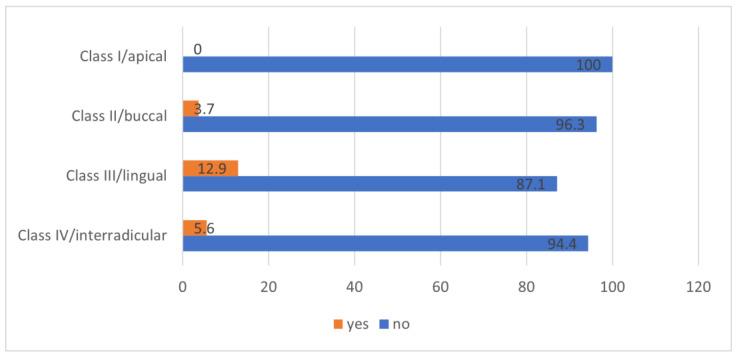
In total, 418 patients who underwent lower third molar extractions ( = 555) were included in this study. Of these, 33 (5.9%) had short-term (i.e., within the initial 7 postoperative days) and 12 (1.3%) long-term (i.e., persisting after 12 months) neurosensory deficits documented. The inferior alveolar nerve position in relation to the tooth roots showed apical position in 27%, buccal position in 30.8%, lingual position in 35.4%, and interradicular position in 6.9%.
CONCLUSIONS
A statistically significant increased incidence of neurosensory deficits occurs when the inferior alveolar nerve is directly positioned lingually to the tooth roots ( = 0.01).
背景
神经感觉功能缺损是下颌阻生第三磨牙拔除术后的主要并发症之一,会导致患者生活质量受损。本研究旨在评估下颌第三磨牙拔除术后神经感觉功能缺损的发生率,并通过影像学检查将其与下牙槽神经的相应位置进行比较。
方法
在一项回顾性研究中,收集了2019年1月至12月期间所有接受下颌阻生第三磨牙拔除术的患者资料。因此,对临床数据以及术前影像学检查结果进行了评估。
结果
本研究共纳入418例接受下颌第三磨牙拔除术的患者(n = 555)。其中,有33例(5.9%)出现短期(即术后最初7天内)神经感觉功能缺损,12例(1.3%)出现长期(即术后12个月后仍持续存在)神经感觉功能缺损。下牙槽神经相对于牙根的位置显示,根尖位置占27%,颊侧位置占30.8%,舌侧位置占35.4%,根间位置占6.9%。
结论
当下牙槽神经直接位于牙根舌侧时,神经感觉功能缺损的发生率在统计学上显著增加(P = 0.01)。


 Zotero 插件