
日本自身免疫性脱髓鞘疾病患者中的 Epstein-Barr 病毒和人类内源性逆转录病毒。
Epstein-Barr Virus and Human Endogenous Retrovirus in Japanese Patients with Autoimmune Demyelinating Disorders.
机构信息
Department of Neurology, Juntendo University, Tokyo 1138431, Japan.
Biomedical Research Core Facilities, Juntendo University, Tokyo 1138431, Japan.
出版信息
Int J Mol Sci. 2023 Dec 5;24(24):17151. doi: 10.3390/ijms242417151.
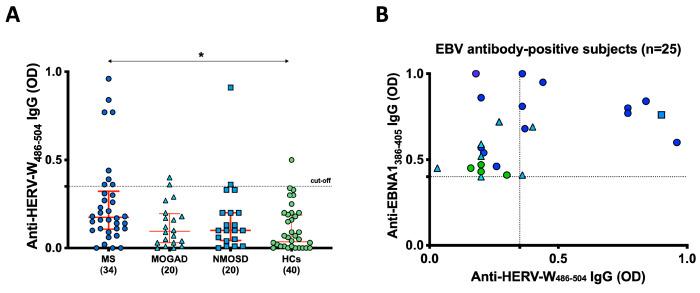
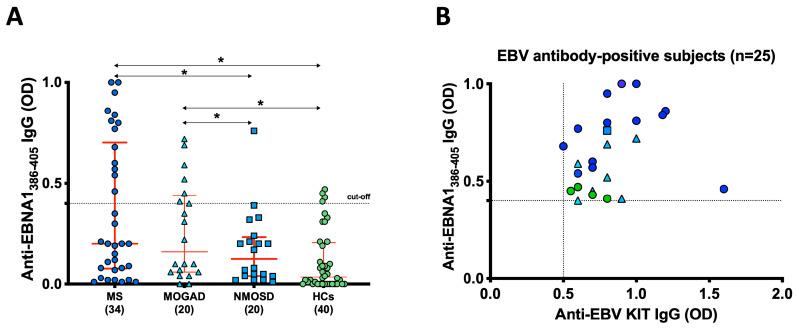
Multiple sclerosis (MS), neuromyelitis optica spectrum disorder (NMOSD), and myelin oligodendrocytes glycoprotein-antibody disease (MOGAD) are distinct autoimmune demyelinating disorders characterized by varying clinical and pathological characteristics. While the precise origins of these diseases remain elusive, a combination of genetic and environmental factors, including viral elements, have been suggested as potential contributors to their development. Our goal was to assess the occurrence of antibodies against pathogenic peptides associated with virus (EBV) and the human endogenous retrovirus-W (HERV-W) in serum samples obtained from Japanese individuals diagnosed with MS, NMOSD, and MOGAD and to make comparisons with a group of healthy controls (HCs). We conducted a retrospective analysis involving 114 Japanese participants, comprising individuals with MS (34), NMOSD (20), MOGAD (20), and HCs (40). These individuals were tested using a peptide-based enzyme-linked immunosorbent assay. A marked increase in antibody response against EBV nuclear antigen 1 (EBNA1) was observed in the serum of MS and MOGAD patients, as compared to HCs. Notably, we observed a correlation between antibodies against EBNA1 and HERV-W peptides in a subset of the antibody-positive MS patients. These findings emphasize the involvement of EBV in the pathogenesis of MS and potentially MOGAD, suggesting its role in the reactivation of HERV-W.
多发性硬化症 (MS)、视神经脊髓炎谱系障碍 (NMOSD) 和髓鞘少突胶质细胞糖蛋白抗体病 (MOGAD) 是三种不同的自身免疫性脱髓鞘疾病,具有不同的临床和病理特征。尽管这些疾病的确切起源仍不清楚,但遗传和环境因素(包括病毒因素)的组合被认为是其发展的潜在因素。我们的目标是评估与病毒(EBV)和人类内源性逆转录病毒-W(HERV-W)相关的致病性肽的抗体在日本 MS、NMOSD 和 MOGAD 患者的血清样本中的出现情况,并与一组健康对照组 (HCs) 进行比较。我们进行了一项回顾性分析,涉及 114 名日本参与者,包括 MS(34 名)、NMOSD(20 名)、MOGAD(20 名)和 HCs(40 名)。这些个体使用基于肽的酶联免疫吸附测定法进行了测试。与 HCs 相比,MS 和 MOGAD 患者的血清中针对 EBV 核抗原 1 (EBNA1) 的抗体反应明显增加。值得注意的是,我们在一组抗体阳性的 MS 患者中观察到针对 EBNA1 和 HERV-W 肽的抗体之间存在相关性。这些发现强调了 EBV 在 MS 和潜在的 MOGAD 发病机制中的作用,表明其在 HERV-W 再激活中的作用。
 Zotero 插件