
提取物可减轻卵清蛋白诱导的大鼠哮喘中炎症介质的产生。
extract attenuates production of inflammatory mediators in ovalbumin-induced asthma in rats.
作者信息
Arora Poonam, Ansari Shahid Husain, Nainwal Lalit Mohan
机构信息
Department of Pharmacognosy and Phytochemistry, School of Pharmaceutical Education and Research, Jamia Hamdard, New Delhi, India.
Department of Pharmacognosy and Phytochemistry, SGT College of Pharmacy, SGT University, Gurugram, Haryana, India.
出版信息
Turk J Chem. 2021 Nov 4;46(2):330-341. doi: 10.3906/kim-2107-22. eCollection 2022.
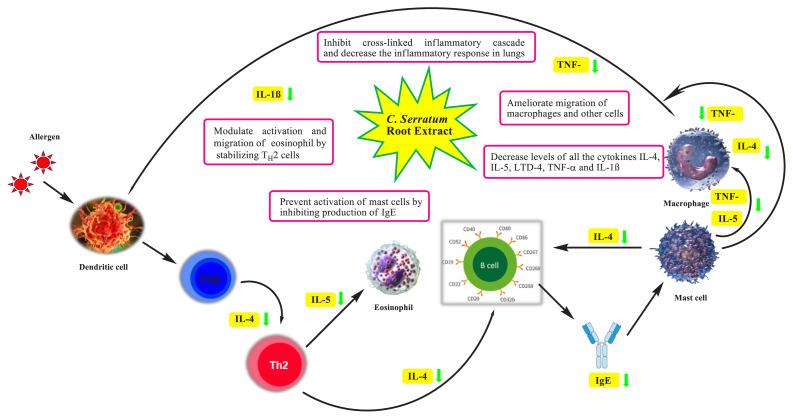
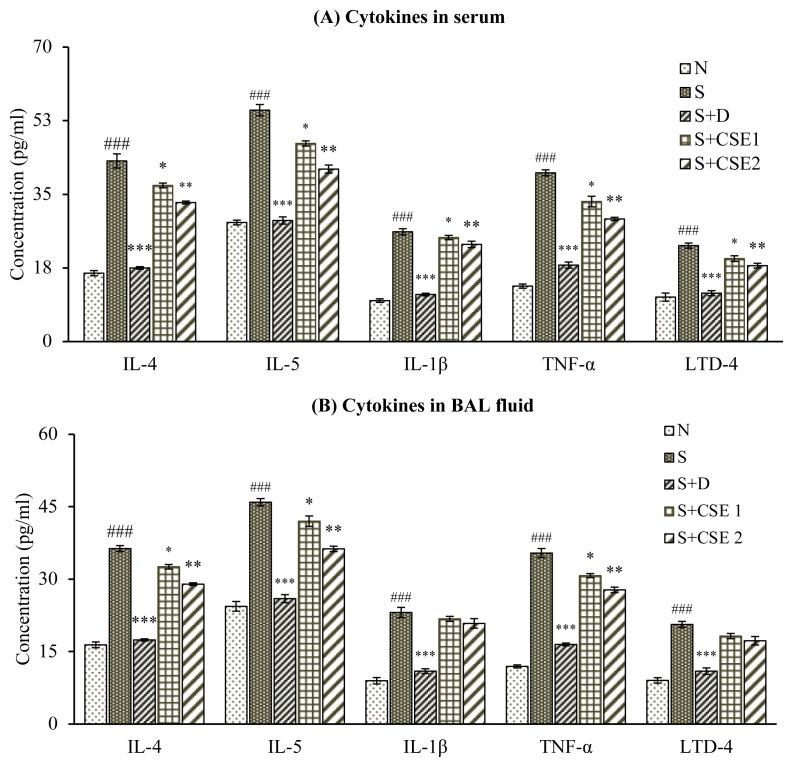
In the present study, ethanolic extract of roots was investigated for its potential to reverse some features of bronchial asthma in ovalbumin-induced murine model of asthma. commonly called bharangi, (family Solanaceae) is a well-known anti-allergic drug in Asian folk system of medicines. In the present work, pharmacological studies are done to provide scientific evidence for therapeutic potential of plant in allergic asthma. Asthma was induced in experimental rats with allergen suspension of ovalbumin and aluminum hydroxide followed by treatment with dexamethasone (2.5 mg/kg, po) or root extract (0.53 and 5.3 mg/kg, b. w., po). Biomarkers of inflammatory response including cell counts, immunoglobulin E, cytokines such as interleukin (IL) -4, -5, -1β, tumor necrosis factor-α (TNF-α), leukotriene (LTD-4), and nitrite concentration in blood as well as bronchial (BAL) fluid were tested. Lung functions in asthmatic and treated animals were evaluated as breathing rate and tidal volume. Treatment with extract markedly (p < 0.001, p < 0.01, and p < 0.05) diminished infiltration of inflammatory cells, IgE, cytokines, and nitrites in blood serum and bronchial fluid. Improvement in lung functions (p < 0.05) of asthmatic animals after CSE treatment also supports our findings. Results of the study suggest therapeutic potential of in allergic asthma that can be related to ability of plant to attenuate response of inflammatory cells and thereby, production of inflammatory and proinflammatory cytokines in airways.
在本研究中,对某植物根的乙醇提取物进行了研究,以探讨其在卵清蛋白诱导的小鼠哮喘模型中逆转支气管哮喘某些特征的潜力。该植物俗称巴拉吉(茄科),是亚洲民间医学中一种著名的抗过敏药物。在本研究中,开展了药理学研究,以提供该植物在过敏性哮喘治疗潜力方面的科学证据。用卵清蛋白和氢氧化铝的过敏原悬液诱导实验大鼠患哮喘,随后用 dexamethasone(2.5 mg/kg,口服)或该植物根提取物(0.53 和 5.3 mg/kg,体重,口服)进行治疗。检测了炎症反应的生物标志物,包括细胞计数、免疫球蛋白 E、细胞因子如白细胞介素(IL)-4、-5、-1β、肿瘤坏死因子-α(TNF-α)、白三烯(LTD-4)以及血液和支气管(BAL)液中的亚硝酸盐浓度。评估了哮喘动物和接受治疗动物的肺功能,指标为呼吸频率和潮气量。用该植物提取物治疗后,血清和支气管液中炎症细胞、IgE、细胞因子和亚硝酸盐的浸润明显减少(p < 0.001、p < 0.01 和 p < 0.05)。CSE 治疗后哮喘动物肺功能的改善(p < 0.05)也支持了我们的研究结果。该研究结果表明该植物在过敏性哮喘方面具有治疗潜力,这可能与其减弱炎症细胞反应的能力有关,从而减少气道中炎症和促炎细胞因子的产生。



 Zotero 插件