
银屑病合并动脉粥样硬化在脂质代谢方面存在交集。
Psoriasis comorbid with atherosclerosis meets in lipid metabolism.
作者信息
Chen Liuping, Chen Huiqi, Guo Sien, Chen Zhijun, Yang Haifeng, Liu Yanjiao, Chen Xiaoling, Chen Xinming, Du Tingting, Long Xinyao, Zhao Jiaxiong, Guo Mingli, Lao Tianfeng, Huang DongHui, Wang Lei, Chen Jing, Liu Chunping
机构信息
Department of Critical Care Medicine, The Dongguan Hospital of Guangzhou University of Chinese Medicine, Dongguan, China.
State Key Laboratory of Dampness Syndrome of Chinese Medicine, The Second Affiliated Hospital of Guangzhou University of Chinese Medicine, Guangzhou, China.
出版信息
Front Pharmacol. 2023 Dec 11;14:1308965. doi: 10.3389/fphar.2023.1308965. eCollection 2023.
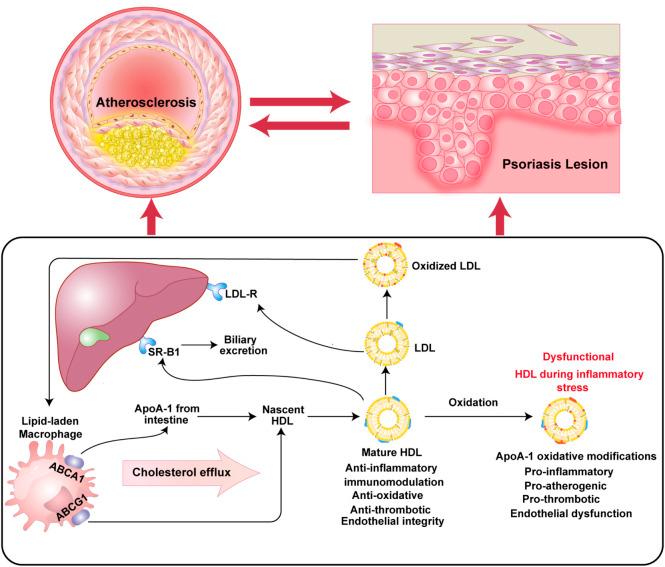
Psoriasis (PSO) is a common skin disease affecting approximately 1%-3% of the population, and the incidence rate is increasing yearly. PSO is associated with a dramatically increased risk of cardiovascular disease, the most common of which is atherosclerosis (AS). In the past, inflammation was considered to be the triggering factor of the two comorbidities, but in recent years, studies have found that lipid metabolism disorders increase the probability of atherosclerosis in patients with psoriasis. In this review, we discuss epidemiological studies, clinical treatment methods, risk factors, and lipid metabolism of psoriasis and atherosclerosis comorbidities.
银屑病(PSO)是一种常见的皮肤病,影响着约1%-3%的人口,且发病率逐年上升。PSO与心血管疾病风险的显著增加相关,其中最常见的是动脉粥样硬化(AS)。过去,炎症被认为是这两种合并症的触发因素,但近年来,研究发现脂质代谢紊乱会增加银屑病患者患动脉粥样硬化的概率。在本综述中,我们讨论了银屑病和动脉粥样硬化合并症的流行病学研究、临床治疗方法、风险因素和脂质代谢。
 Zotero 插件