
转录因子 FOXD2 功能障碍在综合征型先天性肾和泌尿道异常(CAKUT)中的意义。
Implication of transcription factor FOXD2 dysfunction in syndromic congenital anomalies of the kidney and urinary tract (CAKUT).
机构信息
Institute of Human Genetics, Klinikum rechts der Isar, Technical University of Munich, TUM School of Medicine and Health, Munich, Germany; Department of Nephrology, Klinikum rechts der Isar, Technical University of Munich, TUM School of Medicine and Health, Munich, Germany.
Department of Human Genetics, Radboud Institute for Molecular Life Sciences, Radboud University Medical Center, Nijmegen, The Netherlands.
出版信息
Kidney Int. 2024 Apr;105(4):844-864. doi: 10.1016/j.kint.2023.11.032. Epub 2023 Dec 26.
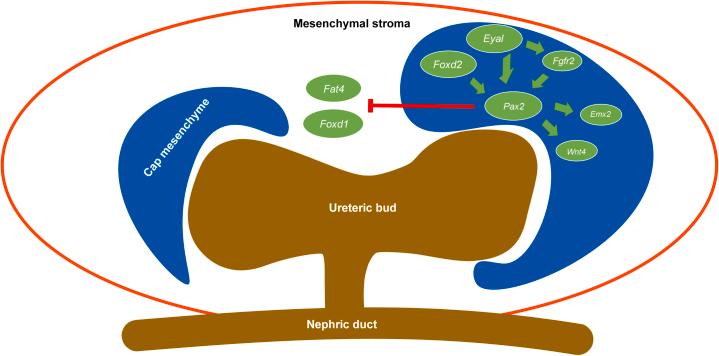
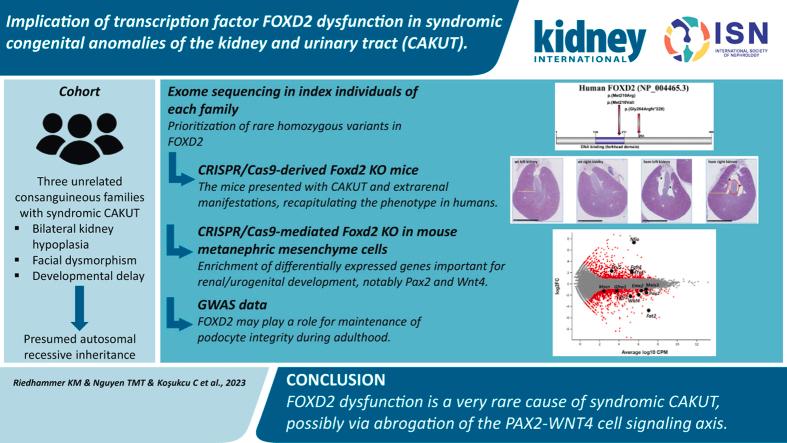
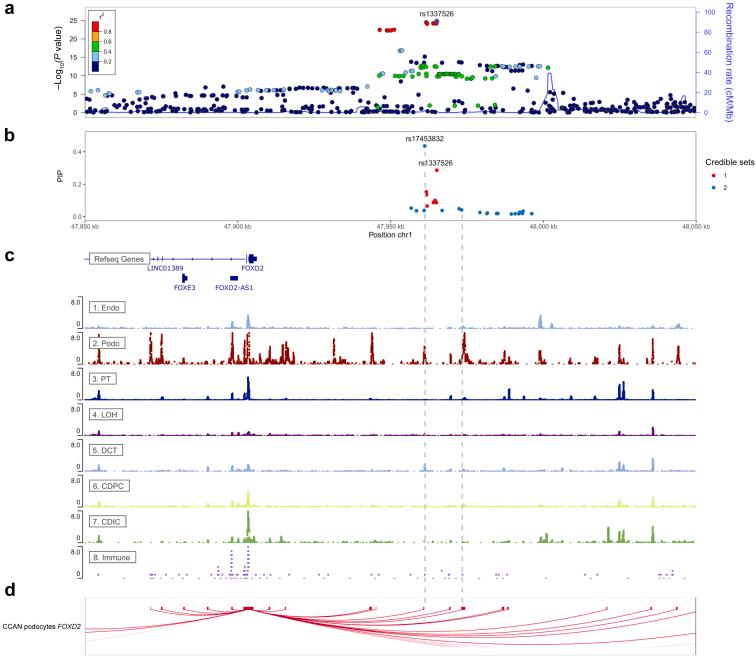
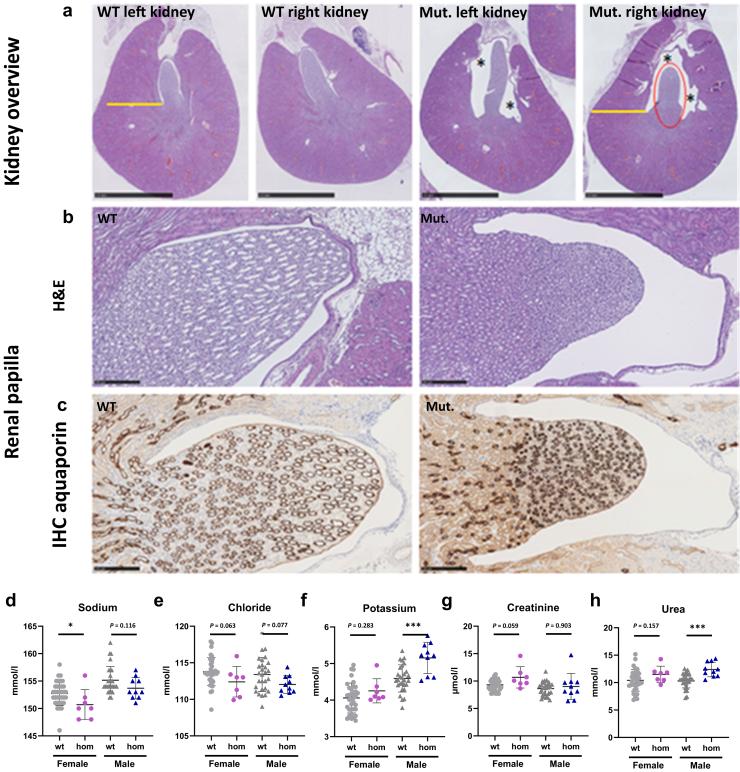
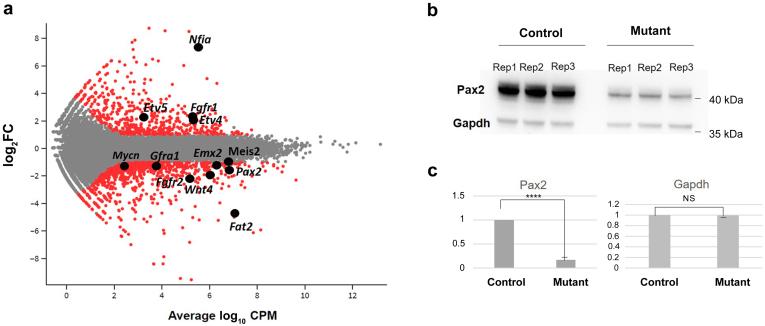
Congenital anomalies of the kidney and urinary tract (CAKUT) are the predominant cause for chronic kidney disease below age 30 years. Many monogenic forms have been discovered due to comprehensive genetic testing like exome sequencing. However, disease-causing variants in known disease-associated genes only explain a proportion of cases. Here, we aim to unravel underlying molecular mechanisms of syndromic CAKUT in three unrelated multiplex families with presumed autosomal recessive inheritance. Exome sequencing in the index individuals revealed three different rare homozygous variants in FOXD2, encoding a transcription factor not previously implicated in CAKUT in humans: a frameshift in the Arabic and a missense variant each in the Turkish and the Israeli family with segregation patterns consistent with autosomal recessive inheritance. CRISPR/Cas9-derived Foxd2 knockout mice presented with a bilateral dilated kidney pelvis accompanied by atrophy of the kidney papilla and mandibular, ophthalmologic, and behavioral anomalies, recapitulating the human phenotype. In a complementary approach to study pathomechanisms of FOXD2-dysfunction-mediated developmental kidney defects, we generated CRISPR/Cas9-mediated knockout of Foxd2 in ureteric bud-induced mouse metanephric mesenchyme cells. Transcriptomic analyses revealed enrichment of numerous differentially expressed genes important for kidney/urogenital development, including Pax2 and Wnt4 as well as gene expression changes indicating a shift toward a stromal cell identity. Histology of Foxd2 knockout mouse kidneys confirmed increased fibrosis. Further, genome-wide association studies suggest that FOXD2 could play a role for maintenance of podocyte integrity during adulthood. Thus, our studies help in genetic diagnostics of monogenic CAKUT and in understanding of monogenic and multifactorial kidney diseases.
先天性肾和尿路畸形 (CAKUT) 是 30 岁以下慢性肾病的主要原因。由于全面的基因测试,如外显子组测序,已经发现了许多单基因形式。然而,在已知与疾病相关的基因中,致病变异仅能解释一部分病例。在这里,我们旨在揭示三个不相关的多态性家族中综合征性 CAKUT 的潜在分子机制,这些家族被认为是常染色体隐性遗传。对索引个体进行外显子组测序,揭示了 FOXD2 中三个不同的罕见纯合变体,FOXD2 编码一种以前未被认为与人类 CAKUT 相关的转录因子:阿拉伯语中的移码和土耳其语和以色列语中的错义变体,其分离模式与常染色体隐性遗传一致。CRISPR/Cas9 衍生的 Foxd2 敲除小鼠表现出双侧扩张的肾盂,伴有肾乳头萎缩和下颌、眼科和行为异常,重现了人类表型。为了研究 FOXD2 功能障碍介导的发育性肾脏缺陷的发病机制,我们采用互补的方法,在输尿管芽诱导的小鼠后肾间充质细胞中产生了 Foxd2 的 CRISPR/Cas9 介导的敲除。转录组分析显示,许多与肾脏/泌尿生殖发育重要的差异表达基因富集,包括 Pax2 和 Wnt4 以及表明向基质细胞特征转变的基因表达变化。Foxd2 敲除小鼠肾脏的组织学证实纤维化增加。此外,全基因组关联研究表明,FOXD2 可能在成年期维持足细胞完整性方面发挥作用。因此,我们的研究有助于单基因 CAKUT 的遗传诊断,并有助于理解单基因和多因素肾脏疾病。



 Zotero 插件