
人体血液和靶器官中主要全氟烷基物质的出现。
Occurrence of Major Perfluorinated Alkylate Substances in Human Blood and Target Organs.
机构信息
Department of Environmental Medicine, University of Southern Denmark, Odense 5230, Denmark.
John A. Paulson School of Engineering and Applied Sciences, Harvard University, Cambridge, Massachusetts 02138, United States.
出版信息
Environ Sci Technol. 2024 Jan 9;58(1):143-149. doi: 10.1021/acs.est.3c06499. Epub 2023 Dec 28.
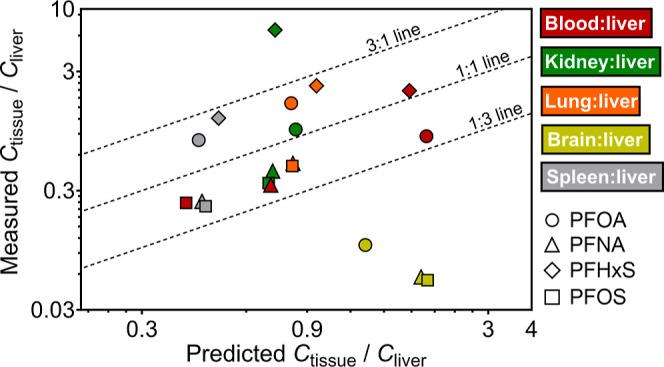
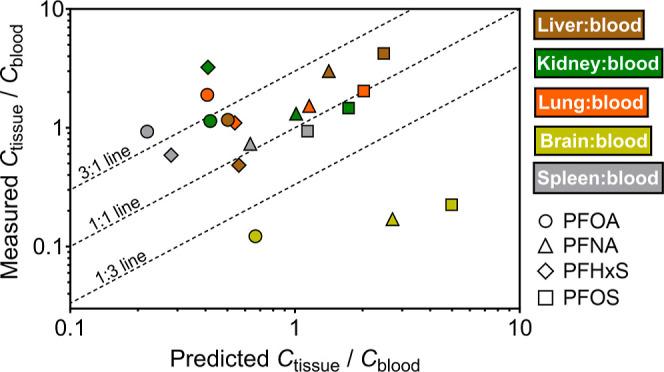
Human exposure to perfluorinated alkylate substances (PFASs) is usually assessed from the concentrations in serum or plasma, assuming one-compartment toxicokinetics. To characterize body distributions of major PFASs, we obtained and extracted tissue samples from 19 forensic autopsies of healthy adult subjects who had died suddenly and were not known to have elevated levels of PFAS exposure. As target organs of toxicological importance, we selected the liver, kidneys, lungs, spleen, and brain, as well as whole blood. Samples weighing about 0.1 g were analyzed by liquid chromatography coupled to triple mass spectrometers. Minor variations in PFAS concentrations were found between the kidney cortex and medulla and between lung lobes. Organ concentrations of perfluorooctanoic sulfonate (PFOS) and perfluorononanoate (PFNA) correlated well with blood concentrations, while perfluorooctanoate (PFOA) and perfluorohexanoic sulfonate (PFHxS) showed more variable associations. Likewise, the liver concentrations correlated well with those of other organs. Calculations of relative distributions were carried out to assess the interdependence of organ retentions. Equilibrium model predictions largely explained the observed PFAS distributions, except for the brain. Although the samples were small and affected by a possible lack of homogeneity, these findings support the use of blood-PFAS concentrations as a measure of PFAS exposure, with the liver possibly acting as the main organ of retention.
人体接触全氟烷基物质 (PFASs) 的水平通常通过血清或血浆浓度来评估,假设其符合一室毒代动力学模型。为了描述主要 PFASs 的体内分布,我们从 19 名死因不明且无已知 PFAS 暴露升高的健康成年尸检对象中获取并提取了组织样本。由于肝脏、肾脏、肺、脾和脑是毒理学上重要的靶器官,我们选择了这些器官以及全血作为目标组织。我们通过液相色谱-串联质谱法分析了约 0.1 克重的样本。在肾皮质和髓质之间以及肺叶之间,PFASs 浓度存在较小的差异。全氟辛烷磺酸 (PFOS) 和全氟壬酸 (PFNA) 在器官中的浓度与血液浓度密切相关,而全氟己酸 (PFOA) 和全氟己基磺酸 (PFHxS) 的相关性则较为复杂。同样,肝脏浓度与其他器官的浓度密切相关。我们还进行了相对分布的计算,以评估器官保留的相互依赖性。平衡模型预测在很大程度上解释了观察到的 PFAS 分布,除了大脑。尽管样本较小且可能存在非均一性问题,但这些发现支持使用血液-PFAS 浓度作为 PFAS 暴露的衡量指标,肝脏可能是主要的蓄积器官。
 Zotero 插件