
受竹子启发的裂纹面桥接纤维增强复合材料同时实现高强度和高韧性。
Bamboo-Inspired Crack-Face Bridging Fiber Reinforced Composites Simultaneously Attain High Strength and Toughness.
作者信息
Wang Hao, Wu Zhangyu, Tao Jie, Wang Bin, He Chaobin
机构信息
Department of Materials Science and Engineering, National University of Singapore, Queenstone, 117575, Singapore.
Department of Mechanical Engineering, City University of Hong Kong, Hong Kong, 999077, China.
出版信息
Adv Sci (Weinh). 2024 Mar;11(10):e2308070. doi: 10.1002/advs.202308070. Epub 2023 Dec 28.
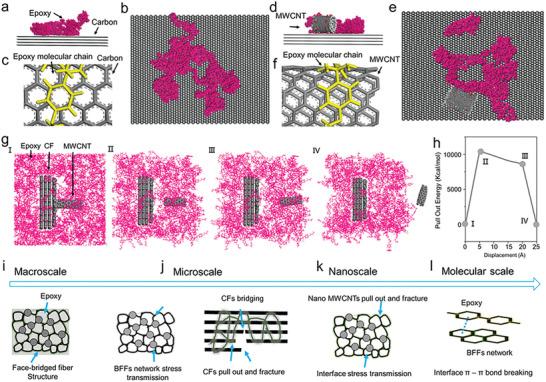
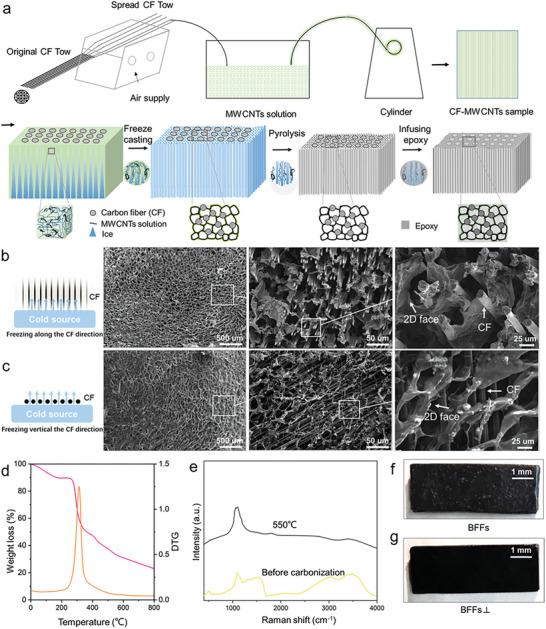
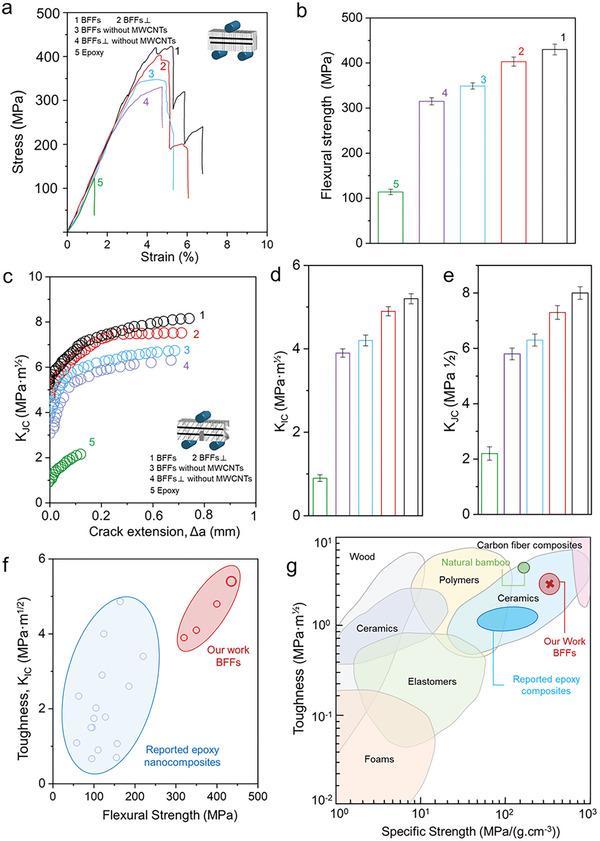
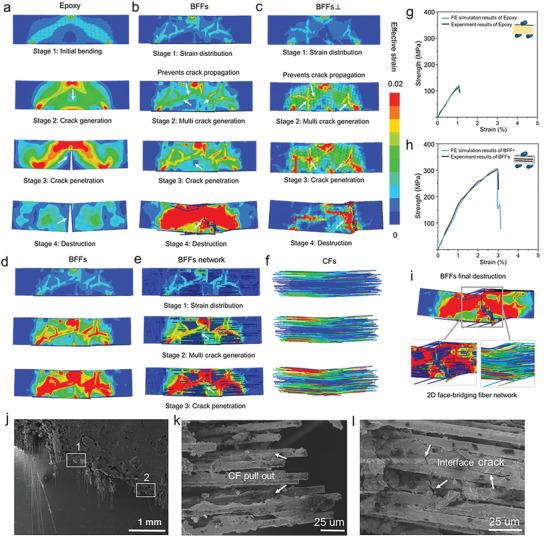
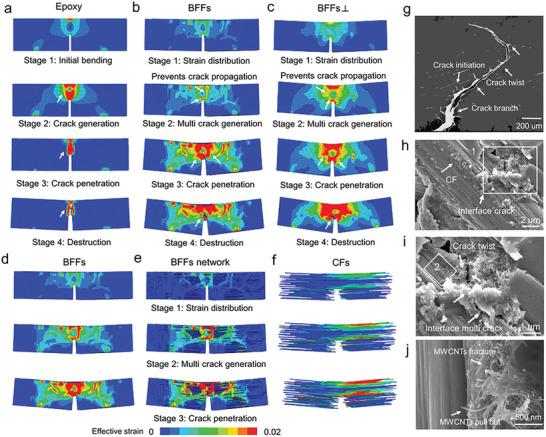
Biological strong and tough materials have been providing original structural designs for developing bioinspired high-performance composites. However, new synergistic strengthening and toughening mechanisms from bioinspired structures remain yet to be explored and employed to upgrade current carbon material reinforced polymer composites, which are keystone to various modern industries. In this work, from bamboo, the featured cell face-bridging fibers, are abstracted and embedded in a cellular network structure, and develop an epoxy resin/carbon composite featuring biomimetic architecture through a fabrication approach integrating freeze casting, carbonization, and resin infusion with carbon fibers (CFs) and carbon nanotubes (CNTs). Results show that this bamboo-inspired crack-face bridging fiber reinforced composite simultaneously possesses a high strength (430.8 MPa) and an impressive toughness (8.3 MPa m ), which surpass those of most resin-based nanocomposites reported in the literature. Experiments and multiscale simulation models reveal novel synergistic strengthening and toughening mechanisms arising from the 2D faces that bridge the CFs: sustaining and transferring loads to enhance the overall load-bearing ability and furthermore, incorporating CNTs pullout that resembles the intrinsic toughening at the molecular to nanoscale and strain delocalization, crack branching, and crack deflection as the extrinsic toughening at the microscale. These constitute a new effective and efficient strategy to develop simultaneously strong and tough composites through abstracting and implenting novel bioinspired structures, which contributes to addressing the long-standingly challenging attainment of both high strength and toughness for advanced structural materials.
生物强韧材料一直为开发受生物启发的高性能复合材料提供原始结构设计。然而,受生物启发结构产生的新的协同增强增韧机制仍有待探索,并用于升级当前的碳材料增强聚合物复合材料,而这些复合材料是各种现代工业的关键。在这项工作中,从竹子中提取出具有特色的细胞面桥接纤维,并将其嵌入细胞网络结构中,通过一种将冷冻铸造、碳化以及碳纤维(CFs)和碳纳米管(CNTs)的树脂灌注相结合的制造方法,开发出一种具有仿生结构的环氧树脂/碳复合材料。结果表明,这种受竹子启发的裂纹面桥接纤维增强复合材料同时具有高强度(430.8MPa)和令人印象深刻的韧性(8.3MPa·m),超过了文献中报道的大多数树脂基纳米复合材料。实验和多尺度模拟模型揭示了由桥接CFs的二维面产生的新型协同增强增韧机制:维持和传递载荷以提高整体承载能力,此外,结合类似于分子到纳米尺度的固有增韧以及应变离域、裂纹分支和裂纹偏转等微尺度的非固有增韧的CNTs拔出。这些构成了一种通过提取和实现新型受生物启发结构来同时开发强韧复合材料的新的有效策略,这有助于解决先进结构材料长期以来在实现高强度和高韧性方面面临的挑战性问题。

 Zotero 插件