
利用健康信息交换来描述纽约市新冠疫情期间艾滋病毒病毒载量抑制情况的变化及差异。
Using a Health Information Exchange to Characterize Changes in HIV Viral Load Suppression and Disparities During the COVID-19 Pandemic in New York City.
作者信息
Tucker Emma, Reyes Nieva Harry, Schiffer Kayla, Yin Michael T, Castor Delivette, Gordon Peter, Elhadad Noémie, Zucker Jason
机构信息
Vagelos College of Physicians and Surgeons, Columbia University, New York, New York, USA.
Department of Biomedical Informatics, Columbia University, New York, New York, USA.
出版信息
Open Forum Infect Dis. 2023 Nov 29;10(12):ofad584. doi: 10.1093/ofid/ofad584. eCollection 2023 Dec.
BACKGROUND
HIV viral suppression requires sustained engagement in care. The COVID-19 pandemic challenged care accessibility for many people living with HIV (PLWH). We used health information exchange data to evaluate the effect of pandemic-related disruptions in HIV care on viral load suppression (VLS) and to examine racial/ethnic disparities in VLS.
METHODS
We performed a retrospective observational cohort study of PLWH using data from a regional health information exchange in the New York City region between 1 January 2018 and 31 December 2022. We established 2 cohorts: PLWH who received HIV care in 2020 (cohort A) and PLWH who did not receive HIV care in 2020 (cohort B). We categorized HIV VLS outcomes as suppressed or not suppressed and calculated the prevalence of VLS between 2018 and 2022. We compared proportions using chi-square tests and used unadjusted and adjusted logistic regression to estimate the association among variables, including race/ethnicity, cohort, and VLS.
RESULTS
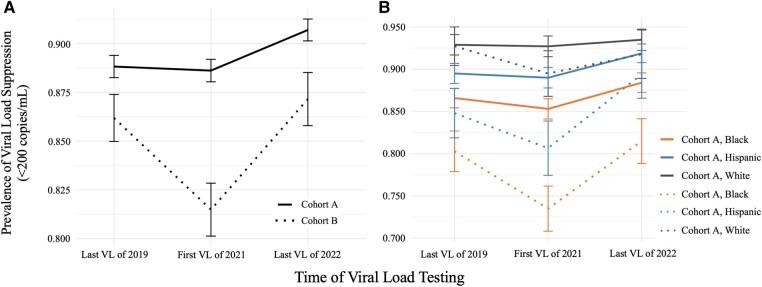
Of 5 301 578 patients, 34 611 met our inclusion criteria for PLWH, 11 653 for cohort A, and 3141 for cohort B. In 2019, cohort B had a lower prevalence of VLS than cohort A (86% vs 89%, < .001). Between 2019 and 2021, VLS dropped significantly among cohort B (86% to 81%, < .001) while staying constant in cohort A (89% to 89%, = .62). By 2022, members of cohort B were less likely than cohort A to be receiving HIV care in New York City (74% vs 88%, < .001). Within both cohorts, Black and Hispanic patients had lower odds of VLS than White patients.
CONCLUSIONS
In New York City, VLS remained high among PLWH who continued to receive care in 2020 and dropped among PLWH who did not receive care. VLS was lower among Black and Hispanic patients even after controlling for receipt of care.
背景
HIV病毒抑制需要持续接受治疗。新冠疫情对许多艾滋病毒感染者(PLWH)的治疗可及性构成了挑战。我们利用健康信息交换数据评估与疫情相关的HIV治疗中断对病毒载量抑制(VLS)的影响,并研究VLS中的种族/族裔差异。
方法
我们利用纽约市地区一个区域健康信息交换机构在2018年1月1日至2022年12月31日期间的数据,对PLWH进行了一项回顾性观察队列研究。我们设立了2个队列:2020年接受HIV治疗的PLWH(队列A)和2020年未接受HIV治疗的PLWH(队列B)。我们将HIV VLS结果分类为抑制或未抑制,并计算2018年至2022年期间VLS的患病率。我们使用卡方检验比较比例,并使用未调整和调整后的逻辑回归来估计变量之间的关联,包括种族/族裔、队列和VLS。
结果
在5301578名患者中,34611名符合我们对PLWH的纳入标准,队列A为11653名患者符合,队列B为3141名患者符合标准。2019年,队列B的VLS患病率低于队列A(86%对89%,P<0.001)。在2019年至2021年期间,队列B中的VLS显著下降(从86%降至81%,P<0.001),而队列A中的VLS保持不变(从89%降至89%,P=0.62)。到2022年,队列B的成员在纽约市接受HIV治疗的可能性低于队列A(74%对88%,P<0.001)。在两个队列中,黑人和西班牙裔患者的VLS几率均低于白人患者。
结论
在纽约市,2020年继续接受治疗的PLWH中VLS仍然很高,而未接受治疗的PLWH中VLS下降。即使在控制了接受治疗的情况后,黑人和西班牙裔患者的VLS仍然较低。


 Zotero 插件