
神经肌肉电刺激对住院成年人的影响:随机对照试验的系统评价和荟萃分析。
The effects of neuromuscular electrical stimulation on hospitalised adults: systematic review and meta-analysis of randomised controlled trials.
机构信息
University of Nottingham, Nottingham, UK.
Department of Physical Therapy, Faculty of Applied Medical Science, Taif University, Taif, Saudi Arabia.
出版信息
Age Ageing. 2023 Dec 1;52(12). doi: 10.1093/ageing/afad236.
INTRODUCTION
Neuromuscular electrical stimulation (NMES) is a treatment to prevent or reverse acquired disability in hospitalised adults. We conducted a systematic review and meta-analysis of its effectiveness.
METHOD
We searched MEDLINE, EMBASE, Cumulative Index to Nursing & Allied Health (CINAHL) and the Cochrane library. Inclusion criteria: randomised controlled trials of hospitalised adult patients comparing NMES to control or usual care. The primary outcome was muscle strength. Secondary outcomes were muscle size, function, hospital length of stay, molecular and cellular biomarkers, and adverse effects. We assessed risk of bias using the Cochrane risk-of-bias tool. We used Review Manager (RevMan) software for data extraction, critical appraisal and synthesis. We assessed certainty using the Grading of Recommendations Assessment, Development and Evaluation tool.
RESULTS
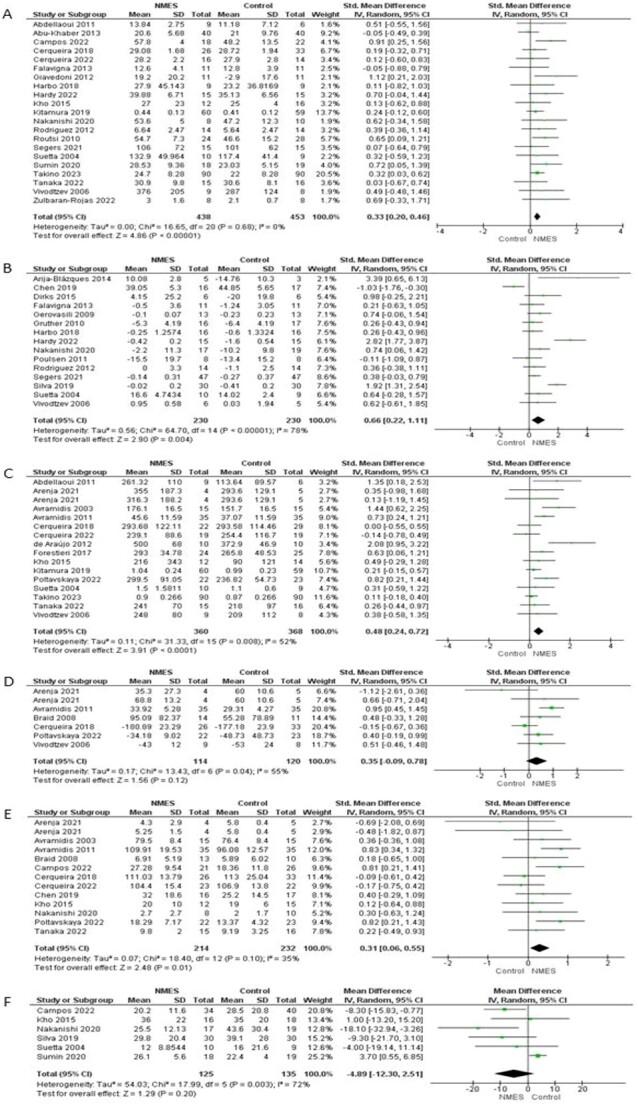
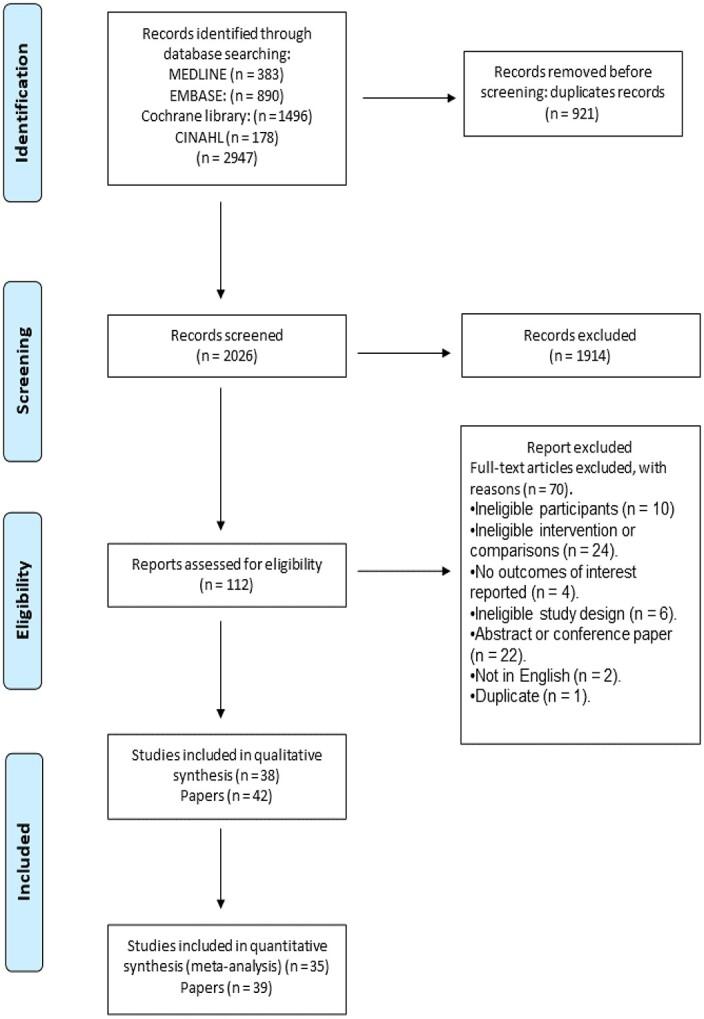
A total of 42 papers were included involving 1,452 participants. Most studies had unclear or high risk of bias. NMES had a small effect on muscle strength (moderate certainty) (standardised mean difference (SMD) = 0.33; P < 0.00001), a moderate effect on muscle size (moderate certainty) (SMD = 0.66; P < 0.005), a small effect on walking performance (moderate certainty) (SMD = 0.48; P < 0.0001) and a small effect on functional mobility (low certainty) (SMD = 0.31; P < 0.05). There was a small and non-significant effect on health-related quality of life (very low certainty) (SMD = 0.35; P > 0.05). In total, 9% of participants reported undesirable experiences. The effects of NMES on length of hospital stay, and molecular and cellular biomarkers were unclear.
CONCLUSIONS
NMES is a promising intervention component that might help to reduce or prevent hospital-acquired disability.
简介
神经肌肉电刺激(NMES)是一种预防或逆转住院成人获得性残疾的治疗方法。我们对其有效性进行了系统评价和荟萃分析。
方法
我们检索了 MEDLINE、EMBASE、护理学及相关健康学科累积索引(CINAHL)和 Cochrane 图书馆。纳入标准:比较 NMES 与对照组或常规护理的住院成年患者的随机对照试验。主要结局为肌肉力量。次要结局为肌肉大小、功能、住院时间、分子和细胞生物标志物以及不良反应。我们使用 Cochrane 偏倚风险工具评估偏倚风险。我们使用 Review Manager(RevMan)软件进行数据提取、批判性评价和综合分析。我们使用推荐评估、制定与评价工具(GRADE)评估确定性。
结果
共纳入 42 篇论文,涉及 1452 名参与者。大多数研究的偏倚风险不明确或高。NMES 对肌肉力量有较小的影响(中等确定性)(标准化均数差(SMD)=0.33;P<0.00001),对肌肉大小有中等影响(中等确定性)(SMD=0.66;P<0.005),对步行能力有较小的影响(中等确定性)(SMD=0.48;P<0.0001),对功能性移动能力有较小的影响(低确定性)(SMD=0.31;P<0.05)。对健康相关生活质量的影响较小且无统计学意义(极低确定性)(SMD=0.35;P>0.05)。总共有 9%的参与者报告了不良体验。NMES 对住院时间和分子及细胞生物标志物的影响尚不清楚。
结论
NMES 是一种有前途的干预措施,可能有助于减少或预防医院获得性残疾。

 Zotero 插件