
在中国精神分裂症患者中,述情障碍与失眠有关。
Alexithymia is associated with insomnia in Chinese patients with schizophrenia.
作者信息
Cai Fangfang, Jiang Huixia, Tong Siyu, Zhou Siyao, Wang Mengpu, Sun Shiyu, Liu Jie, Xu Yao, Lin Nankai, Dai Jiajing, Wang Xinyao, Wang Wei, Zhao Ke, Wu Xixi
机构信息
School of Mental Health, Wenzhou Medical University, Wenzhou, China.
Renji College of Wenzhou Medical University, Wenzhou, China.
出版信息
Front Psychiatry. 2023 Dec 15;14:1252763. doi: 10.3389/fpsyt.2023.1252763. eCollection 2023.
BACKGROUND
Sleep disorders are prevalent among patients with schizophrenia and are associated with several negative consequences. Although, researchers have recently suggested that sleep disorders have a close correlation with alexithymia, and schizophrenia also has a strong correlation with alexithymia, there have been few studies on the relationships between schizophrenia, sleep disorders and alexithymia. Therefore, this study aimed to explore the relationships between psychiatric symptoms, alexithymia and sleep problems in patients with schizophrenia so as to provide a reference for the clinical treatment of this comorbidity.
METHODS
In total, 977 patients with schizophrenia were recruited for this study. The Insomnia Severity Index (ISI) was used to assess sleep disorders, and the Positive and Negative Syndrome Scale (PANSS), Repeatable Battery for the Assessment of Neuropsychological Status (RBANS) and Toronto Alexithymia Scale (TAS) were used to evaluate clinical symptoms, cognitive functions and the ability to express emotion, respectively.
RESULTS
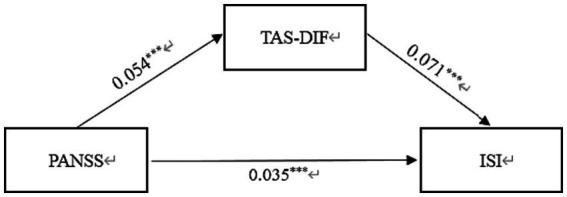
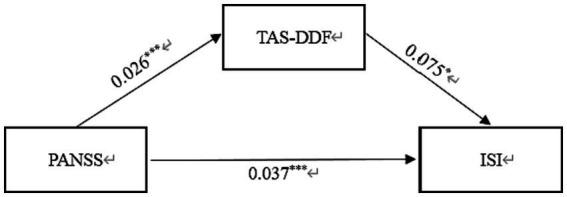
The results indicated that the PANSS subscales (G-subscore) and TAS group were risk factors for insomnia in schizophrenia patients (all < 0.05). The mediation model showed the standardized path coefficients from schizophrenia to alexithymia ( = 0.104, < 0.001) and from alexithymia to insomnia ( = 0.038, < 0.001) were statistically significant.
CONCLUSION
The results of this study indicated that alexithymia is associated with sleep disturbance in patients with schizophrenia. These findings may provide a new avenue for the treatment of schizophrenia patients with sleep disorders.
背景
睡眠障碍在精神分裂症患者中普遍存在,并与多种负面后果相关。尽管研究人员最近提出睡眠障碍与述情障碍密切相关,且精神分裂症也与述情障碍有很强的相关性,但关于精神分裂症、睡眠障碍和述情障碍之间的关系却鲜有研究。因此,本研究旨在探讨精神分裂症患者的精神症状、述情障碍和睡眠问题之间的关系,以便为这种共病的临床治疗提供参考。
方法
本研究共招募了977例精神分裂症患者。采用失眠严重程度指数(ISI)评估睡眠障碍,分别采用阳性和阴性症状量表(PANSS)、可重复神经心理状态评估量表(RBANS)和多伦多述情障碍量表(TAS)评估临床症状、认知功能和表达情感的能力。
结果
结果表明,PANSS分量表(G分)和TAS组是精神分裂症患者失眠的危险因素(均<0.05)。中介模型显示,从精神分裂症到述情障碍(β = 0.104,P < 0.001)以及从述情障碍到失眠(β = 0.038,P < 0.001)的标准化路径系数具有统计学意义。
结论
本研究结果表明,述情障碍与精神分裂症患者的睡眠障碍有关。这些发现可能为治疗伴有睡眠障碍的精神分裂症患者提供新的途径。

 Zotero 插件