
微塑料和纳米塑料的光氧化:环境中的物理、化学和生物效应。
Photo-oxidation of Micro- and Nanoplastics: Physical, Chemical, and Biological Effects in Environments.
机构信息
Key Laboratory of Drinking Water Science and Technology, Research Centre for Eco-Environmental Sciences, Chinese Academy of Sciences, Beijing 100085, P. R. China.
Section of Sanitary Engineering, Department of Water Management, Faculty of Civil Engineering and Geosciences, Delft University of Technology, Stevinweg 1, 2628 CN Delft, The Netherlands.
出版信息
Environ Sci Technol. 2024 Jan 16;58(2):991-1009. doi: 10.1021/acs.est.3c07035. Epub 2024 Jan 3.
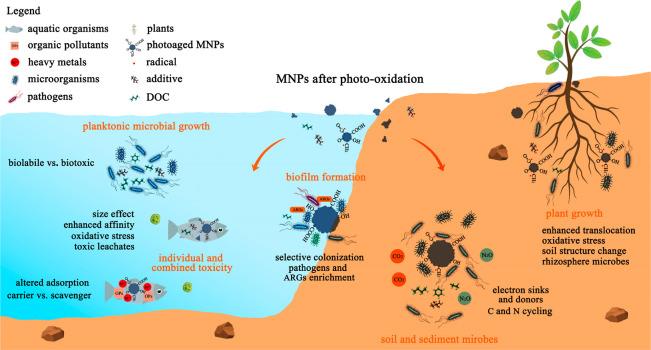
Micro- and nanoplastics (MNPs) are attracting increasing attention due to their persistence and potential ecological risks. This review critically summarizes the effects of photo-oxidation on the physical, chemical, and biological behaviors of MNPs in aquatic and terrestrial environments. The core of this paper explores how photo-oxidation-induced surface property changes in MNPs affect their adsorption toward contaminants, the stability and mobility of MNPs in water and porous media, as well as the transport of pollutants such as organic pollutants (OPs) and heavy metals (HMs). It then reviews the photochemical processes of MNPs with coexisting constituents, highlighting critical factors affecting the photo-oxidation of MNPs, and the contribution of MNPs to the phototransformation of other contaminants. The distinct biological effects and mechanism of aged MNPs are pointed out, in terms of the toxicity to aquatic organisms, biofilm formation, planktonic microbial growth, and soil and sediment microbial community and function. Furthermore, the research gaps and perspectives are put forward, regarding the underlying interaction mechanisms of MNPs with coexisting natural constituents and pollutants under photo-oxidation conditions, the combined effects of photo-oxidation and natural constituents on the fate of MNPs, and the microbiological effect of photoaged MNPs, especially the biotransformation of pollutants.
微塑料和纳米塑料(MNPs)因其持久性和潜在的生态风险而受到越来越多的关注。本文批判性地总结了光氧化对水相和土壤相中 MNPs 的物理、化学和生物行为的影响。本文的核心探讨了光氧化诱导的 MNPs 表面性质变化如何影响其对污染物的吸附、MNPs 在水和多孔介质中的稳定性和迁移性,以及污染物(如有机污染物(OPs)和重金属(HMs))的迁移。然后,本文回顾了共存物质存在下的 MNPs 的光化学过程,强调了影响 MNPs 光氧化的关键因素,以及 MNPs 对其他污染物光转化的贡献。本文还指出了老化 MNPs 的独特生物学效应和机制,包括对水生生物的毒性、生物膜形成、浮游微生物生长以及土壤和沉积物微生物群落和功能的影响。此外,本文还提出了研究空白和展望,涉及在光氧化条件下 MNPs 与共存天然物质和污染物的相互作用机制、光氧化和天然物质对 MNPs 命运的联合影响,以及光老化 MNPs 的微生物学效应,特别是污染物的生物转化。


 Zotero 插件