
乳铁蛋白免疫阻断小细胞外囊泡抑制 sEV 介导的促转移能力增加。
Lactadherin immunoblockade in small extracellular vesicles inhibits sEV-mediated increase of pro-metastatic capacities.
机构信息
Center for Regenerative Medicine, Institute for Sciences and Innovation in Medicine, Facultad de Medicina, Clínica Alemana Universidad del Desarrollo, Santiago, Chile.
Facultad de Medicina, Clínica Alemana Universidad del Desarrollo, Santiago, Chile.
出版信息
Biol Res. 2024 Jan 3;57(1):1. doi: 10.1186/s40659-023-00477-8.
BACKGROUND
Tumor-derived small extracellular vesicles (sEVs) can promote tumorigenic and metastatic capacities in less aggressive recipient cells mainly through the biomolecules in their cargo. However, despite recent advances, the specific molecules orchestrating these changes are not completely defined. Lactadherin is a secreted glycoprotein typically found in the milk fat globule membrane. Its overexpression has been associated with increased tumorigenesis and metastasis in breast cancer (BC) and other tumors. However, neither its presence in sEVs secreted by BC cells, nor its role in sEV-mediated intercellular communication have been described. The present study focused on the role of lactadherin-containing sEVs from metastatic MDA-MB-231 triple-negative BC (TNBC) cells (sEV-MDA231) in the promotion of pro-metastatic capacities in non-tumorigenic and non-metastatic recipient cells in vitro, as well as their pro-metastatic role in a murine model of peritoneal carcinomatosis.
RESULTS
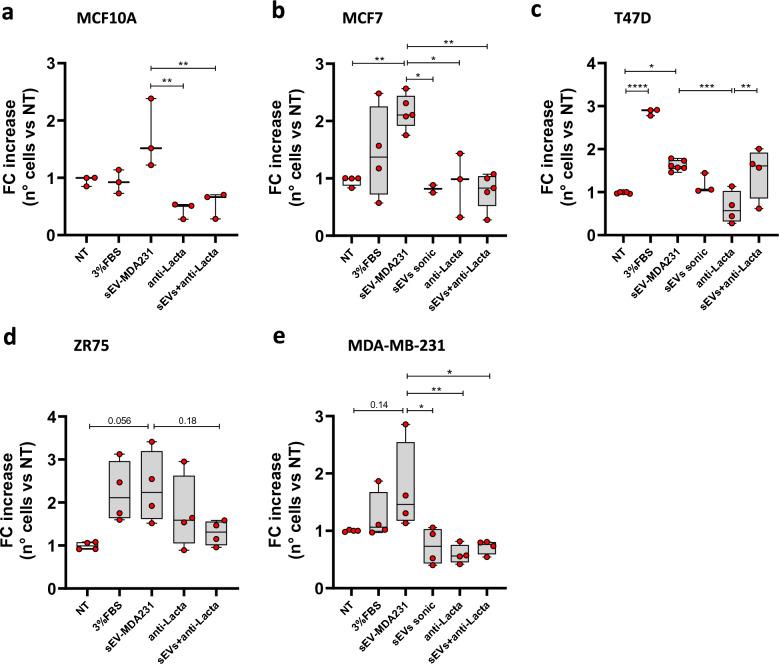
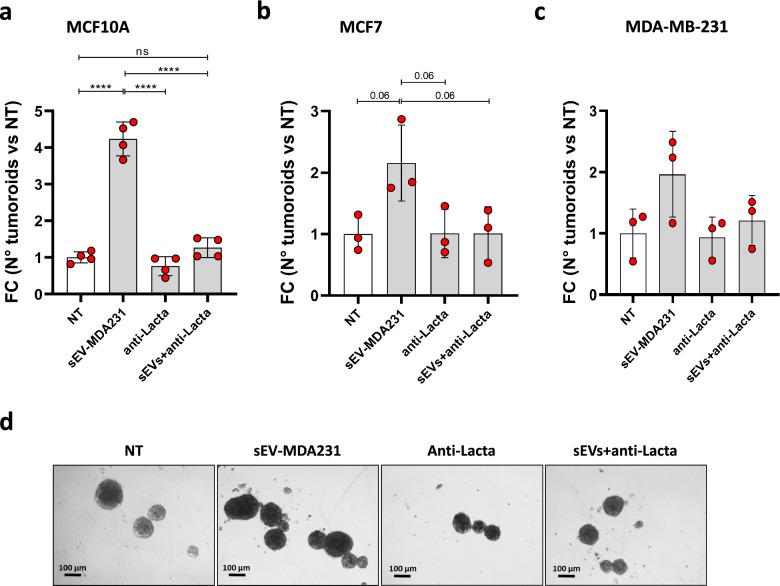
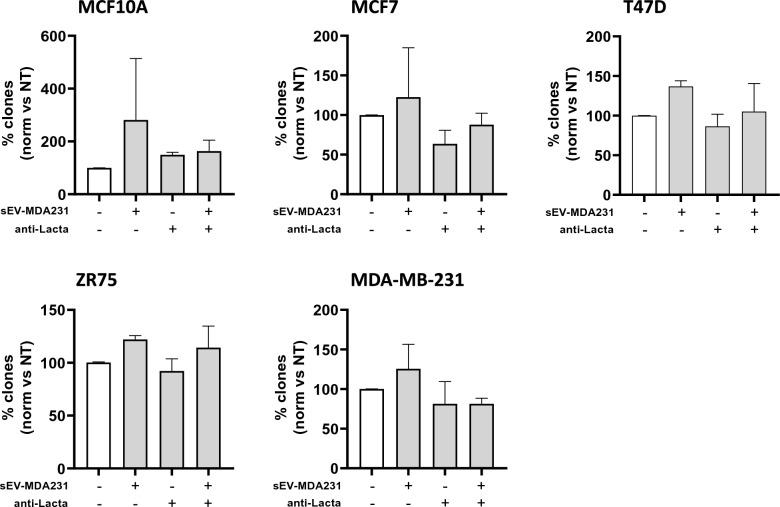
We show that lactadherin is present in sEVs secreted by BC cells and it is higher in sEV-MDA231 compared with the other BC cell-secreted sEVs measured through ELISA. Incubation of non-metastatic recipient cells with sEV-MDA231 increases their migration and, to some extent, their tumoroid formation capacity but not their anchorage-independent growth. Remarkably, lactadherin blockade in sEV-MDA231 results in a significant decrease of those sEV-mediated changes in vitro. Similarly, intraperitoneally treatment of mice with MDA-MB-231 BC cells and sEV-MDA231 greatly increase the formation of malignant ascites and tumor micronodules, effects that were significantly inhibited when lactadherin was previously blocked in those sEV-MDA231.
CONCLUSIONS
As to our knowledge, our study provides the first evidence on the role of lactadherin in metastatic BC cell-secreted sEVs as promoter of: (i) metastatic capacities in less aggressive recipient cells, and ii) the formation of malignant ascites and metastatic tumor nodules. These results increase our understanding on the role of lactadherin in sEVs as promoter of metastatic capacities which can be used as a therapeutic option for BC and other malignancies.
背景
肿瘤来源的小细胞外囊泡(sEVs)可以通过其货物中的生物分子主要在侵袭性较低的受体细胞中促进致瘤性和转移能力。然而,尽管最近取得了进展,但协调这些变化的特定分子尚未完全确定。乳贴蛋白是一种分泌型糖蛋白,通常存在于乳脂肪球膜中。它的过表达与乳腺癌(BC)和其他肿瘤的肿瘤发生和转移增加有关。然而,BC 细胞分泌的 sEV 中乳贴蛋白的存在及其在 sEV 介导的细胞间通讯中的作用尚未描述。本研究集中于转移性 MDA-MB-231 三阴性乳腺癌(TNBC)细胞(sEV-MDA231)分泌的含有乳贴蛋白的 sEV 在促进体外非致瘤性和非转移性受体细胞的促转移能力中的作用,以及其在腹膜癌病的小鼠模型中的促转移作用。
结果
我们表明乳贴蛋白存在于 BC 细胞分泌的 sEV 中,通过 ELISA 测量,与其他 BC 细胞分泌的 sEV 相比,sEV-MDA231 中的乳贴蛋白含量更高。用 sEV-MDA231 孵育非转移性受体细胞会增加其迁移能力,并且在某种程度上增加其肿瘤形成能力,但不增加其非锚定依赖性生长。值得注意的是,在 sEV-MDA231 中阻断乳贴蛋白会导致体外这些 sEV 介导的变化显著减少。同样,用 MDA-MB-231 BC 细胞和 sEV-MDA231 腹腔内治疗小鼠会大大增加恶性腹水和肿瘤微结节的形成,当预先阻断这些 sEV-MDA231 中的乳贴蛋白时,这些作用会显著抑制。
结论
据我们所知,我们的研究首次提供了乳贴蛋白在转移性 BC 细胞分泌的 sEV 中作为促进因子的作用的证据:(i)在侵袭性较低的受体细胞中促进转移能力,和 ii)形成恶性腹水和转移性肿瘤结节。这些结果增加了我们对乳贴蛋白在促进转移能力的 sEV 中的作用的理解,这可以作为 BC 和其他恶性肿瘤的一种治疗选择。



 Zotero 插件