
抗髓鞘相关糖蛋白性神经病的治疗结果与电生理生物标志物:韩国一项多中心队列研究
Therapeutic Outcomes and Electrophysiological Biomarkers in Anti-Myelin-Associated Glycoprotein Neuropathy: A Multicenter Cohort Study in South Korea.
作者信息
Min Young Gi, Han Hee-Jo, Shin Ha Young, Baek Jong-Gyu, Kim Jun-Soon, Park Kyung-Seok, Baek Seol-Hee, Yoo Ilhan, Huh So-Young, Kwon Young Nam, Choi Seok-Jin, Kim Sung-Min, Hong Yoon-Ho, Sung Jung-Joon
机构信息
Department of Translational Medicine, Seoul National University College of Medicine, Seoul, Korea.
Department of Neurology, Seoul National University Hospital, Seoul, Korea.
出版信息
J Clin Neurol. 2024 Jan;20(1):50-58. doi: 10.3988/jcn.2023.0127.
BACKGROUND AND PURPOSE
Unlike other immune-mediated neuropathies, anti-myelin-associated glycoprotein (MAG) neuropathy is often refractory to immunotherapy. It is necessary to compare the relative efficacies of various immunotherapies and develop objective biomarkers in order to optimize its clinical management.
METHODS
This study recruited 91 patients with high anti-MAG antibody titers from 7 tertiary hospitals in South Korea. We analyzed the baseline characteristics, therapeutic outcomes, and nerve conduction study (NCS) findings of 68 patients and excluded 23 false positive cases.
RESULTS
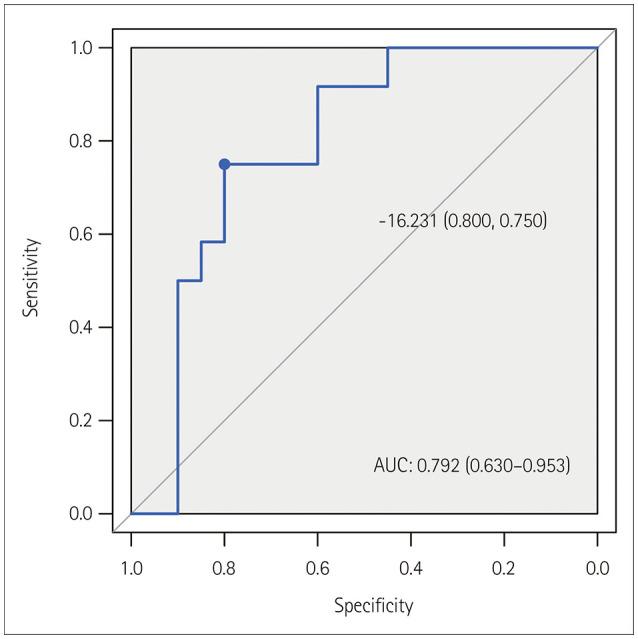
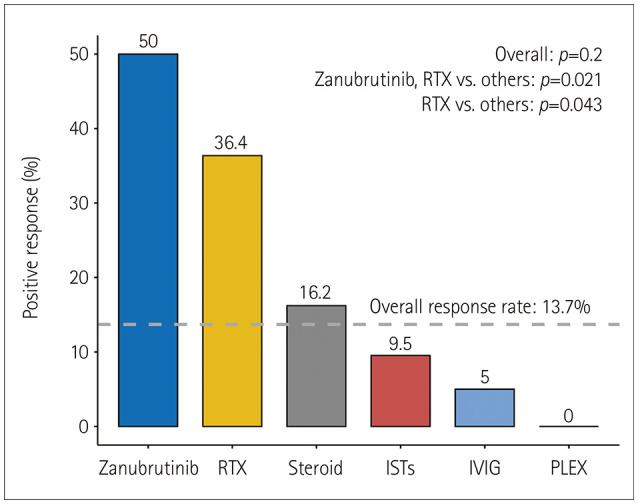
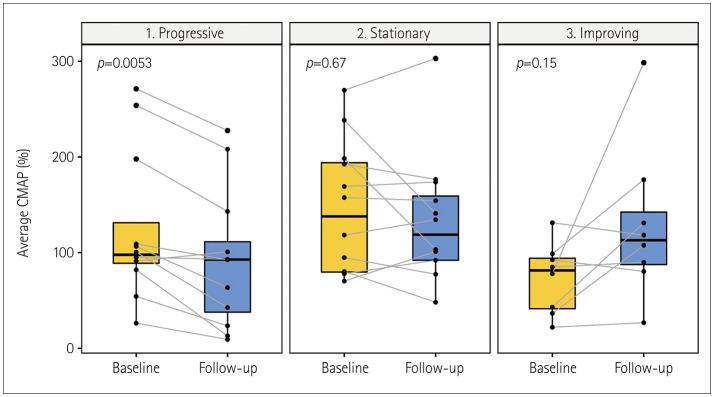
The rate of positive responses to treatment was highest using zanubrutinib (50%) and rituximab (36.4%), followed by corticosteroids (16.7%), immunosuppressants (9.5%), intravenous immunoglobulin (5%), and plasma exchange (0%). Disability and weakness were significantly associated with multiple NCS parameters at the time of diagnosis, especially distal compound muscle action potential (CMAP) amplitudes. Moreover, the longitudinal trajectory of the average CMAP amplitudes paralleled the clinical courses, with a 16.2 percentile decrease as an optimal cutoff for predicting a clinical exacerbation (area under the receiver operating characteristic curve=0.792).
CONCLUSIONS
Our study supports the use of NCS as an objective marker for estimating disease burden and tracking clinical changes in patients with anti-MAG neuropathy. We have described the beneficial effects of rituximab and a new drug, zanubrutinib, compared with conventional immunotherapies.
背景与目的
与其他免疫介导的神经病不同,抗髓鞘相关糖蛋白(MAG)神经病通常对免疫治疗难治。有必要比较各种免疫治疗的相对疗效并开发客观的生物标志物,以优化其临床管理。
方法
本研究从韩国7家三级医院招募了91例抗MAG抗体滴度高的患者。我们分析了68例患者的基线特征、治疗结果和神经传导研究(NCS)结果,并排除了23例假阳性病例。
结果
使用泽布替尼(50%)和利妥昔单抗(36.4%)治疗的阳性反应率最高,其次是皮质类固醇(16.7%)、免疫抑制剂(9.5%)、静脉注射免疫球蛋白(5%)和血浆置换(0%)。残疾和无力在诊断时与多个NCS参数显著相关,尤其是远端复合肌肉动作电位(CMAP)波幅。此外,平均CMAP波幅的纵向轨迹与临床病程平行,下降16.2百分位数作为预测临床恶化的最佳截断值(受试者操作特征曲线下面积=0.792)。
结论
我们的研究支持将NCS用作评估抗MAG神经病患者疾病负担和跟踪临床变化的客观标志物。我们描述了利妥昔单抗和一种新药泽布替尼与传统免疫治疗相比的有益效果。
 Zotero 插件