
评估联合和单药免疫疗法在转移性黑色素瘤患者疾病进展和生存的真实世界模式中的疗效。
Evaluating the efficacy of combination and single-agent immunotherapies in real-world patterns of disease progression and survival of metastatic melanoma patients.
机构信息
National Cancer Institute, Bethesda, Maryland.
Montefiore Einstein Cancer Center, Albert Einstein College of Medicine, Bronx.
出版信息
Melanoma Res. 2024 Apr 1;34(2):134-141. doi: 10.1097/CMR.0000000000000945. Epub 2024 Jan 4.
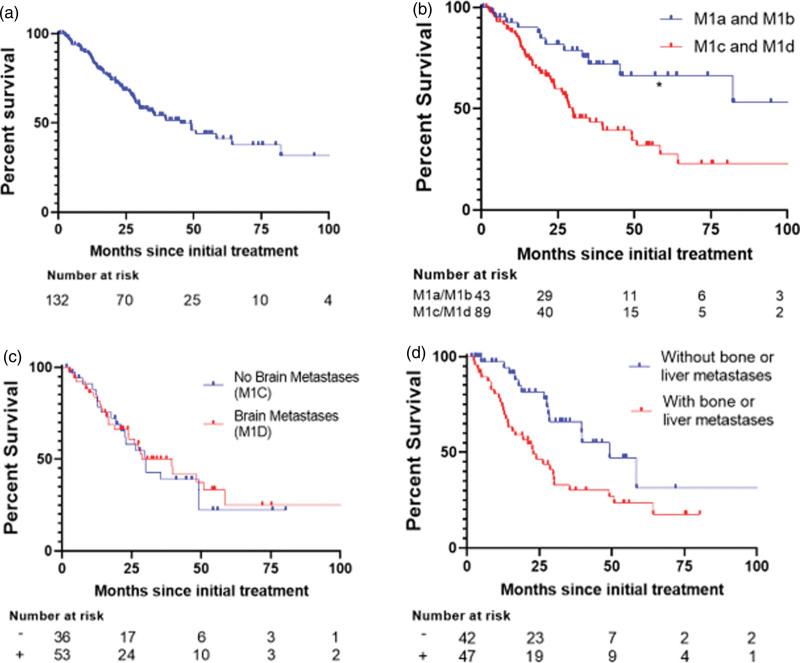
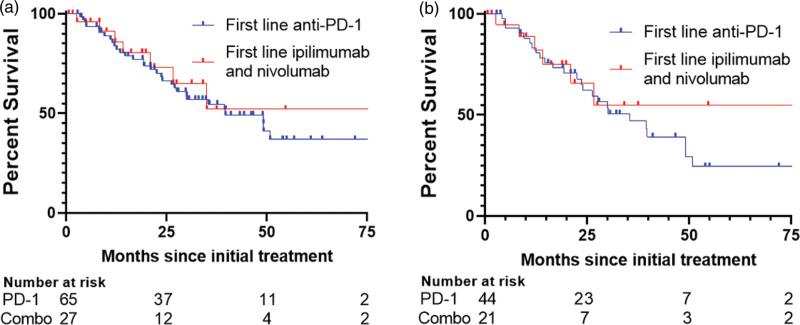
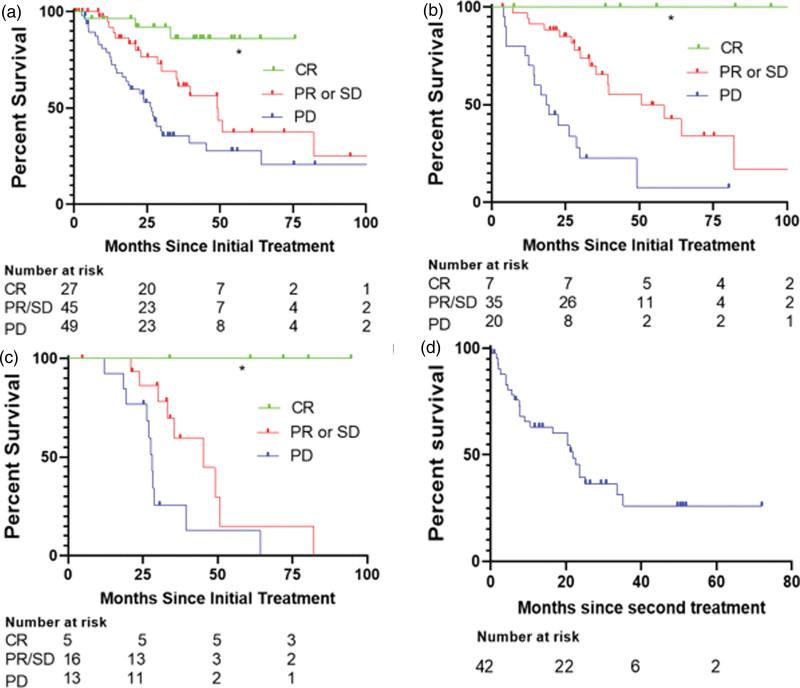
The objective of this study is to describe survival outcomes in patients with metastatic melanoma in a real-world setting receiving combination and single-agent immunotherapy outside the clinical trial context. We conducted a retrospective single-institution study of patients with metastatic melanoma in a real-world setting. Survival was calculated using log-rank test. Contingency tables were analyzed using Fisher's Exact test. CD8 + T-cell densities were measured using quantitative immunofluorescence and analyzed using Mann-Whitney U test. The median overall survival (OS) for 132 patients was 45.3 months. Brain metastasis did not confer a higher risk of death relative to liver and/or bone disease (39.53 versus 30.00 months, respectively; P = 0.687). Anti-PD-1 monotherapy was the most common first-line treatment, received by 49.2% of patients. There was no significant difference in OS between patients receiving single-agent anti-PD-1 and combination anti-PD-1 plus CTLA-4 (39.4 months versus undefined; P = 0.643). Patients treated with combination therapy were more likely to be alive without progression at the last follow-up than those who received monotherapy (70.4% versus 49.2%; P = 0.0408). Median OS was 21.8 months after initiation of second-line therapy after anti-PD-1 monotherapy. CD8+ T-cell densities were higher in patients who achieved disease control on first-line immunotherapy ( P = 0.013). In a real-world setting, patients with metastatic melanoma have excellent survival rates, and treatment benefit can be achieved even after progression on first-line therapy. Combination immunotherapy may produce more favorable long-term outcomes in a real-world setting. High pretreatment CD8+ T-cell infiltration correlates with immunotherapy efficacy.
本研究旨在描述在临床试验环境之外接受联合和单药免疫治疗的转移性黑色素瘤患者的生存结果。我们对真实环境中的转移性黑色素瘤患者进行了回顾性单机构研究。使用对数秩检验计算生存。使用 Fisher 精确检验分析列联表。使用定量免疫荧光法测量 CD8+T 细胞密度,并使用 Mann-Whitney U 检验进行分析。132 例患者的中位总生存期(OS)为 45.3 个月。脑转移与肝和/或骨疾病相比,死亡风险并未增加(分别为 39.53 个月和 30.00 个月,P=0.687)。抗 PD-1 单药治疗是最常见的一线治疗,49.2%的患者接受了该治疗。接受单药抗 PD-1 和联合抗 PD-1 加 CTLA-4 治疗的患者 OS 无显著差异(39.4 个月与未定义;P=0.643)。接受联合治疗的患者在最后一次随访时无进展生存的可能性高于接受单药治疗的患者(70.4%比 49.2%;P=0.0408)。抗 PD-1 单药治疗后二线治疗开始后,中位 OS 为 21.8 个月。在一线免疫治疗中获得疾病控制的患者的 CD8+T 细胞密度更高(P=0.013)。在真实环境中,转移性黑色素瘤患者的生存率非常高,即使在一线治疗进展后,也能获得治疗益处。联合免疫治疗在真实环境中可能产生更有利的长期结果。高预处理 CD8+T 细胞浸润与免疫治疗疗效相关。

 Zotero 插件