
终末期肾病中增量血液透析与传统血液透析的系统评价和荟萃分析
Incremental versus conventional haemodialysis in end-stage kidney disease: a systematic review and meta-analysis.
作者信息
Takkavatakarn Kullaya, Jintanapramote Kavita, Phannajit Jeerath, Praditpornsilpa Kearkiat, Eiam-Ong Somchai, Susantitaphong Paweena
机构信息
Division of Nephrology, Department of Medicine, King Chulalongkorn Memorial Hospital, Faculty of Medicine, Chulalongkorn University, Bangkok, Thailand.
Division of Nephrology, Department of Medicine, Bhumibol Adulyadej Hospital, Royal Thai Air Force, Bangkok, Thailand.
出版信息
Clin Kidney J. 2023 Nov 8;17(1):sfad280. doi: 10.1093/ckj/sfad280. eCollection 2024 Jan.
BACKGROUND
Appropriate dialysis prescription in the transitional setting from chronic kidney disease to end-stage kidney disease is still challenging. Conventional thrice-weekly haemodialysis (HD) might be associated with rapid loss of residual kidney function (RKF) and high mortality. The benefits and risks of incremental HD compared with conventional HD were explored in this systematic review and meta-analysis.
METHODS
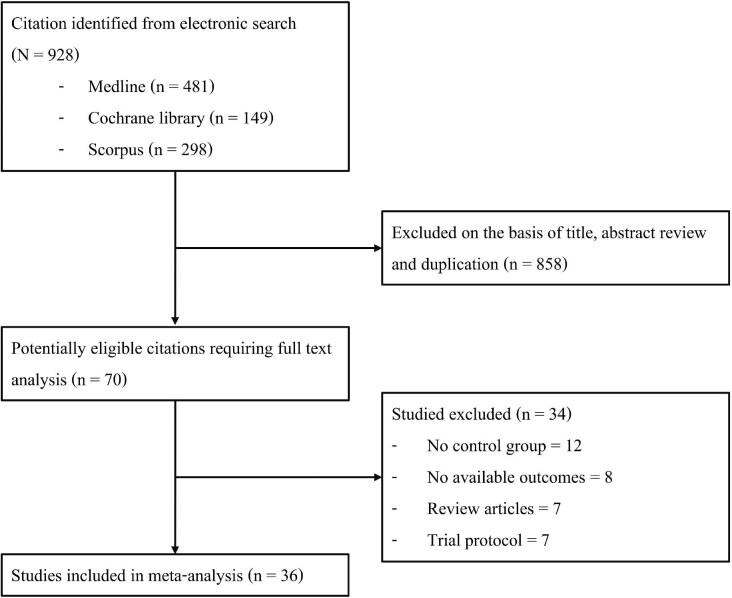
We searched MEDLINE, Scopus and Cochrane Central Register of Controlled Trials up to April 2023 for studies that compared the impacts of incremental (once- or twice-weekly HD) and conventional thrice-weekly HD on cardiovascular events, RKF, vascular access complications, quality of life, hospitalization and mortality.
RESULTS
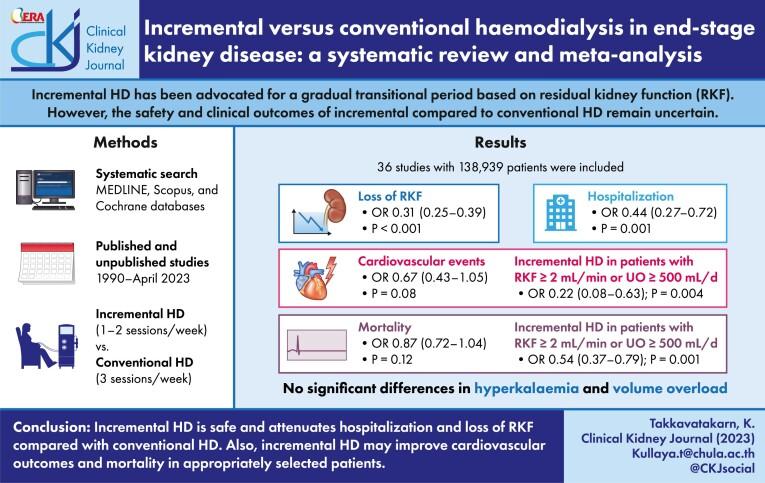
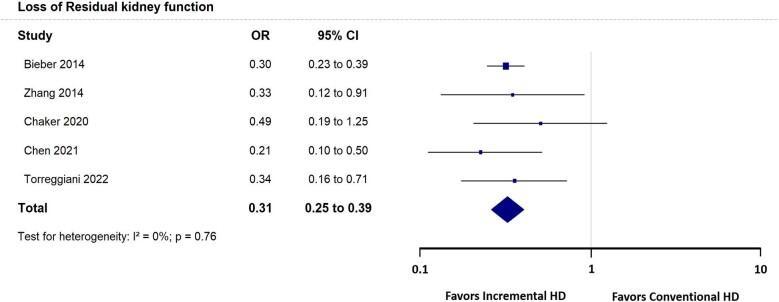
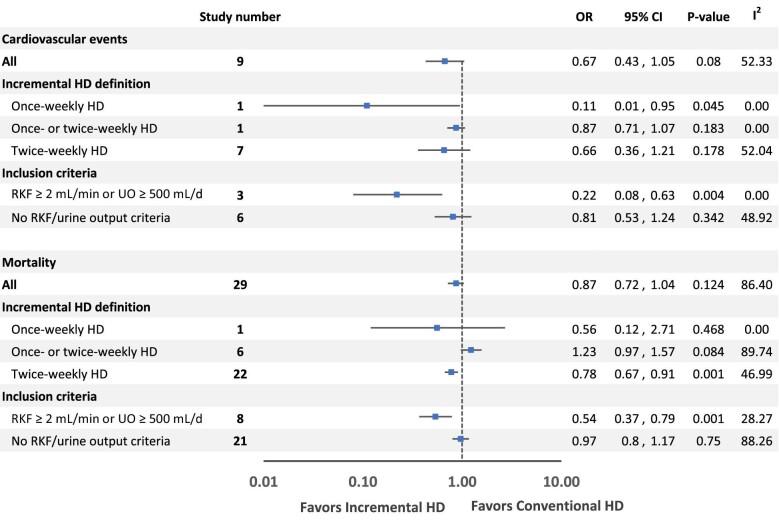
A total of 36 articles (138 939 participants) were included in this meta-analysis. The mortality rate and cardiovascular events were similar between incremental and conventional HD {odds ratio [OR] 0.87 [95% confidence interval (CI)] 0.72-1.04 and OR 0.67 [95% CI 0.43-1.05], respectively}. However, hospitalization and loss of RKF were significantly lower in patients treated with incremental HD [OR 0.44 (95% CI 0.27-0.72) and OR 0.31 (95% CI 0.25-0.39), respectively]. In a sensitivity analysis that included studies restricted to those with RKF or urine output criteria, incremental HD had significantly lower cardiovascular events [OR 0.22 (95% CI 0.08-0.63)] and mortality [OR 0.54 (95% CI 0.37-0.79)]. Vascular access complications, hyperkalaemia and volume overload were not statistically different between groups.
CONCLUSIONS
Incremental HD has been shown to be safe and may provide superior benefits in clinical outcomes, particularly in appropriately selected patients. Large-scale randomized controlled trials are required to confirm these potential advantages.
背景
在从慢性肾脏病到终末期肾病的过渡阶段,制定合适的透析方案仍具有挑战性。传统的每周三次血液透析(HD)可能与残余肾功能(RKF)的快速丧失和高死亡率相关。本系统评价和荟萃分析探讨了与传统HD相比,递增式HD的益处和风险。
方法
我们检索了截至2023年4月的MEDLINE、Scopus和Cochrane对照试验中央注册库,以寻找比较递增式(每周一次或两次HD)和传统每周三次HD对心血管事件、RKF、血管通路并发症、生活质量、住院率和死亡率影响的研究。
结果
本荟萃分析共纳入36篇文章(138939名参与者)。递增式HD和传统HD之间的死亡率和心血管事件相似{优势比[OR]分别为0.87[95%置信区间(CI)]0.72 - 1.04和OR 0.67[95%CI 0.43 - 1.05]}。然而,递增式HD治疗的患者住院率和RKF丧失显著更低[分别为OR 0.44(95%CI 0.27 - 0.72)和OR 0.31(95%CI 0.25 - 0.39)]。在一项敏感性分析中,纳入仅限于符合RKF或尿量标准的研究,递增式HD的心血管事件[OR 0.22(95%CI 0.08 - 0.63)]和死亡率[OR 0.54(95%CI 0.37 - 0.79)]显著更低。两组之间的血管通路并发症、高钾血症和容量超负荷无统计学差异。
结论
递增式HD已被证明是安全的,并且可能在临床结局方面提供更好的益处,特别是在适当选择的患者中。需要大规模随机对照试验来证实这些潜在优势。


 Zotero 插件