
体圆指数与胰岛素敏感性的相关性优于体质量指数在年轻和中年日本人。
Body Roundness Index Is Better Correlated with Insulin Sensitivity than Body Shape Index in Young and Middle-Aged Japanese Persons.
机构信息
Division of Diabetes, Metabolism and Endocrinology, Showa University Fujigaoka Hospital, Yokohama, Japan.
Division of Endocrinology and Metabolism, Department of Medicine, Jichi Medical University, Tochigi, Japan.
出版信息
Metab Syndr Relat Disord. 2024 Mar;22(2):151-159. doi: 10.1089/met.2023.0175. Epub 2024 Jan 9.
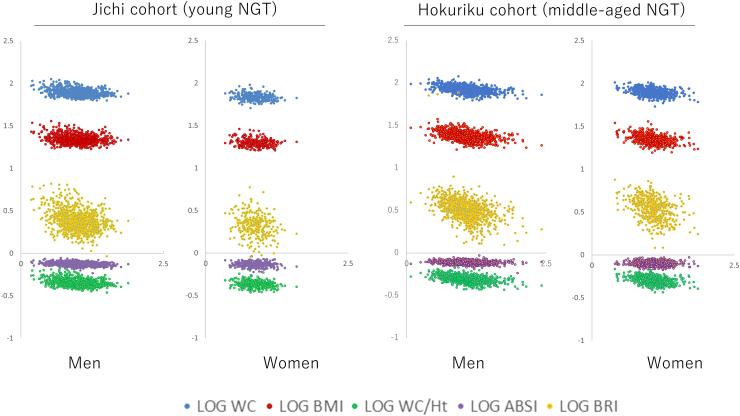
The present study aimed to clarify the relationships between novel and traditional anthropometric indices and insulin sensitivity (SI) in young and middle-aged Japanese persons with normal glucose tolerance (NGT), and middle-aged Japanese persons with NGT and glucose intolerance. Plasma glucose and insulin levels were measured in 1270 young (age <40 years) and 2153 middle-aged persons with NGT ( = 1531) and glucose intolerance ( = 622) during a 75-g oral glucose tolerance test. Height (Ht), weight, and waist circumference (WC) were measured. The body mass index (BMI), WC, and the WC/Ht ratio were used as traditional anthropometric indices. A body shape index (ABSI) and the body roundness index (BRI) were calculated as novel indices. Indices of SI (Matsuda index and 1/homeostasis model assessment of insulin resistance) were calculated and compared with anthropometric indices. The ABSI showed a weak correlation with SI indices in all groups. The BRI showed almost the same correlation with SI indices as the BMI, WC, and WC/Ht in all groups. The inverse correlation between each of the anthropometric indices other than ABSI and SI indices was weak in young persons, at 0.16-0.27 (Spearman's ρ values), but strong in middle-aged persons, at 0.38-1.00. On receiver-operating characteristic (ROC) curve analysis for detection of insulin resistance, the ABSI had a lower area under the ROC curve (AUC) than the other anthropometric indices, and the BRI and the WC/Ht ratio showed similar AUCs. The AUCs for the BRI and WC/Ht ratio were the highest in middle-aged men with NGT and glucose intolerance. The BRI, not the ABSI, was better correlated with SI in young and middle-aged Japanese persons. The BRI and WC/Ht ratio were comparable in their correlations with SI and the detection of insulin resistance in the participants of the present study.
本研究旨在明确新型和传统人体测量学指标与年轻和中年日本糖耐量正常(NGT)人群以及中年日本 NGT 伴葡萄糖耐量受损(IGT)人群胰岛素敏感性(SI)之间的关系。在 75g 口服葡萄糖耐量试验期间,测量了 1270 名年轻(年龄<40 岁)和 2153 名中年 NGT(=1531 名)和 IGT(=622 名)人群的血浆葡萄糖和胰岛素水平。测量了身高(Ht)、体重和腰围(WC)。体重指数(BMI)、WC 和 WC/Ht 比值用作传统人体测量学指标。计算了身体形状指数(ABSI)和身体圆润度指数(BRI)作为新型指数。计算了 SI 指数(Matsuda 指数和 1/稳态模型评估的胰岛素抵抗)并与人体测量学指数进行比较。ABSI 与所有组的 SI 指数均呈弱相关。BRI 与所有组的 BMI、WC 和 WC/Ht 具有几乎相同的 SI 指数相关性。在年轻人中,除了 ABSI 之外的每个人体测量学指数与 SI 指数之间的负相关较弱,在 0.16-0.27(Spearman ρ 值)之间,而在中年人中,负相关较强,在 0.38-1.00 之间。在用于检测胰岛素抵抗的受试者工作特征(ROC)曲线分析中,ABSI 的 ROC 曲线下面积(AUC)低于其他人体测量学指数,而 BRI 和 WC/Ht 比值显示出相似的 AUC。BRI 和 WC/Ht 比值在中年 NGT 和 IGT 男性中 AUC 最高。BRI 而非 ABSI 与年轻和中年日本人群的 SI 相关性更好。在本研究参与者中,BRI 和 WC/Ht 比值与 SI 的相关性和胰岛素抵抗的检测相当。
 Zotero 插件