
HPV 相关口咽癌:寻找早期病变的替代生物标志物。
HPV-associated oropharyngeal cancer: in search of surrogate biomarkers for early lesions.
机构信息
Department of Periodontics and Oral Medicine, University of Michigan School of Dentistry, 1011 N. University Ave, Ann Arbor, MI, USA.
Department of Pathology, University of Michigan Medical School, Ann Arbor, MI, USA.
出版信息
Oncogene. 2024 Feb;43(8):543-554. doi: 10.1038/s41388-023-02927-9. Epub 2024 Jan 8.
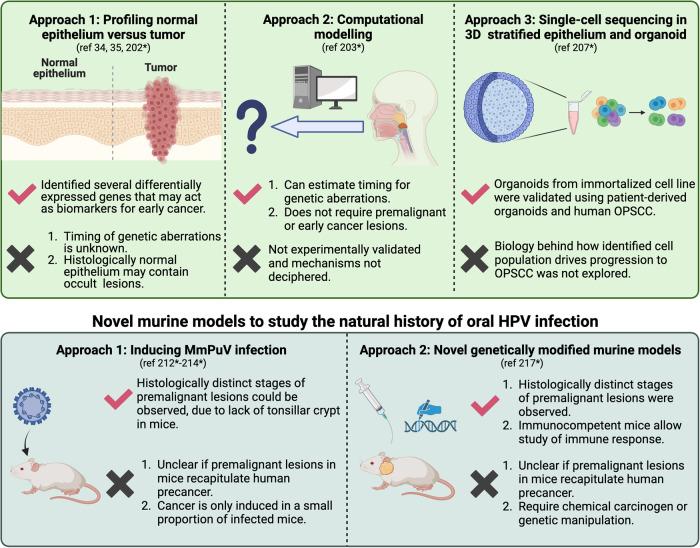
The incidence of oropharyngeal cancer (OPSCC) has escalated in the past few decades; this has largely been triggered by high-risk human papillomavirus (HPV). Early cancer screening is needed for timely clinical intervention and may reduce mortality and morbidity, but the lack of knowledge about premalignant lesions for OPSCC poses a significant challenge to early detection. Biomarkers that identify individuals at high risk for OPSCC may act as surrogate markers for precancer but these are limited as only a few studies decipher the multistep progression from HPV infection to OPSCC development. Here, we summarize the current literature describing the multistep progression from oral HPV infection, persistence, and tumor development in the oropharynx. We also examine key challenges that hinder the identification of premalignant lesions in the oropharynx and discuss potential biomarkers for oropharyngeal precancer. Finally, we evaluate novel strategies to improve investigations of the biological process that drives oral HPV persistence and OPSCC, highlighting new developments in the establishment of a genetic progression model for HPV + OPSCC and in vivo models that mimic HPV + OPSCC pathogenesis.
过去几十年中,口咽癌(OPSCC)的发病率不断上升;这在很大程度上是由高危型人乳头瘤病毒(HPV)引起的。早期癌症筛查对于及时进行临床干预至关重要,可降低死亡率和发病率,但对 OPSCC 癌前病变缺乏了解,这给早期发现带来了重大挑战。可识别 OPSCC 高危人群的生物标志物可作为癌前病变的替代标志物,但这些标志物有限,因为只有少数研究阐明了 HPV 感染到 OPSCC 发展的多步骤进展。在这里,我们总结了目前描述口咽 HPV 感染、持续存在和肿瘤发展的多步骤进展的文献。我们还检查了阻碍口咽癌前病变识别的关键挑战,并讨论了口咽癌前病变的潜在生物标志物。最后,我们评估了改善对驱动口腔 HPV 持续存在和 OPSCC 的生物学过程的研究的新策略,重点介绍了 HPV+OPSCC 遗传进展模型建立和模拟 HPV+OPSCC 发病机制的体内模型的新进展。


 Zotero 插件