
体力活动与日本中青年劳动者运动障碍综合征的关系。
Relationship between physical activity and locomotive syndrome among young and middle-aged Japanese workers.
机构信息
Department of Public Health, Faculty of Life Sciences, Kumamoto University, Kumamoto, 860-8556, Japan.
Division of Rehabilitation Technology, Department of Medical Technology, Kumamoto University Hospital, Kumamoto, 860-8556, Japan.
出版信息
J Occup Health. 2024 Jan 4;66(1). doi: 10.1093/joccuh/uiae001.
OBJECTIVES
This study aimed to examine the relationship between physical activity (PA) and locomotive syndrome (LS) among young and middle-aged Japanese workers.
METHODS
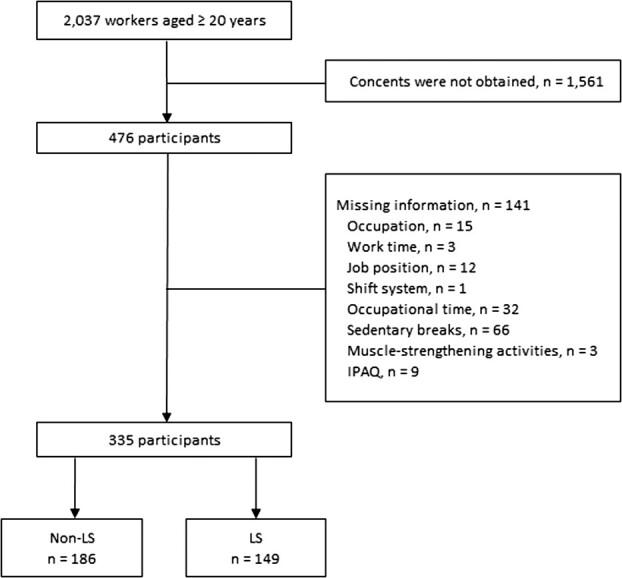
This cross-sectional study included 335 participants from a company in Kumamoto, Japan. LS was evaluated using the 25-question Geriatric Locomotive Function Scale (GLFS-25); a GLFS-25 score ≥7 was defined as LS. Weekly PA was measured using the International Physical Activity Questionnaire. Work-related PA (time spent sitting, standing, walking, and strenuous work per day) and sedentary breaks were measured using a Work-related Physical Activity Questionnaire. Screen usage (television [TV], smartphones, tablets, and personal computers) during leisure time was recorded. The association between PA and LS was examined using a multivariate logistic regression analysis adjusted for age, sex, body mass index, history of musculoskeletal disorders, cancer, stroke, occupation, employment type, work time, shift system, employment status, and body pain.
RESULTS
A total of 149 participants had LS. Fewer sedentary breaks during work (>70-minute intervals, odds ratio [OR] = 2.96; prolonged sitting, OR = 4.12) and longer TV viewing time (≥180 minutes, OR = 3.02) were significantly associated with LS. In contrast, moderate PA (OR = 0.75) was significantly associated with a lower risk of LS.
CONCLUSIONS
Fewer sedentary breaks during work and longer TV viewing time could increase the risk of LS in young and middle-aged Japanese workers.
目的
本研究旨在探讨日本年轻和中年工人身体活动(PA)与活动能力降低综合征(LS)之间的关系。
方法
本横断面研究纳入了来自日本熊本县一家公司的 335 名参与者。LS 使用 25 项老年人体力活动量表(GLFS-25)进行评估;GLFS-25 评分≥7 定义为 LS。每周 PA 使用国际体力活动问卷进行测量。工作相关 PA(每天坐着、站着、走动和剧烈工作的时间)和久坐休息时间使用工作相关体力活动问卷进行测量。休闲时间的屏幕使用(电视[TV]、智能手机、平板电脑和个人电脑)记录在案。使用多变量逻辑回归分析调整年龄、性别、体重指数、肌肉骨骼疾病、癌症、中风、职业、就业类型、工作时间、轮班制度、就业状况和身体疼痛等因素后,对 PA 与 LS 之间的关系进行了检查。
结果
共有 149 名参与者患有 LS。工作时较少的久坐休息时间(间隔>70 分钟,比值比[OR] = 2.96;长时间坐着,OR = 4.12)和更长的电视观看时间(≥180 分钟,OR = 3.02)与 LS 显著相关。相比之下,适度的 PA(OR = 0.75)与 LS 风险降低显著相关。
结论
工作期间较少的久坐休息时间和更长的电视观看时间可能会增加日本年轻和中年工人 LS 的风险。
 Zotero 插件