
PKD1 截断突变加速常染色体显性多囊肾病患者的 eGFR 下降。
PKD1 Truncating Mutations Accelerate eGFR Decline in Autosomal Dominant Polycystic Kidney Disease Patients.
机构信息
Department of Medical Laboratory Sciences, Faculty of Allied Health Sciences, Health Sciences Center (HSC), Kuwait University, Jabriya, Kuwait.
Department of Genetics and Bioinformatics, Dasman Diabetes Institute (DDI), Dasman, Kuwait.
出版信息
Am J Nephrol. 2024;55(3):380-388. doi: 10.1159/000536165. Epub 2024 Jan 9.
INTRODUCTION
Autosomal dominant polycystic kidney disease (ADPKD) is a monogenic disease characterized by the accumulation of fluid-filled cysts in the kidneys, leading to renal volume enlargement and progressive kidney function impairment. Disease severity, though, may vary due to allelic and genetic heterogeneity. This study aimed to determine genotype-phenotype correlations between PKD1 truncating and non-truncating mutations and kidney function decline in ADPKD patients.
METHODS
We established a single-center retrospective cohort study in Kuwait where we followed every patient with a confirmed PKD1-ADPKD diagnosis clinically and genetically. Renal function tests were performed annually. We fitted generalized additive mixed effects models with random intercepts for each individual to analyze repeated measures of kidney function across mutation type. We then calculated survival time to kidney failure in a cox proportional hazards model. Models were adjusted for sex, age at visit, and birth year.
RESULTS
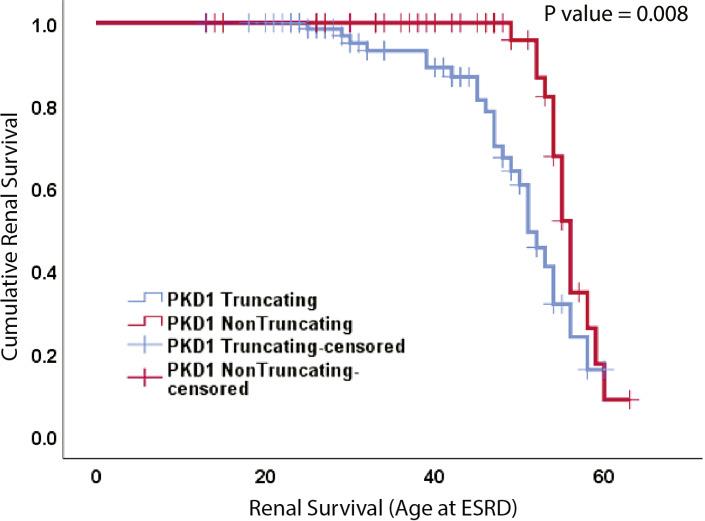
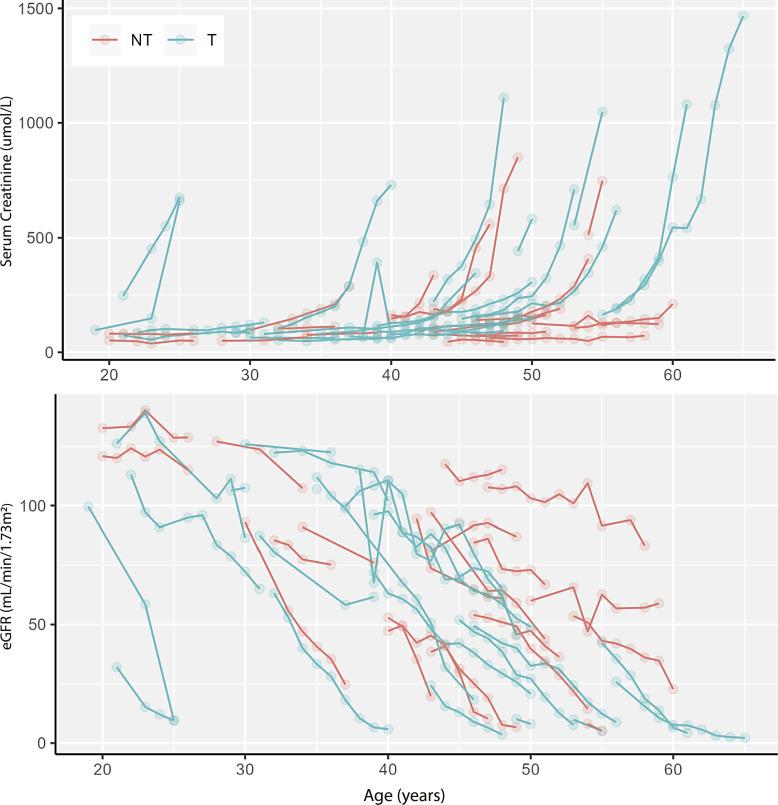
The study included 22 truncating and 20 non-truncating (42 total) patients followed for an average of 6.6 years (range: 1-12 years). Those with PKD1 truncating mutations had a more rapid rate of eGFR decline (-4.7 mL/min/1.73 m2 per year; 95% CI: -5.0, -4.4) compared to patients with PKD1 non-truncating mutations (-3.5 mL/min/1.73 m2 per year; 95% CI: -4.0, -3.1) (p for interaction <0.001). Kaplan-Meier survival analysis of time to kidney failure showed that patients with PKD1 truncating mutations had a shorter renal survival time (median 51 years) compared to those with non-truncating mutations (median 56 years) (P for log-rank = 0.008).
CONCLUSION
In longitudinal and survival analyses, patients with PKD1 truncating mutations showed a faster decline in kidney function compared to patients PKD1 non-truncating mutations. Early identification of patients with PKD1 truncating mutations can, at best, inform early clinical interventions or, at least, help suggest aggressive monitoring.
简介
常染色体显性多囊肾病(ADPKD)是一种单基因疾病,其特征是肾脏中充满液体的囊肿积聚,导致肾脏体积增大和进行性肾功能损害。然而,由于等位基因和遗传异质性,疾病的严重程度可能有所不同。本研究旨在确定 PKD1 截断和非截断突变与 ADPKD 患者肾功能下降之间的基因型-表型相关性。
方法
我们在科威特建立了一个单中心回顾性队列研究,对每一位经临床和基因确诊为 PKD1-ADPKD 的患者进行随访。每年进行肾功能检查。我们使用具有个体随机截距的广义加性混合效应模型分析跨突变类型的肾功能重复测量值。然后,我们在 Cox 比例风险模型中计算肾衰竭的生存时间。模型调整了性别、就诊时年龄和出生年份。
结果
该研究纳入了 22 名截断和 20 名非截断(共 42 名)患者,平均随访 6.6 年(范围:1-12 年)。与 PKD1 非截断突变患者相比(每年 -3.5 毫升/分钟/1.73 平方米;95%CI:-4.0,-3.1),PKD1 截断突变患者的 eGFR 下降速度更快(每年 -4.7 毫升/分钟/1.73 平方米;95%CI:-5.0,-4.4)(交互作用 p <0.001)。肾衰竭时间的 Kaplan-Meier 生存分析显示,PKD1 截断突变患者的肾脏生存时间更短(中位 51 年),而非截断突变患者的肾脏生存时间更长(中位 56 年)(对数秩检验 P = 0.008)。
结论
在纵向和生存分析中,与 PKD1 非截断突变患者相比,PKD1 截断突变患者的肾功能下降速度更快。早期识别 PKD1 截断突变患者,最多可以告知早期临床干预,或者至少可以提示加强监测。

 Zotero 插件