
西班牙真实世界环境中基于杂交捕获的下一代测序对实体瘤进行可操作的基因突变分析。
Actionable mutational profiling in solid tumors using hybrid-capture-based next-generation sequencing in a real-world setting in Spain.
机构信息
Department of Pathology, Fundación Jiménez Díaz University Hospital, Madrid, Spain.
IIS-Fundación Jimenez Diaz, Center for Biomedical Network Research on Cancer (CIBERONC), Madrid, Spain.
出版信息
Cancer Med. 2024 Feb;13(3):e6827. doi: 10.1002/cam4.6827. Epub 2024 Jan 11.
OBJECTIVE
This study aimed to describe the performance of a next-generation sequencing (NGS) panel for the detection of precise genomic alterations in cancer in Spanish clinical practice. The impact of tumor characteristics was evaluated on informative NGS and actionable mutation rates.
MATERIALS AND METHODS
A cross-sectional study was conducted at the Fundación Jiménez Díaz University Hospital (May 2021-March 2022) where molecular diagnostic of 537 Formalin-Fixed Paraffin-Embedded (FFPE) tissue samples of diverse solid tumors (lung, colorectal, melanoma, gastrointestinal stromal, among others) was performed using AVENIO Tumor Tissue Targeted Kit. A descriptive analysis of the features of all samples was carried out. Multivariable logistic analysis was conducted to assess the impact of sample characteristics on NGS performance defined by informative results rate (for all tumors and for lung tumors), and on actionable mutations rate (for lung tumors only).
RESULTS
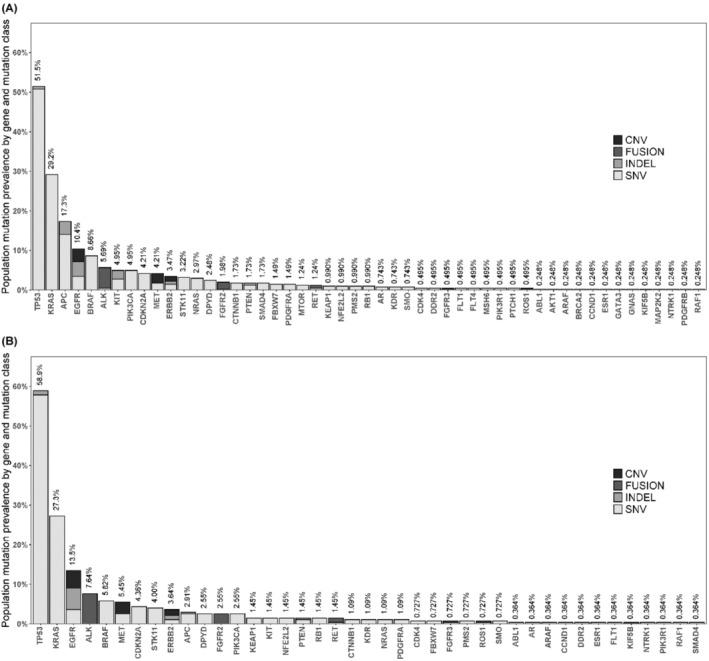
AVENIO performance rate was 75.2% in all tumor samples and 75.3% in lung cancer samples, and the multivariable analysis showed that surgical specimens are most likely to provide informative results than diagnostic biopsies. Regarding the mutational findings, 727 pathogenic, likely pathogenic, or variant of unknown significance mutations were found in all tumor samples. Single nucleotide variant was the most common genomic alteration, both for all tumor samples (85.3% and 81.9% for all solid tumors and lung samples, respectively). In lung tumors, multivariable analysis showed that it is more likely to find actionable mutations from non-smokers and patients with adenocarcinoma, large cell, or undifferentiated histologies.
CONCLUSION
This is the largest cohort-level study in Spain to profile the analyses of biopsy samples of different tumors using NGS in routine clinical practice. Our findings showed that the use of NGS routinely provides good rates of informative results and can improve tumor characterization and identify a greater number of actionable mutations.
目的
本研究旨在描述下一代测序(NGS)面板在西班牙临床实践中检测癌症精确基因组改变的性能。评估肿瘤特征对信息性 NGS 和可操作性突变率的影响。
材料和方法
在 Fundación Jiménez Díaz 大学医院(2021 年 5 月至 2022 年 3 月)进行了一项横断面研究,对来自不同实体瘤(肺癌、结直肠癌、黑色素瘤、胃肠道间质瘤等)的 537 个福尔马林固定石蜡包埋(FFPE)组织样本进行了分子诊断,使用 AVENIO 肿瘤组织靶向试剂盒。对所有样本的特征进行了描述性分析。进行多变量逻辑分析,以评估样本特征对定义为信息结果率(所有肿瘤和肺癌)的 NGS 性能以及对可操作性突变率(仅肺癌)的影响。
结果
AVENIO 在所有肿瘤样本中的性能率为 75.2%,在肺癌样本中的性能率为 75.3%,多变量分析表明手术标本比诊断性活检更有可能提供信息性结果。关于突变发现,在所有肿瘤样本中发现了 727 个致病性、可能致病性或意义不明的变异突变。单核苷酸变异是最常见的基因组改变,无论是在所有肿瘤样本(所有实体瘤和肺癌样本分别为 85.3%和 81.9%)还是在肺癌样本中。在肺癌中,多变量分析表明,从不吸烟者和腺癌、大细胞或未分化组织学患者中更有可能发现可操作性突变。
结论
这是西班牙最大的队列水平研究,用于在常规临床实践中使用 NGS 对不同肿瘤的活检样本进行分析。我们的研究结果表明,常规使用 NGS 可提供较高的信息结果率,并可改善肿瘤特征描述,识别更多的可操作性突变。
 Zotero 插件