
解析肿瘤微环境:CXCL9 和 SPP1 作为肿瘤相关巨噬细胞极性的关键决定因素和预后指标。
Deciphering tumor microenvironment: CXCL9 and SPP1 as crucial determinants of tumor-associated macrophage polarity and prognostic indicators.
机构信息
Key Laboratory of Novel Targets and Drug Study for Neural Repair of Zhejiang Province, School of Medicine, Hangzhou City University, Hangzhou, Zhejiang, China.
Department of Clinical Medicine, Hangzhou City University, Hangzhou, Zhejiang, China.
出版信息
Mol Cancer. 2024 Jan 13;23(1):13. doi: 10.1186/s12943-023-01931-7.
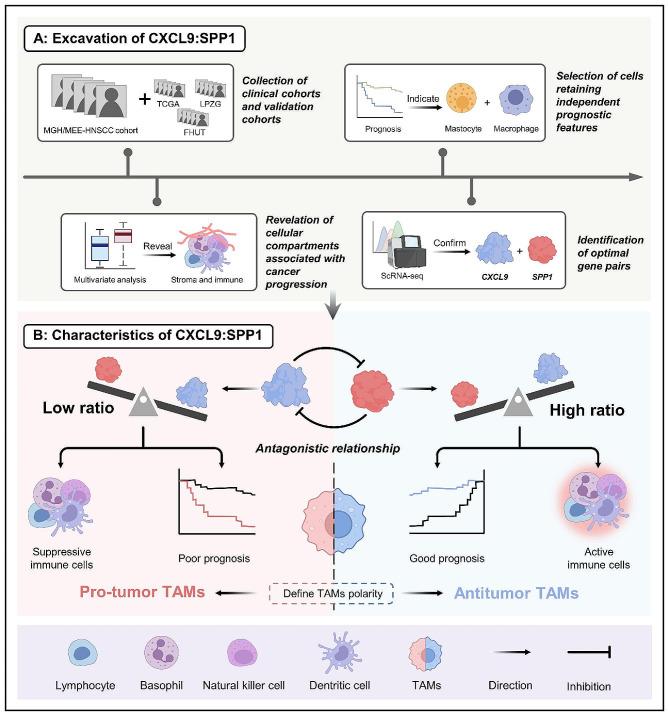
The tumor microenvironment (TME) is an intricate system comprised of tumor cells and the surrounding cellular and non-cellular components, exerting a pivotal influence on the initiation and progression of tumors. Exhibiting dynamic and diverse compositions as well as functional states across various tumors and patients, a profound comprehension of its specific internal interactions is indispensable for formulating efficacious anti-cancer treatment strategies. Extensive interactions among various immune cell types within the TME are well-documented, with their phenotypes and abundances closely linked to clinical prognoses. TME research is progressing towards greater complexity and precision, yet, to date, no representative TME biomarkers suitable for clinical applications have been definitively identified and validated. In a recent study, the collaborative actions of CXCL9 and SPP1 (CXCL9:SPP1) were found to collectively dictate the polarity of tumor-associated macrophages (TAMs) within the TME, exerting profound effects on tumor progression and treatment responses. The mutually exclusive expression of CXCL9:SPP1 in the TME not only governs TAM polarity but also exhibits strong correlations with immune cell profiles, antitumor factors, and patient outcomes, significantly influencing prognosis. This article consolidates the significance and prospects of CXCL9:SPP1 as a novel indicator for tumor development and prognosis, while also proposing future research directions and addressing potential challenges in this promising field.
肿瘤微环境(TME)是一个由肿瘤细胞及周围的细胞和非细胞成分组成的复杂系统,对肿瘤的发生和发展起着关键作用。TME 在不同的肿瘤和患者中具有动态和多样的组成和功能状态,深入了解其特定的内部相互作用对于制定有效的抗癌治疗策略是必不可少的。TME 中各种免疫细胞类型之间的广泛相互作用已有大量记录,它们的表型和丰度与临床预后密切相关。TME 研究正在朝着更加复杂和精确的方向发展,但迄今为止,尚未明确确定和验证适合临床应用的代表性 TME 生物标志物。在最近的一项研究中,发现 CXCL9 和 SPP1(CXCL9:SPP1)的协同作用共同决定了 TME 中肿瘤相关巨噬细胞(TAMs)的极性,对肿瘤的进展和治疗反应产生深远影响。TME 中 CXCL9:SPP1 的相互排斥表达不仅控制 TAM 极性,而且与免疫细胞谱、抗肿瘤因子和患者预后表现出强烈的相关性,显著影响预后。本文总结了 CXCL9:SPP1 作为肿瘤发生和预后的新型标志物的意义和前景,并提出了该领域未来的研究方向和潜在挑战。
 Zotero 插件