
基于城市儿科社区样本的睡眠呼吸障碍相关症状负担的多水平风险因素
Multilevel Risk Factors for Sleep-Disordered Breathing-Related Symptom Burden in an Urban Pediatric Community-Based Sample.
作者信息
Gueye-Ndiaye Seyni, Hauptman Marissa, Yu Xinting, Li Le, Rueschman Michael, Castro-Diehl Cecilia, Sofer Tamar, Owens Judith, Gold Diane R, Adamkiewicz Gary, Metwali Nervana, Thorne Peter S, Phipatanakul Wanda, Redline Susan
机构信息
Harvard Medical School (S. G.-N., M. H., X. Y., L. L., M. R., C. C.-D., J. O., D. R. G., W. P., and S. R.); the Division of Sleep and Circadian Disorders (S. G.-N., X. Y., L. L., M. R., C. C.-D., and S. R.), Brigham and Women's Hospital; the Division of Pulmonary and Sleep Medicine(S. G.-N.), Boston Children's Hospital; the Division of General Pediatrics (M. H.), Boston Children's Hospital; the Region1 New England Pediatric Environmental Health Specialty Unit (PEHSU) (M. H.); the Department of Statistics (T. S.), Harvard T.H. Chan School of Public Health; the Division of Neurology (J. O.), Boston Children's Hospital; the Department of Medicine (D. R. G.), Brigham and Women's Hospital; the Department of Environmental Medicine (D. R. G. and G. A.), Harvard T.H. Chan School of Public Health; the Department of Occupational and Environmental Health (N. M. and P. S. T.), University of Iowa College of Public Health; the Division of Allergy/Immunology (W. P.), Boston Children's Hospital; and the Department of Epidemiology (S. R.), Harvard T.H. Chan School of Public Health.
出版信息
CHEST Pulm. 2023 Dec;1(3). doi: 10.1016/j.chpulm.2023.100019. Epub 2023 Sep 9.
BACKGROUND
Pediatric sleep-disordered breathing (SDB) disproportionately affects children with low socioeconomic status (SES). The multilevel risk factors that drive these associations are not well understood.
RESEARCH QUESTION
What are the associations between SDB risk factors, including individual health conditions (obesity, asthma, and allergies), household SES (maternal education), indoor exposures (environmental tobacco smoke [ETS] and pests), and neighborhood characteristics (neighborhood disadvantage), and pediatric SDB symptoms?
STUDY DESIGN AND METHODS
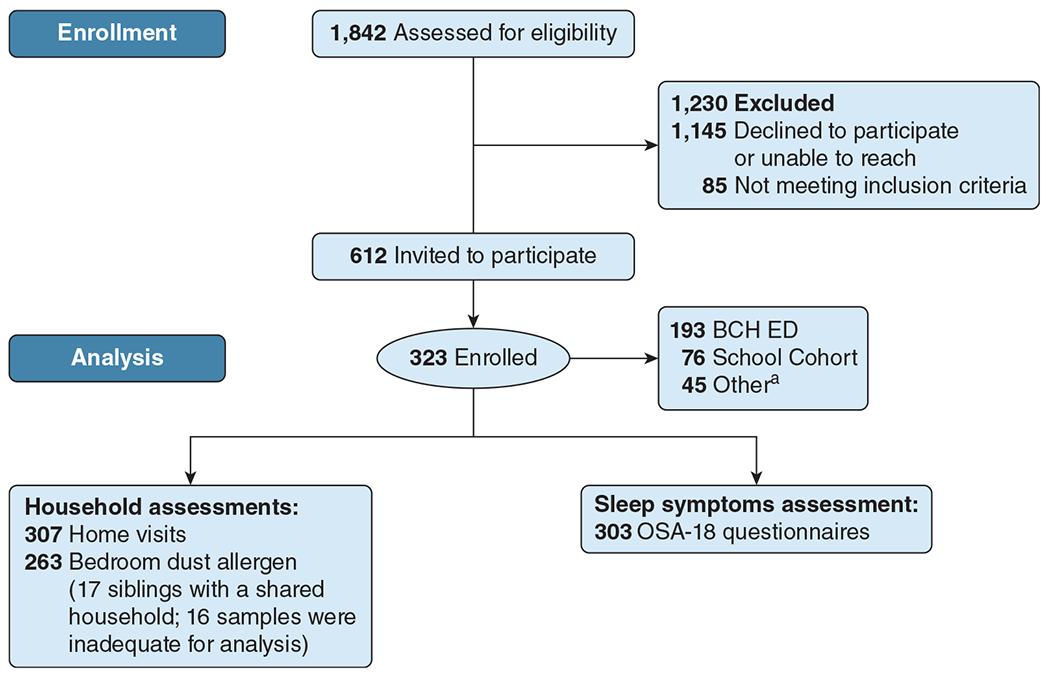
Cross-sectional analyses were performed on 303 children (aged 6-12 years) enrolled in the Environmental Assessment of Sleep Youth study from 2018 to 2022. Exposures were determined by caregiver reports, assays of measured settled dust from the child's bedroom, and neighborhood-level Census data (deriving the Childhood Opportunity Index to characterize neighborhood disadvantage). The primary outcome was the SDB-related symptom burden assessed by the OSA-18 questionnaire total score. Using linear regression models, we calculated associations between exposures and SDB-related symptom burden, adjusting for sociodemographic factors, then health conditions, indoor environment, and neighborhood factors.
RESULTS
The sample included 303 children (39% Hispanic, Latino, Latina, or Spanish origin; 30% Black or African American; 22% White; and 11% other). Increasing OSA-18 total scores were associated with low household SES after adjustment for demographic factors, and with asthma, allergies, ETS, pests (mouse, cockroach, and rodents), and an indoor environmental index (sum of the presence of pests and ETS; 0-2) after adjusting for sociodemographic factors. Even after further adjusting for asthma, allergies, and neighborhood disadvantage, ETS and pest exposure were associated with OSA-18 (ETS: β = 12.80; 95% CI, 7.07-18.53, also adjusted for pest; pest exposure: β = 3.69; 95% CI, 0.44-6.94, also adjusted for ETS).
INTERPRETATION
In addition to associations with ETS, a novel association was observed for indoor pest exposure and SDB symptom burden. Strategies to reduce household exposure to ETS and indoor allergens should be tested as approaches for reducing sleep health disparities.
背景
小儿睡眠呼吸障碍(SDB)对社会经济地位(SES)较低的儿童影响尤为严重。导致这些关联的多层次风险因素尚未得到充分理解。
研究问题
SDB风险因素之间有何关联,这些因素包括个体健康状况(肥胖、哮喘和过敏)、家庭SES(母亲教育程度)、室内暴露(环境烟草烟雾[ETS]和害虫)以及社区特征(社区劣势)与小儿SDB症状?
研究设计与方法
对2018年至2022年参与青少年睡眠环境评估研究的303名儿童(6至12岁)进行横断面分析。暴露情况由照顾者报告、对儿童卧室中测量的沉降灰尘的检测以及社区层面的人口普查数据(得出儿童机会指数以表征社区劣势)确定。主要结局是通过OSA - 18问卷总分评估的与SDB相关的症状负担。使用线性回归模型,我们计算了暴露与SDB相关症状负担之间的关联,并对社会人口学因素、健康状况、室内环境和社区因素进行了调整。
结果
样本包括303名儿童(39%为西班牙裔、拉丁裔或有西班牙血统;30%为黑人或非裔美国人;22%为白人;11%为其他)。在调整人口统计学因素后,OSA - 18总分升高与低家庭SES相关,在调整社会人口学因素后,与哮喘、过敏、ETS、害虫(老鼠、蟑螂和啮齿动物)以及室内环境指数(害虫和ETS存在情况总和;0 - 2)相关。即使在进一步调整哮喘、过敏和社区劣势后,ETS和害虫暴露仍与OSA - 18相关(ETS:β = 12.80;95% CI,7.07 - 18.53,也对害虫进行了调整;害虫暴露:β = 3.69;9% CI,0.44 - 6.94,也对ETS进行了调整)。
解读
除了与ETS的关联外,还观察到室内害虫暴露与SDB症状负担之间存在新的关联。应测试减少家庭接触ETS和室内过敏原的策略,作为减少睡眠健康差距的方法。
 Zotero 插件