
巩固性度伐利尤单抗在局部晚期非小细胞肺癌同步放化疗后增强局部区域控制对改善总生存期的贡献:来自真实世界数据的见解
Contribution of Enhanced Locoregional Control to Improved Overall Survival with Consolidative Durvalumab after Concurrent Chemoradiotherapy in Locally Advanced Non-Small Cell Lung Cancer: Insights from Real-World Data.
作者信息
Jang Jeong Yun, Song Si Yeol, Shin Young Seob, Kim Ha Un, Choi Eun Kyung, Kim Sang-We, Lee Jae Cheol, Lee Dae Ho, Choi Chang-Min, Yoon Shinkyo, Kim Su Ssan
机构信息
Department of Radiation Oncology, Konkuk University Medical Center, Konkuk University School of Medicine, Seoul, Korea.
Department of Radiation Oncology, Asan Medical Center, University of Ulsan College of Medicine, Seoul, Korea.
出版信息
Cancer Res Treat. 2024 Jul;56(3):785-794. doi: 10.4143/crt.2023.1014. Epub 2024 Jan 16.
PURPOSE
This study aimed to assess the real-world clinical outcomes of consolidative durvalumab in patients with unresectable locally advanced non-small cell lung cancer (LA-NSCLC) and to explore the role of radiotherapy in the era of immunotherapy.
MATERIALS AND METHODS
This retrospective study assessed 171 patients with unresectable LA-NSCLC who underwent concurrent chemoradiotherapy (CCRT) with or without consolidative durvalumab at Asan Medical Center between May 2018 and May 2021. Primary outcomes included freedom from locoregional failure (FFLRF), distant metastasis-free survival (DMFS), progression-free survival (PFS), and overall survival (OS).
RESULTS
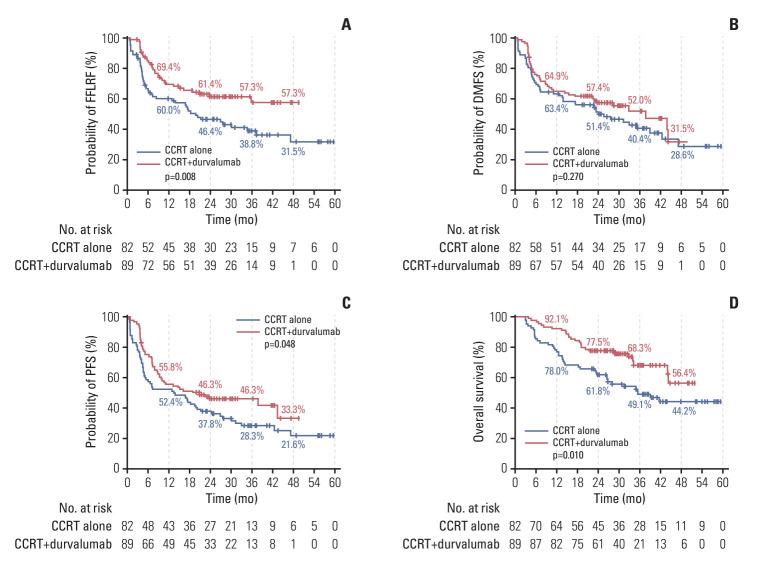
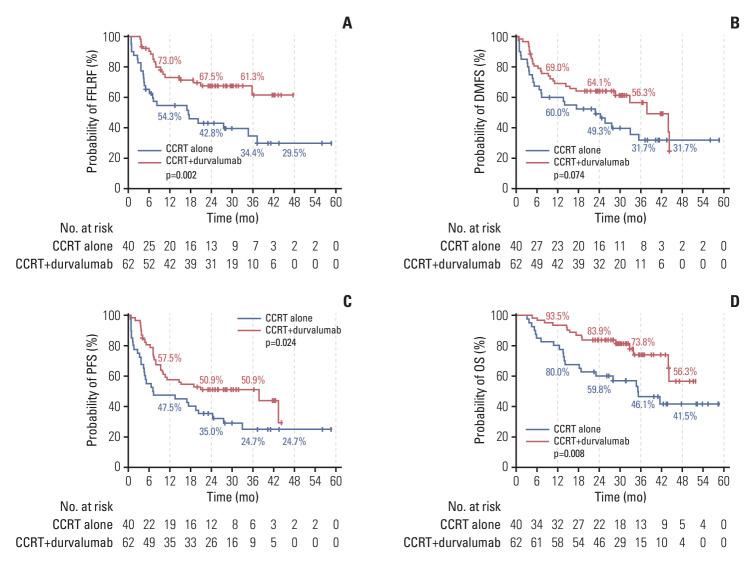
Durvalumab following CCRT demonstrated a prolonged median PFS of 20.9 months (p=0.048) and a 3-year FFLRF rate of 57.3% (p=0.008), compared to 13.7 months and 38.8%, respectively, with CCRT alone. Furthermore, the incidence of in-field recurrence was significantly greater in the CCRT-alone group compared to the durvalumab group (26.8% vs. 12.4%, p=0.027). While median OS was not reached with durvalumab, it was 35.4 months in patients receiving CCRT alone (p=0.010). Patients positive for programmed cell death ligand 1 (PD-L1) expression showed notably better outcomes, including FFLRF, DMFS, PFS, and OS. Adherence to PACIFIC trial eligibility criteria identified 100 patients (58.5%) as ineligible. The use of durvalumab demonstrated better survival regardless of eligibility criteria.
CONCLUSION
The use of durvalumab consolidation following CCRT significantly enhanced locoregional control and OS in patients with unresectable LA-NSCLC, especially in those with PD-L1-positive tumors, thereby validating the role of durvalumab in standard care.
目的
本研究旨在评估巩固性度伐利尤单抗在不可切除的局部晚期非小细胞肺癌(LA-NSCLC)患者中的真实世界临床疗效,并探讨放疗在免疫治疗时代的作用。
材料与方法
这项回顾性研究评估了2018年5月至2021年5月期间在峨山医学中心接受同步放化疗(CCRT)且接受或未接受巩固性度伐利尤单抗治疗的171例不可切除的LA-NSCLC患者。主要结局包括无局部区域失败生存期(FFLRF)、无远处转移生存期(DMFS)、无进展生存期(PFS)和总生存期(OS)。
结果
与单纯CCRT相比,CCRT后使用度伐利尤单抗的中位PFS延长至20.9个月(p=0.048),3年FFLRF率为57.3%(p=0.008),而单纯CCRT组分别为13.7个月和38.8%。此外,单纯CCRT组的野内复发率显著高于度伐利尤单抗组(26.8%对12.4%,p=0.027)。虽然度伐利尤单抗组未达到中位OS,但单纯接受CCRT的患者为35.4个月(p=0.010)。程序性细胞死亡配体1(PD-L1)表达阳性的患者在FFLRF、DMFS、PFS和OS等方面的结局明显更好。遵循PACIFIC试验纳入标准发现100例患者(58.5%)不符合标准。无论纳入标准如何,使用度伐利尤单抗均显示出更好的生存率。
结论
CCRT后使用度伐利尤单抗巩固治疗可显著增强不可切除的LA-NSCLC患者的局部区域控制和OS,尤其是PD-L1阳性肿瘤患者,从而验证了度伐利尤单抗在标准治疗中的作用。

 Zotero 插件