
白蛋白和晶体液预充策略对体外循环心脏手术中红细胞输注的影响:网状荟萃分析。
Effects of albumin and crystalloid priming strategies on red blood cell transfusions in on-pump cardiac surgery: a network meta-analysis.
机构信息
Department of Cardiopulmonary Bypass, Fuwai Hospital, National Center for Cardiovascular Disease, State Key Laboratory of Cardiovascular Medicine, Chinese Academy of Medical Sciences & Peking Union Medical College, No. 167 Beilishi Road, Xicheng District, Beijing, 10010, China.
Department of Anesthesiology, Beijing Tongren Hospital, Capital Medical University, Beijing, China.
出版信息
BMC Anesthesiol. 2024 Jan 16;24(1):26. doi: 10.1186/s12871-024-02414-y.
BACKGROUND
In on-pump cardiac surgery, the albumin priming strategy could maintain colloid osmotic pressure better than crystalloid solutions and reduce excessive perioperative fluid balance. However, a high-quality meta-analysis is required to compare the safety of these approaches in perioperative red blood cell (RBC) transfusions. Owing to limited direct evidence, we conducted a network meta-analysis (NMA) to increase the pool of studies and provide indirect evidence.
METHODS
The pre-defined primary outcomes were intraoperative and the first 24 h postoperative RBC transfusion volume in units. The pre-defined secondary outcome was postoperative blood loss (the first 24 h). We reviewed all randomized controlled trials comparing albumin, crystalloid, and artificial colloid priming strategies. Studies that only displayed pre-defined outcomes could be included. A pairwise meta-analysis was performed on studies that directly compared the pre-defined outcomes between albumin and crystalloids. Additionally, a random-effects network meta-analysis (NMA) model was employed to generate indirect evidence for the pre-defined outcomes between albumin and crystalloids.
RESULTS
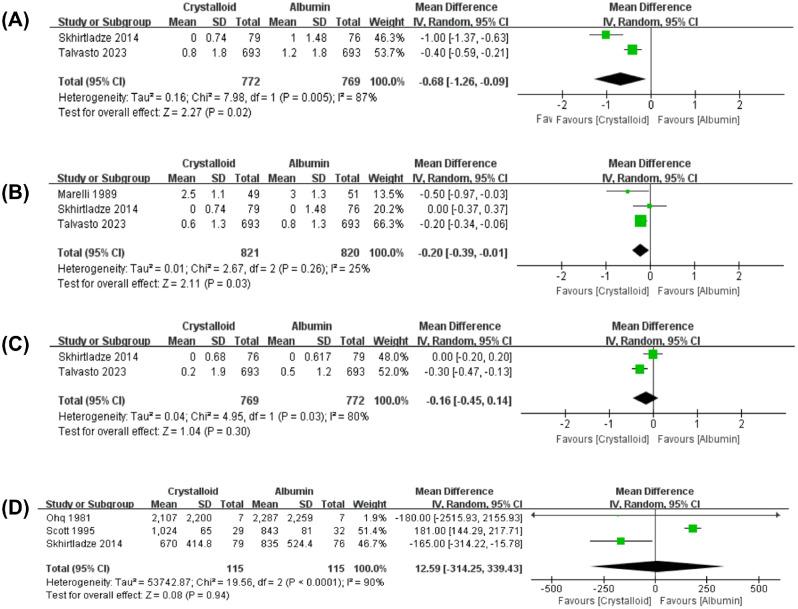
The literature search identified 830 studies,10 of which were included in the final analysis. Direct meta-analysis indicated that crystalloid priming significantly decreased total perioperative RBC transfusions (MD: -0.68U; 95%CI: -1.26, -0.09U; P = 0.02) and intraoperative RBC transfusions (MD: -0.20U; 95%CI: -0.39, -0.01U; P = 0.03) compared to albumin. Postoperative RBC transfusions showed a decreasing trend in the crystalloid group; however, the difference was not statistically significant. (MD: -0.16U; 95%CI: -0.45, 0.14U; P = 0.30). After including indirect evidence, the NMA results continued to demonstrate a higher RBC receiving with the albumin priming strategy compared to crystalloids, although the differences did not reach statistical significance. For postoperative blood loss, direct evidence showed no significant differences between albumin and crystalloid priming strategies. However, NMA evidence displayed that albumin exist higher probability of reducing postoperative blood loss than crystalloid.
CONCLUSION
Both direct and NMA evidence indicated that the albumin priming strategy resulted in more perioperative RBC transfusions than crystalloids. Considering the additional blood management burden, the application of an albumin-priming strategy in on-pump cardiac surgery still needs more consideration.
背景
在体外循环心脏手术中,白蛋白预充策略可以比晶体溶液更好地维持胶体渗透压,并减少围手术期过多的液体平衡。然而,需要进行高质量的荟萃分析来比较这些方法在围手术期红细胞(RBC)输注方面的安全性。由于直接证据有限,我们进行了网络荟萃分析(NMA),以增加研究数量并提供间接证据。
方法
预定义的主要结局是单位术中及术后 24 小时内 RBC 输注量。预定义的次要结局是术后失血(第 24 小时)。我们回顾了比较白蛋白、晶体和人工胶体预充策略的所有随机对照试验。仅显示预定义结局的研究可以纳入。对白蛋白和晶体之间直接比较预定义结局的研究进行了配对荟萃分析。此外,还采用随机效应网络荟萃分析(NMA)模型生成白蛋白和晶体之间预定义结局的间接证据。
结果
文献检索共确定了 830 项研究,其中 10 项研究纳入最终分析。直接荟萃分析表明,与白蛋白相比,晶体液预充可显著减少围手术期总 RBC 输注量(MD:-0.68U;95%CI:-1.26,-0.09U;P=0.02)和术中 RBC 输注量(MD:-0.20U;95%CI:-0.39,-0.01U;P=0.03)。晶体组术后 RBC 输注呈减少趋势,但差异无统计学意义。(MD:-0.16U;95%CI:-0.45,0.14U;P=0.30)。纳入间接证据后,NMA 结果继续表明,与晶体液相比,白蛋白预充策略接受 RBC 的可能性更高,尽管差异无统计学意义。术后出血量方面,直接证据显示白蛋白和晶体预充策略之间无显著差异。然而,NMA 证据显示白蛋白比晶体更有可能减少术后失血。
结论
直接证据和 NMA 证据均表明,白蛋白预充策略比晶体液导致更多的围手术期 RBC 输注。考虑到额外的血液管理负担,在体外循环心脏手术中应用白蛋白预充策略仍需更多考虑。



 Zotero 插件