
2010 年至 2020 年期间,俄亥俄州芬太尼对种族造成的州和县级精神兴奋剂和可卡因过量死亡率的影响:时间序列和时空分析。
The impact of fentanyl on state- and county-level psychostimulant and cocaine overdose death rates by race in Ohio from 2010 to 2020: a time series and spatiotemporal analysis.
机构信息
Division of Epidemiology, College of Public Health, The Ohio State University, Columbus, USA.
Division of Public Health Sciences, Department of Biostatistics and Data Science, Wake Forest University School of Medicine, Winston-Salem, USA.
出版信息
Harm Reduct J. 2024 Jan 17;21(1):13. doi: 10.1186/s12954-024-00936-9.
BACKGROUND
Over the past decade in the USA, increases in overdose rates of cocaine and psychostimulants with opioids were highest among Black, compared to White, populations. Whether fentanyl has contributed to the rise in cocaine and psychostimulant overdoses in Ohio is unknown. We sought to measure the impact of fentanyl on cocaine and psychostimulant overdose death rates by race in Ohio.
METHODS
We conducted time series and spatiotemporal analyses using data from the Ohio Public Health Information Warehouse. Primary outcomes were state- and county-level overdose death rates from 2010 to 2020 for Black and White populations. Measures of interest were overdoses consisting of four drug involvement classes: (1) all cocaine overdoses, (2) cocaine overdoses not involving fentanyl, (3) all psychostimulant overdoses, and (4) psychostimulant overdoses not involving fentanyl. We fit a time series model of log standardized mortality ratios (SMRs) using a Bayesian generalized linear mixed model to estimate posterior median rate ratios (RR). We conducted a spatiotemporal analysis by modeling the SMR for each drug class at the county level to characterize county-level variation over time.
RESULTS
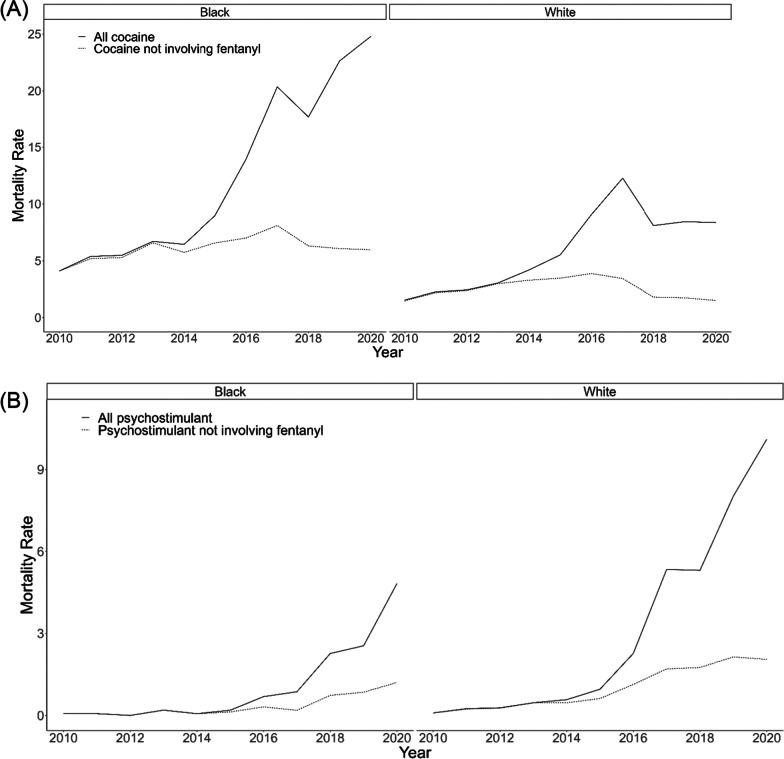
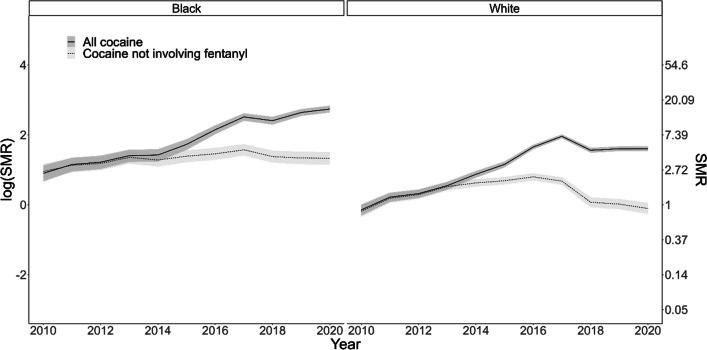
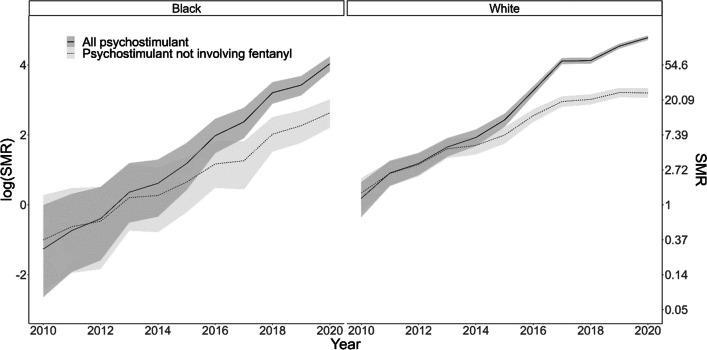
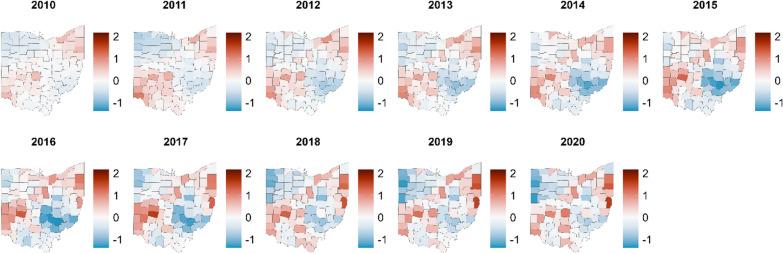
In 2020, the greatest overdose rates involved cocaine among Black (24.8 deaths/100,000 people) and psychostimulants among White (10.1 deaths/100,000 people) populations. Annual mortality rate ratios were highest for psychostimulant-involved overdoses among Black (aRR = 1.71; 95% CI (1.43, 2.02)) and White (aRR = 1.60, 95% CI (1.39, 1.80)) populations. For cocaine not involving fentanyl, annual mortality rate ratios were similar among Black (aRR = 1.04; 95% CI (0.96,1.16)) and White (aRR = 1.02; 95% CI (0.87, 1.20)) populations. Within each drug category, change over time was similar for both racial groups. The spatial models highlighted county-level variation for all drug categories.
CONCLUSIONS
Without the involvement of fentanyl, cocaine overdoses remained constant while psychostimulant overdoses increased. Tailored harm reduction approaches, such as distribution of fentanyl test strips and the removal of punitive laws that influence decisions to contact emergency services, are the first steps to reduce cocaine overdose rates involving fentanyl among urban populations in Ohio. In parallel, harm reduction policies to address the increase in psychostimulant overdoses are warranted.
背景
在过去十年中,与白人相比,美国可卡因和兴奋剂类药物的用药过量率在黑人中增长最快。在俄亥俄州,芬太尼是否导致可卡因和兴奋剂类药物用药过量增加尚不清楚。我们旨在通过种族衡量芬太尼对俄亥俄州可卡因和兴奋剂类药物用药过量死亡率的影响。
方法
我们利用俄亥俄州公共卫生信息仓库的数据,进行了时间序列和时空分析。主要结局指标是 2010 年至 2020 年黑人和白人的州和县级用药过量死亡率。感兴趣的指标是包含四种药物使用类别(1)所有可卡因用药过量,(2)不涉及芬太尼的可卡因用药过量,(3)所有兴奋剂类药物用药过量,(4)不涉及芬太尼的兴奋剂类药物用药过量。我们使用贝叶斯广义线性混合模型拟合对数标准化死亡率比(SMR)的时间序列模型,以估计后验中位数比率(RR)。我们通过对每类药物的县级 SMR 进行建模,在县级层面进行时空分析,以描述随时间的县级变化。
结果
2020 年,黑人(24.8 人/100,000 人)用药过量率最高的是可卡因,白人(10.1 人/100,000 人)用药过量率最高的是兴奋剂类药物。黑人(aRR=1.71;95%置信区间(1.43,2.02))和白人(aRR=1.60,95%置信区间(1.39,1.80))兴奋剂类药物用药过量的年死亡率比率最高。不涉及芬太尼的可卡因用药过量,黑人(aRR=1.04;95%置信区间(0.96,1.16))和白人(aRR=1.02;95%置信区间(0.87,1.20))的年死亡率比率相似。在每个药物类别中,两组的变化趋势相似。空间模型突出显示了所有药物类别的县级差异。
结论
如果不涉及芬太尼,可卡因用药过量率将保持不变,而兴奋剂类药物用药过量率将增加。减少芬太尼参与的可卡因用药过量率的第一步是采用有针对性的减少伤害方法,例如分发芬太尼检测条和取消影响联系紧急服务决策的惩罚性法律。同时,有必要采取减少兴奋剂类药物用药过量的减少伤害政策。

 Zotero 插件