
评估孕前饮食对男性生育力的影响:系统范围综述。
Assessing the influence of preconception diet on male fertility: a systematic scoping review.
机构信息
Adelaide Medical School, The University of Adelaide, Adelaide, SA, Australia.
Repromed, Dulwich, Adelaide, SA, Australia.
出版信息
Hum Reprod Update. 2024 May 2;30(3):243-261. doi: 10.1093/humupd/dmad035.
BACKGROUND
The last decade has seen increased research on the relationship between diet and male fertility, but there are no clearly defined nutritional recommendations for men in the preconception period to support clinical fertility outcomes.
OBJECTIVE AND RATIONALE
The purpose of this scoping review is to examine the extent and range of research undertaken to evaluate the effect(s) of diet in the preconception period on male clinical fertility and reproductive outcomes.
SEARCH METHODS
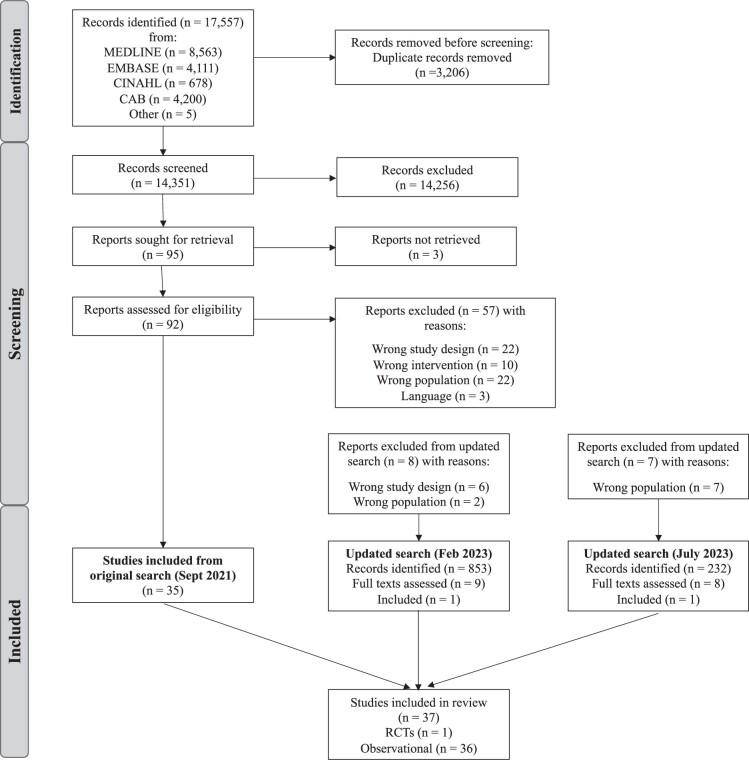
Four electronic databases (MEDLINE and EMBASE via Ovid, CAB Direct, and CINAHL via EBSCO) were searched from inception to July 2023 for randomized controlled trials (RCTs) and observational studies (prospective/retrospective, case-control, and cross-sectional). Intervention studies in male participants or couples aiming to achieve dietary or nutritional change, or non-intervention studies examining dietary or nutritional components (whole diets, dietary patterns, food groups or individual foods) in the preconception period were included. Controls were defined as any comparison group for RCTs, and any/no comparison for observational studies. Primary outcomes of interest included the effect(s) of male preconception diet on clinical outcomes such as conception (natural or via ART), pregnancy rates and live birth rates. Secondary outcomes included time to conception and sperm parameters.
OUTCOMES
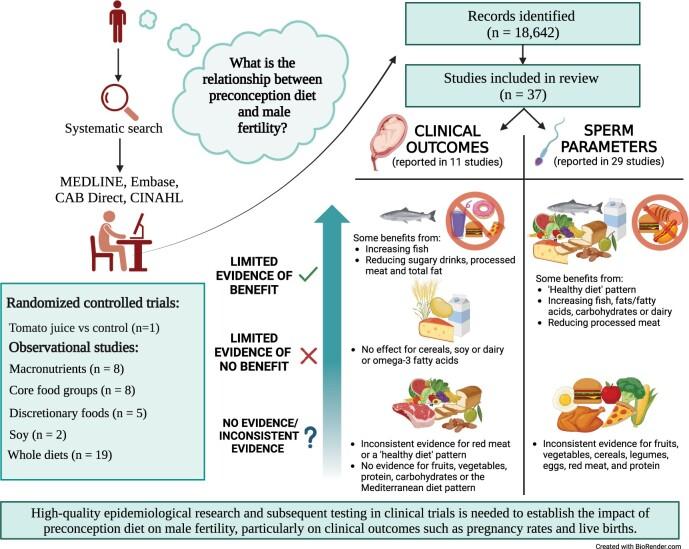
A total of 37 studies were eligible, including one RCT and 36 observational studies (prospective, cross-sectional, and case-control studies; four studies in non-ART populations) published between 2008 and 2023. Eight reported clinical outcomes, 26 reported on secondary outcomes, and three reported on both. The RCT did not assess clinical outcomes but found that tomato juice may benefit sperm motility. In observational studies, some evidence suggested that increasing fish or reducing sugar-sweetened beverages, processed meat or total fat may improve fecundability. Evidence for other clinical outcomes, such as pregnancy rates or live birth rates, showed no relationship with cereals, soy and dairy, and inconsistent relationships with consuming red meat or a 'healthy diet' pattern. For improved sperm parameters, limited evidence supported increasing fish, fats/fatty acids, carbohydrates and dairy, and reducing processed meat, while the evidence for fruits, vegetables, cereals, legumes, eggs, red meat and protein was inconsistent. Healthy diet patterns in general were shown to improve sperm health.
WIDER IMPLICATIONS
Specific dietary recommendations for improving male fertility are precluded by the lack of reporting on clinical pregnancy outcomes, heterogeneity of the available literature and the paucity of RCTs to determine causation or to rule out reverse causation. There may be some benefit from increasing fish, adopting a healthy dietary pattern, and reducing consumption of sugar-sweetened beverages and processed meat, but it is unclear whether these benefits extend beyond sperm parameters to improve clinical fertility. More studies exploring whole diets rather than singular foods or nutritional components in the context of male fertility are encouraged, particularly by means of RCTs where feasible. Further assessment of core fertility outcomes is warranted and requires careful planning in high-quality prospective studies and RCTs. These studies can lay the groundwork for targeted dietary guidelines and enhance the prospects of successful fertility outcomes for men in the preconception period. Systematic search of preconception diet suggests that increasing fish and reducing sugary drinks, processed meats and total fat may improve male fertility, while consuming healthy diets, fish, fats/fatty acids, carbohydrates and dairy and reducing processed meat can improve sperm health.
背景
过去十年,人们对饮食与男性生育力之间的关系进行了大量研究,但对于男性在受孕前阶段的饮食,尚无明确的营养建议来支持临床生育结果。
目的和理由
本次范围综述的目的是评估在受孕前阶段饮食对男性临床生育力和生殖结果的影响所进行的研究的广度和范围。
检索方法
从各数据库(Ovid 中的 MEDLINE 和 EMBASE、EBSCO 中的 CAB Direct 和 CINAHL)检索从建库至 2023 年 7 月的随机对照试验(RCT)和观察性研究(前瞻性/回顾性、病例对照和横断面研究)。纳入的干预性研究为男性参与者或夫妇旨在实现饮食或营养改变的研究,或非干预性研究为在受孕前阶段检查饮食或营养成分(整体饮食、饮食模式、食物组或单个食物)的研究。对照组定义为 RCT 的任何对照,和观察性研究的任何/无对照。主要结局为男性受孕前饮食对临床结局(自然或通过 ART 受孕)、妊娠率和活产率的影响。次要结局包括受孕时间和精子参数。
结果
共有 37 项研究符合纳入标准,包括一项 RCT 和 36 项观察性研究(前瞻性、横断面和病例对照研究;四项非 ART 人群的研究),发表于 2008 年至 2023 年之间。8 项研究报告了临床结局,26 项研究报告了次要结局,3 项研究报告了两者。RCT 并未评估临床结局,但发现番茄汁可能有益于精子活力。在观察性研究中,一些证据表明增加鱼类或减少含糖饮料、加工肉类或总脂肪可能会提高生育力。其他临床结局(如妊娠率或活产率)的证据与谷物、大豆和乳制品之间没有关系,与食用红肉或“健康饮食”模式的关系也不一致。对于改善精子参数,有限的证据支持增加鱼类、脂肪/脂肪酸、碳水化合物和乳制品,减少加工肉类,而水果、蔬菜、谷物、豆类、鸡蛋、红肉和蛋白质的证据则不一致。一般而言,健康的饮食模式被证明可以改善精子健康。
意义
由于缺乏关于临床妊娠结局的报告、现有文献的异质性以及 RCT 确定因果关系或排除反向因果关系的数量不足,特定的饮食建议来改善男性生育力是不可能的。增加鱼类摄入、采用健康的饮食模式、减少含糖饮料和加工肉类的摄入可能会带来一些益处,但尚不清楚这些益处是否会超出精子参数,以改善临床生育力。鼓励更多的研究探索男性生育力背景下的整体饮食,而不是单一食物或营养成分,特别是在可行的情况下进行 RCT。进一步评估核心生育结局是必要的,需要在高质量的前瞻性研究和 RCT 中进行精心规划。这些研究可以为有针对性的饮食指南奠定基础,并提高男性在受孕前阶段成功生育的前景。
 Zotero 插件