
游离 DNA 水平与 COPD 加重和死亡率相关。
Cell-free DNA levels associate with COPD exacerbations and mortality.
机构信息
Department of Medicine, Division of Cardiology, Center for Metabolism and Mitochondrial Medicine, University of Pittsburgh School of Medicine, 200 Lothrop Street BST W1044, Pittsburgh, PA, 15261, USA.
Department of Medicine, Division of Pulmonary, Allergy and Critical Care Medicine, University of Pittsburgh School of Medicine, Pittsburgh, PA, USA.
出版信息
Respir Res. 2024 Jan 18;25(1):42. doi: 10.1186/s12931-023-02658-1.
THE QUESTION ADDRESSED BY THE STUDY
Good biological indicators capable of predicting chronic obstructive pulmonary disease (COPD) phenotypes and clinical trajectories are lacking. Because nuclear and mitochondrial genomes are damaged and released by cigarette smoke exposure, plasma cell-free mitochondrial and nuclear DNA (cf-mtDNA and cf-nDNA) levels could potentially integrate disease physiology and clinical phenotypes in COPD. This study aimed to determine whether plasma cf-mtDNA and cf-nDNA levels are associated with COPD disease severity, exacerbations, and mortality risk.
MATERIALS AND METHODS
We quantified mtDNA and nDNA copy numbers in plasma from participants enrolled in the Evaluation of COPD Longitudinally to Identify Predictive Surrogate Endpoints (ECLIPSE, n = 2,702) study and determined associations with relevant clinical parameters.
RESULTS
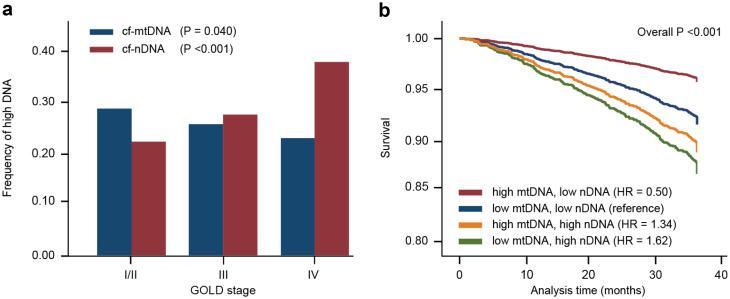
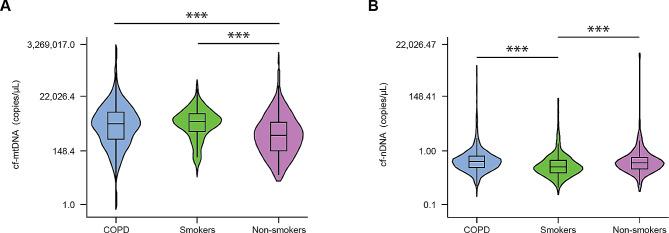
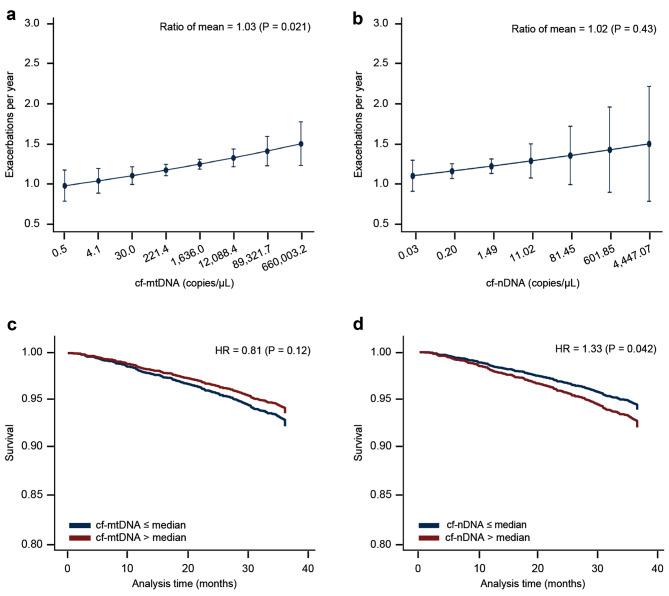
Of the 2,128 participants with COPD, 65% were male and the median age was 64 (interquartile range, 59-69) years. During the baseline visit, cf-mtDNA levels positively correlated with future exacerbation rates in subjects with mild/moderate and severe disease (Global Initiative for Obstructive Lung Disease [GOLD] I/II and III, respectively) or with high eosinophil count (≥ 300). cf-nDNA positively associated with an increased mortality risk (hazard ratio, 1.33 [95% confidence interval, 1.01-1.74] per each natural log of cf-nDNA copy number). Additional analysis revealed that individuals with low cf-mtDNA and high cf-nDNA abundance further increased the mortality risk (hazard ratio, 1.62 [95% confidence interval, 1.16-2.25] per each natural log of cf-nDNA copy number).
ANSWER TO THE QUESTION
Plasma cf-mtDNA and cf-nDNA, when integrated into quantitative clinical measurements, may aid in improving COPD severity and progression assessment.
本研究旨在探讨
缺乏能够预测慢性阻塞性肺疾病(COPD)表型和临床轨迹的良好生物标志物。由于核和线粒体基因组受到香烟烟雾暴露的破坏和释放,血浆无细胞线粒体和核 DNA(cf-mtDNA 和 cf-nDNA)水平可能整合 COPD 中的疾病生理学和临床表型。本研究旨在确定血浆 cf-mtDNA 和 cf-nDNA 水平是否与 COPD 疾病严重程度、加重和死亡风险相关。
我们在评估 COPD 纵向以确定预测替代终点(ECLIPSE)研究中定量了参与者血浆中的 mtDNA 和 nDNA 拷贝数,并确定了与相关临床参数的关联。在 2128 名 COPD 患者中,65%为男性,中位年龄为 64(四分位距,59-69)岁。在基线就诊时,cf-mtDNA 水平与轻度/中度和重度疾病(全球倡议性阻塞性肺病[GOLD] I/II 和 III)或高嗜酸性粒细胞计数(≥300)患者未来加重率呈正相关。cf-nDNA 与死亡率风险增加呈正相关(风险比,1.33 [95%置信区间,1.01-1.74] 每增加一个自然对数 cf-nDNA 拷贝数)。进一步分析显示,cf-mtDNA 水平低和 cf-nDNA 丰度高的个体进一步增加了死亡风险(风险比,1.62 [95%置信区间,1.16-2.25] 每增加一个自然对数 cf-nDNA 拷贝数)。
血浆 cf-mtDNA 和 cf-nDNA,当整合到定量临床测量中时,可能有助于改善 COPD 严重程度和进展评估。

 Zotero 插件