
靶向细胞外羟基磷灰石的新型药物肿瘤治疗:范式转变。
Tumor therapy by targeting extracellular hydroxyapatite using novel drugs: A paradigm shift.
机构信息
Vanderbilt University Institute of Imaging Science, Vanderbilt University Medical Center, Nashville, Tennessee, USA.
Departments of Radiology and Radiological Sciences, Vanderbilt Univerity Medical Center, Nashville, Tennessee, USA.
出版信息
Cancer Med. 2024 Feb;13(3):e6812. doi: 10.1002/cam4.6812. Epub 2024 Jan 18.
BACKGROUND
It has been shown that tumor microenvironment (TME) hydroxyapatite (HAP) is typically associated with many malignancies and plays a role in tumor progression and growth. Additionally, acidosis in the TME has been reported to play a key role in selecting for a more aggressive tumor phenotype, drug resistance and desensitization to immunotherapy for many types of cancers. TME-HAP is an attractive target for tumor detection and treatment development since HAP is generally absent from normal soft tissue. We provide strong evidence that dissolution of hydroxyapatite (HAP) within the tumor microenvironment (TME-HAP) using a novel therapeutic can be used to kill cancer cells both in vitro and in vivo with minimal adverse effects.
METHODS
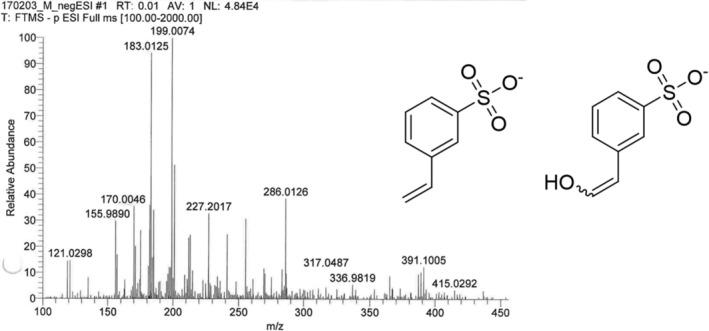
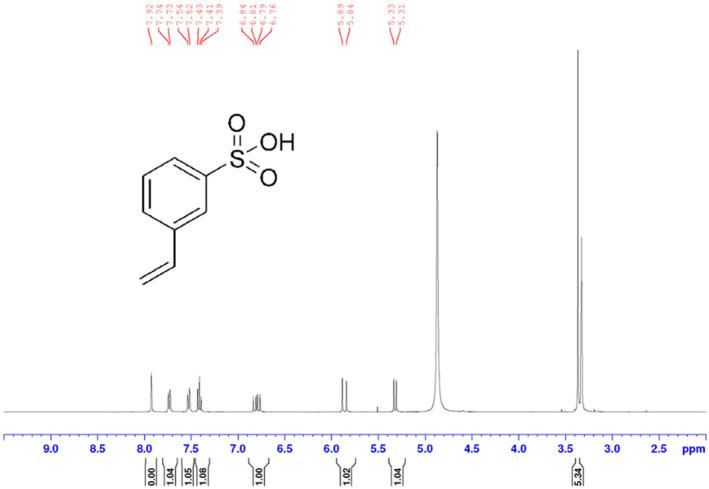
We developed an injectable cation exchange nano particulate sulfonated polystyrene solution (NSPS) that we engineered to dissolve TME-HAP, inducing localized acute alkalosis and inhibition of tumor growth and glucose metabolism. This was evaluated in cell culture using 4T1, MDA-MB-231 triple negative breast cancer cells, MCF10 normal breast cells, and H292 lung cancer cells, and in vivo using orthotopic mouse models of cancer that contained detectable microenvironment HAP including breast (MMTV-Neu, 4T1, and MDA-MB-231), prostate (PC3) and colon (HCA7) cancer using F-NaF for HAP and F-FDG for glucose metabolism with PET imaging. On the other hand, H292 lung tumor cells that lacked detectable microenvironment HAP and MCF10a normal breast cells that do not produce HAP served as negative controls. Tumor microenvironment pH levels following injection of NSPS were evaluated via Chemical Exchange Saturation (CEST) MRI and via ex vivo methods.
RESULTS
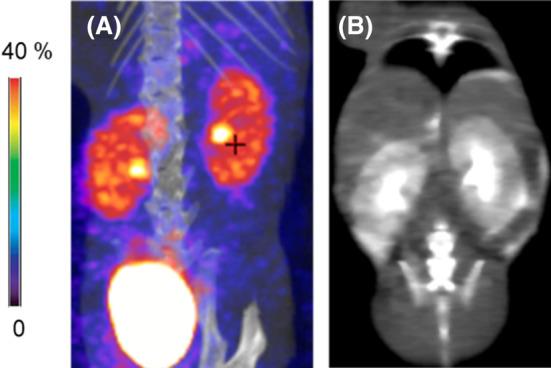
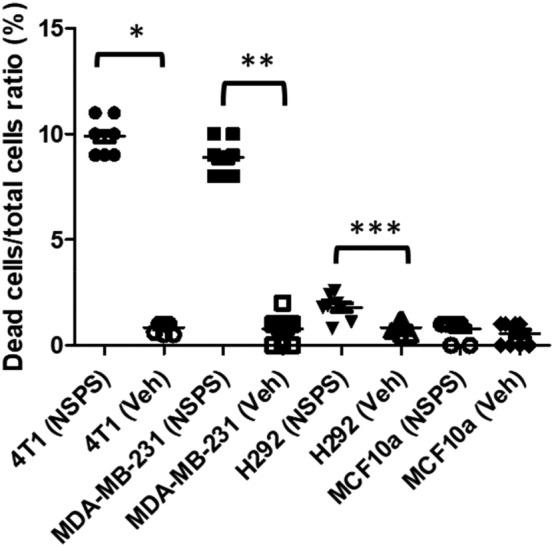
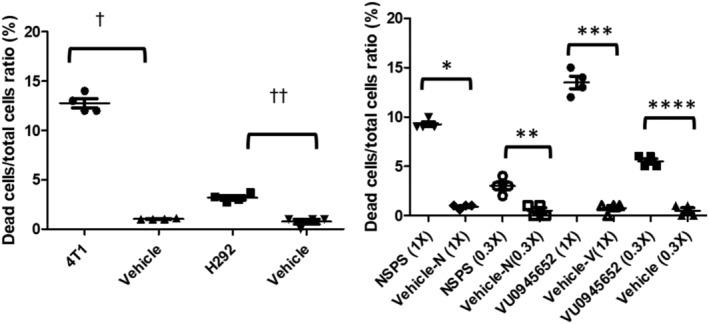
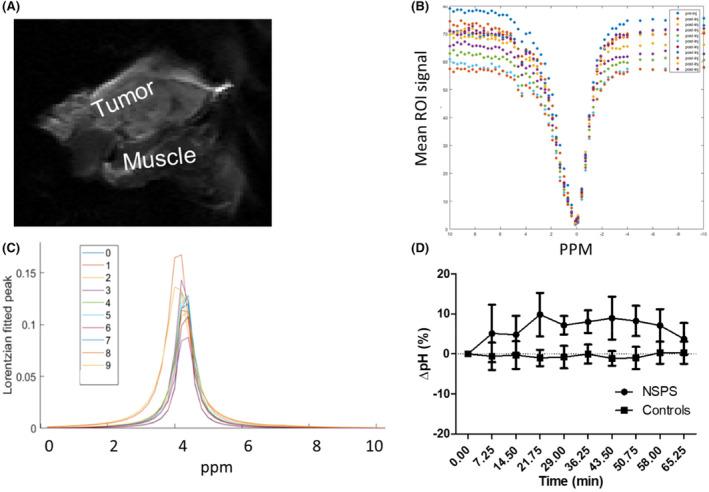
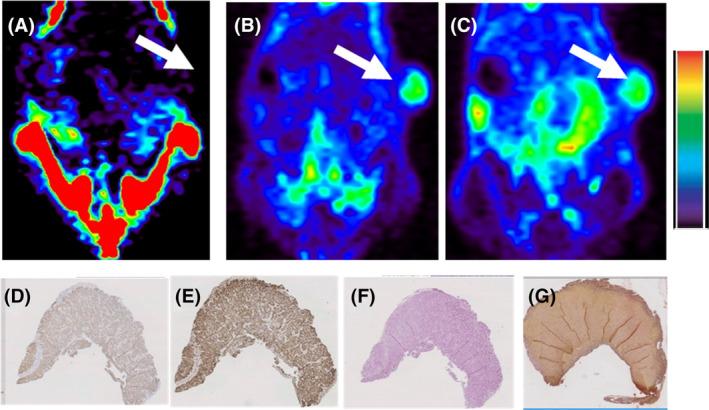
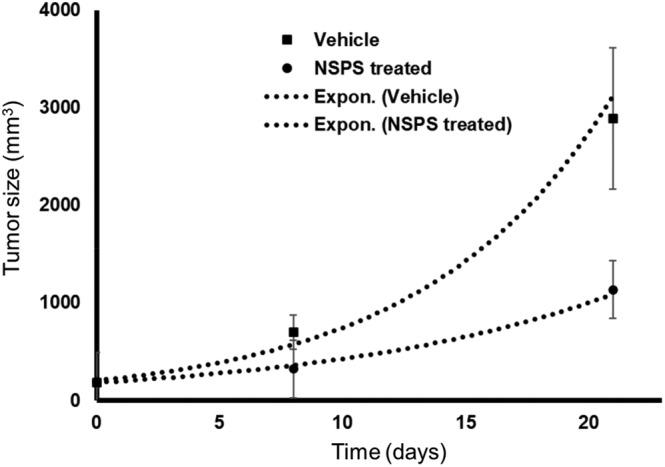
Within 24 h of adding the small concentration of 1X of NSPS (7 μM), we observed significant tumor cell death ( 10%, p < 0.05) in 4T1 and MDA-MB-231 cell cultures that contain HAP but ⟨2% in H292 and MCF10a cells that lack detectable HAP and in controls. Using CEST MRI, we found extracellular pH (pHe) in the 4T1 breast tumors, located in the mammary fat pad, to increase by nearly 10% from baseline before gradually receding back to baseline during the first hour post NSPS administration. in the tumors that contained TME-HAP in mouse models, MMTV-Neu, 4T1, and MDA-MB-231, PC3, and HCA7, there was a significant reduction (p<0.05) in F-Na Fuptake post NSPS treatment as expected; F uptake in the tumor = 3.8 ± 0.5 %ID/g (percent of the injected dose per gram) at baseline compared to 1.8 ±0.5 %ID/g following one-time treatment with 100 mg/kg NSPS. Of similar importance, is that F-FDG uptake in the tumors was reduced by more than 75% compared to baseline within 24 h of treatment with one-time NSPS which persisted for at least one week. Additionally, tumor growth was significantly slower (p < 0.05) in the mice treated with one-time NSPS. Toxicity showed no evidence of any adverse effects, a finding attributed to the absence of HAP in normal soft tissue and to our therapeutic NSPS having limited penetration to access HAP within skeletal bone.
CONCLUSION
Dissolution of TME-HAP using our novel NSPS has the potential to provide a new treatment paradigm to enhance the management of cancer patients with poor prognosis.
背景
已经表明肿瘤微环境(TME)羟基磷灰石(HAP)通常与许多恶性肿瘤有关,并在肿瘤的进展和生长中发挥作用。此外,据报道,TME 的酸中毒在选择更具侵袭性的肿瘤表型、耐药性和对许多类型癌症的免疫治疗脱敏方面发挥着关键作用。TME-HAP 是肿瘤检测和治疗发展的一个有吸引力的目标,因为 HAP 通常不存在于正常软组织中。我们提供了强有力的证据,即使用新型治疗剂溶解肿瘤微环境中的羟基磷灰石(TME-HAP)可用于杀死体外和体内的癌细胞,同时最小化不良反应。
方法
我们开发了一种可注射的阳离子交换纳米颗粒磺化聚苯乙烯溶液(NSPS),我们设计该溶液可溶解 TME-HAP,在局部引发急性碱中毒,并抑制肿瘤生长和葡萄糖代谢。在细胞培养中,使用 4T1、MDA-MB-231 三阴性乳腺癌细胞、MCF10 正常乳腺细胞和 H292 肺癌细胞进行了评估,并在包含可检测微环境 HAP 的原位小鼠模型中进行了评估,包括乳腺(MMTV-Neu、4T1 和 MDA-MB-231)、前列腺(PC3)和结肠(HCA7)癌症,使用 F-NaF 检测 HAP 和 F-FDG 检测葡萄糖代谢,使用 PET 成像。另一方面,H292 肺癌细胞缺乏可检测的微环境 HAP,MCF10a 正常乳腺细胞不产生 HAP,用作阴性对照。用 NSPS 注射后,通过化学交换饱和(CEST)MRI 和离体方法评估肿瘤微环境 pH 值。
结果
在添加 1X 低浓度 NSPS(约 7μM)后的 24 小时内,我们观察到含有 HAP 的 4T1 和 MDA-MB-231 细胞培养物中的肿瘤细胞死亡显著(约 10%,p<0.05),但在缺乏可检测 HAP 的 H292 和 MCF10a 细胞中仅为 ⟨2%,在缺乏 HAP 的对照组中为 ⟨2%。使用 CEST MRI,我们发现位于乳腺脂肪垫中的 4T1 乳腺肿瘤的细胞外 pH(pHe)从基线增加了近 10%,然后在 NSPS 给药后第一个小时逐渐回落到基线。在含有 TME-HAP 的小鼠模型中,MMTV-Neu、4T1 和 MDA-MB-231、PC3 和 HCA7 肿瘤中,预期 NSPS 治疗后 F-NaF 摄取显著减少(p<0.05);肿瘤中的 F 摄取基线时为 3.8 ± 0.5%ID/g(每克注射剂量的百分比),与单次使用 100 mg/kg NSPS 治疗后 1.8 ± 0.5%ID/g 相比。同样重要的是,与基线相比,在单次 NSPS 治疗后 24 小时内肿瘤内的 F-FDG 摄取减少了 75%以上,并且至少持续了一周。此外,单次 NSPS 治疗的小鼠肿瘤生长明显较慢(p<0.05)。毒性未显示出任何不良反应的迹象,这一发现归因于正常软组织中不存在 HAP,以及我们的治疗性 NSPS 有限渗透到骨骼中以接触 HAP。
结论
使用我们的新型 NSPS 溶解 TME-HAP 有可能为改善预后不良的癌症患者的治疗提供新的治疗模式。


 Zotero 插件