
维生素 C、氢化可的松和硫胺素在儿童感染性休克复苏中的应用:一项多中心随机试验研究。
Resuscitation With Vitamin C, Hydrocortisone, and Thiamin in Children With Septic Shock: A Multicenter Randomized Pilot Study.
机构信息
Child Health Research Centre, The University of Queensland, Brisbane, QLD, Australia.
Paediatric Intensive Care Unit, Queensland Children's Hospital, Children's Health Queensland, Brisbane, QLD, Australia.
出版信息
Pediatr Crit Care Med. 2024 Feb 1;25(2):159-170. doi: 10.1097/PCC.0000000000003346. Epub 2024 Jan 19.
OBJECTIVES
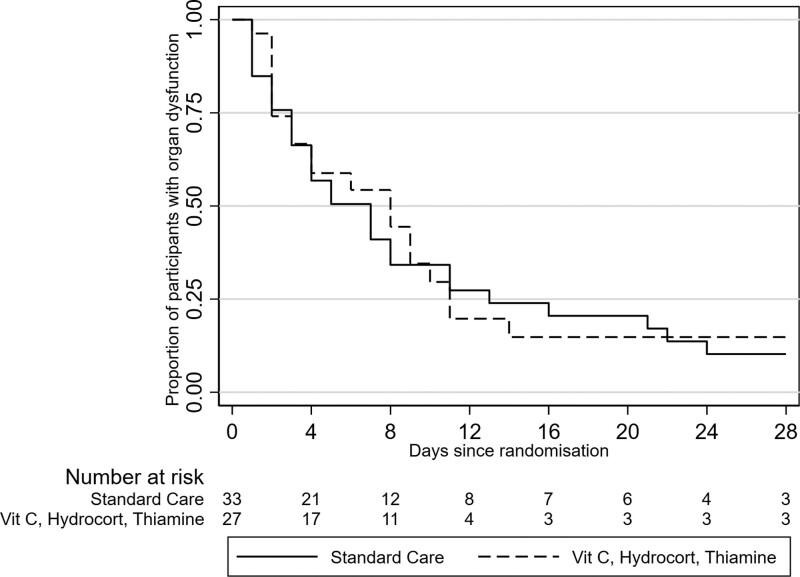
Adjunctive therapy with vitamin C, hydrocortisone, and thiamin has been evaluated in adults, but randomized controlled trial (RCT) data in children are lacking. We aimed to test the feasibility of vitamin C, hydrocortisone, and thiamin in PICU patients with septic shock; and to explore whether the intervention is associated with increased survival free of organ dysfunction.
DESIGN
Open-label parallel, pilot RCT multicenter study. The primary endpoint was feasibility. Clinical endpoints included survival free of organ dysfunction censored at 28 days and nine secondary outcomes, shock reversal, and two proxy measures of intervention efficacy.
SETTING
Six PICUs in Australia and New Zealand.
PATIENTS
Children of age between 28 days and 18 years requiring vasoactive drugs for septic shock between August 2019 and March 2021.
INTERVENTIONS
Patients were assigned 1:1 to receive 1 mg/kg hydrocortisone every 6 hours (q6h), 30 mg/kg ascorbic acid q6h, and 4 mg/kg thiamin every 12 hours (n = 27), or standard septic shock management (n = 33).
MEASUREMENTS AND MAIN RESULTS
Sixty of 77 (78%) eligible patients consented with 91% of approached parents providing consent. The median time from randomization to intervention was 44 (interquartile range [IQR] 29-120) min. Seventy of seventy-seven (28%) patients had received IV steroids before randomization. Median survival alive and free of organ dysfunction was 20.0 (0.0-26.0) days in the intervention and 21.0 (0.0-25.0) days in the standard care group. Median PICU length of stay was 5.3 (2.5-11.3) days in the intervention group versus 6.9 (3.0-11.5) days in the control group. Shock reversal occurred at a median of 35.2 (14.6-101.2) hours in the intervention group versus 47.3 (22.4-106.8) hours in the standard care group (median difference -12 hr; 95% CI, -56.8 to 32.7 hr).
CONCLUSIONS
In children requiring vasopressors for septic shock, a protocol comparing adjunctive treatment with high-dose vitamin C, hydrocortisone, and thiamin versus standard care was feasible. These findings assist in making modifications to the trial protocol to enable a better-designed larger RCT.
目的
维生素 C、氢化可的松和硫胺素的辅助治疗已在成人中进行了评估,但缺乏儿童随机对照试验(RCT)的数据。我们旨在测试维生素 C、氢化可的松和硫胺素在儿科重症监护病房(PICU)患有败血症性休克的患者中的可行性;并探讨该干预措施是否与无器官功能障碍的生存率增加有关。
设计
开放标签平行、试点 RCT 多中心研究。主要终点是可行性。临床终点包括 28 天无器官功能障碍的生存,并以 9 个次要结局、休克逆转和干预疗效的两个替代指标进行校正。
地点
澳大利亚和新西兰的 6 个儿科重症监护病房。
患者
年龄在 28 天至 18 岁之间,需要血管活性药物治疗败血症性休克的患者,纳入时间为 2019 年 8 月至 2021 年 3 月。
干预措施
患者按 1:1 随机分配接受 1mg/kg 氢化可的松每 6 小时(q6h)、30mg/kg 抗坏血酸 q6h 和 4mg/kg 硫胺素每 12 小时(n=27)或标准败血症休克管理(n=33)。
测量和主要结果
77 名符合条件的患者中有 60 名(78%)同意,91%的入组父母同意。从随机分组到干预的中位时间为 44(四分位距 [IQR] 29-120)分钟。77 名患者中有 28%(28%)在随机分组前接受了 IV 类固醇治疗。干预组中位生存时间无器官功能障碍为 20.0(0.0-26.0)天,标准治疗组为 21.0(0.0-25.0)天。干预组儿科重症监护病房的中位住院时间为 5.3(2.5-11.3)天,对照组为 6.9(3.0-11.5)天。干预组休克逆转的中位时间为 35.2(14.6-101.2)小时,对照组为 47.3(22.4-106.8)小时(中位差值-12 小时;95%CI,-56.8 至 32.7 小时)。
结论
在需要血管加压药物治疗败血症性休克的儿童中,与标准治疗相比,比较辅助治疗高剂量维生素 C、氢化可的松和硫胺素与标准治疗的方案是可行的。这些发现有助于对试验方案进行修改,以便进行更好设计的更大规模 RCT。

 Zotero 插件