
居住地址加剧了糖尿病足溃疡患者的健康差距和感染风险。
Residential Address Amplifies Health Disparities and Risk of Infection in Individuals With Diabetic Foot Ulcers.
机构信息
Division of Metabolism, Endocrinology, and Diabetes, Department of Internal Medicine, University of Michigan Health, Ann Arbor, MI.
Department of Biostatistics, School of Public Health, University of Michigan, Ann Arbor, MI.
出版信息
Diabetes Care. 2024 Mar 1;47(3):508-515. doi: 10.2337/dc23-1787.
OBJECTIVE
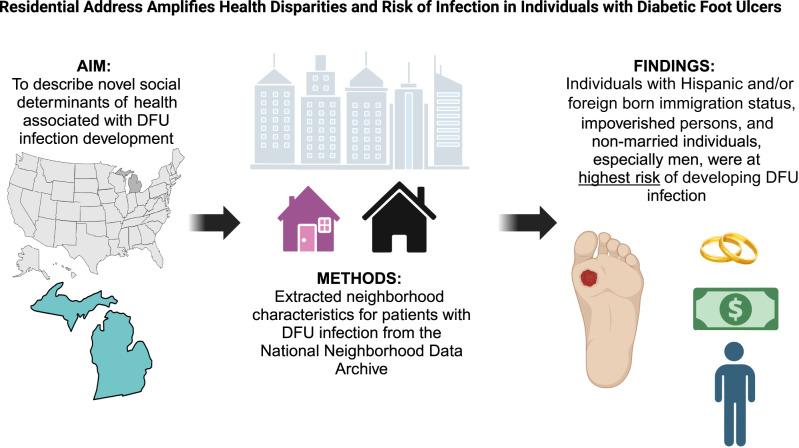
To determine the association between social determinants of health (SDOH) and a diagnosis of diabetic foot ulcer (DFU) infection.
RESEARCH DESIGN AND METHODS
Targeted interrogation of electronic health record data using novel search engines to analyze individuals with a DFU infection during a 5-year period (2013-2017) was performed. We extracted geolocated neighborhood data and SDOH characteristics from the National Neighborhood Data Archive and used univariate and multiple logistic regression to evaluate associations with outcomes in the population with diabetes.
RESULTS
Among 4.3 million people overall and 144,564 individuals with diabetes seen between 2013 and 2017, 8,351 developed DFU, of which cases 2,252 were complicated by a DFU infection. Sex interactions occurred, as men who experienced a DFU infection more frequently identified as having nonmarried status than their female counterparts. For the population with DFU infection, there were higher rates for other SDOH, including higher neighborhood disadvantaged index score, poverty, nonmarriage, and less access to physician/allied health professionals (all P < 0.01). In multiple logistic regression, those individuals who developed DFU infection came from neighborhoods with greater Hispanic and/or foreign-born concentrations (odds ratio 1.11, P = 0.015).
CONCLUSIONS
We found significant differences in neighborhood characteristics driving a higher risk for DFU infection in comparisons with the grouping of individuals with diabetes overall, including increased risk for individuals with Hispanic and/or foreign-born immigration status. These data strongly support the need to incorporate SDOH, particularly ethnic and immigration status, into triage algorithms for DFU risk stratification to prevent severe diabetic foot complications and move beyond biologic-only determinants of health.
目的
确定健康的社会决定因素(SDOH)与糖尿病足溃疡(DFU)感染诊断之间的关联。
研究设计和方法
使用新型搜索引擎对电子健康记录数据进行靶向查询,以分析在 5 年期间(2013-2017 年)患有 DFU 感染的个体。我们从国家邻里数据档案中提取地理位置邻里数据和 SDOH 特征,并使用单变量和多变量逻辑回归来评估与糖尿病人群结局的关联。
结果
在总计 430 万人和 2013 年至 2017 年间就诊的 144564 名糖尿病患者中,有 8351 人发展为 DFU,其中 2252 例为 DFU 感染并发症。存在性别交互作用,因为患有 DFU 感染的男性比女性更频繁地被确定为未婚状态。对于患有 DFU 感染的人群,其他 SDOH 的发生率更高,包括邻里劣势指数得分更高、贫困、未婚和获得医生/联合健康专业人员的机会减少(均 P <0.01)。在多变量逻辑回归中,那些发展为 DFU 感染的个体来自具有更高西班牙裔和/或外国出生人口比例的邻里(比值比 1.11,P = 0.015)。
结论
我们发现,与糖尿病整体人群相比,邻里特征存在显著差异,导致 DFU 感染风险更高,包括具有西班牙裔和/或外国出生移民身份的个体风险增加。这些数据强烈支持将 SDOH,特别是种族和移民身份,纳入 DFU 风险分层的分诊算法,以预防严重的糖尿病足并发症,并超越健康的生物学决定因素。

 Zotero 插件