
考虑到收入水平的调节作用,孝道对中国居民主观幸福感的影响。
Impact of filial piety on residents' subjective well-being in China considering the moderating effect of income level.
机构信息
School of History and Culture, Lanzhou University, Lanzhou, China.
出版信息
Medicine (Baltimore). 2024 Jan 19;103(3):e36983. doi: 10.1097/MD.0000000000036983.
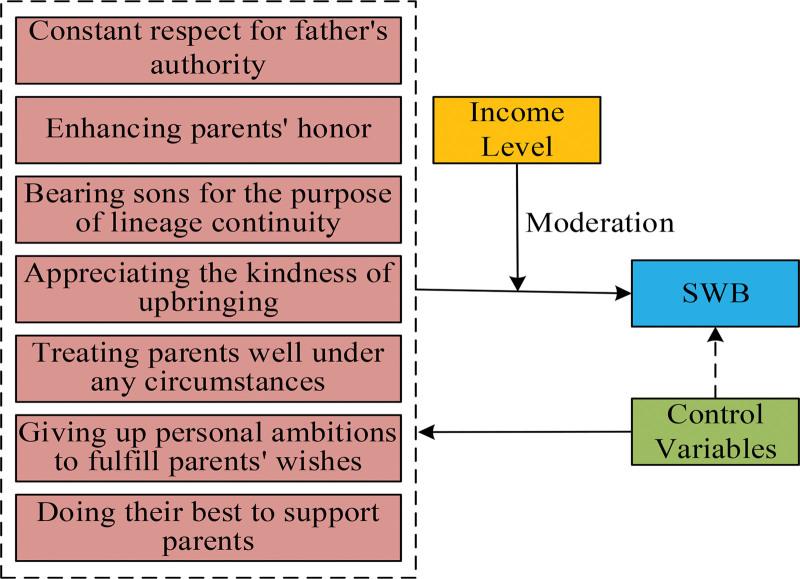
Subjective well-being (SWB) reflects an individual's subjective evaluation of overall life satisfaction and healthcare situation. As one of the most important concepts in traditional Chinese culture, filial piety refers to an ancient and significant ethical concept that originates from traditional Chinese culture. Filial piety emphasizes the respect, care, and filial devotion of children towards their parents, and has a complex influence on SWB. Moreover, in the context of rapid economic development, an individual's income level significantly moderates the influence of filial piety. Revealing the influence of different types of filial piety on SWB is of great significance for enhancing residents' SWB. However, existing studies rarely touch upon this topic. Therefore, this paper focuses on the 7 kinds of filial piety, establishes an ordered logit model based on the data from the China General Social Survey, and analyzes the influence of these 7 kinds of filial piety on SWB. On this basis, this study analyzes the moderating effect of income level. Finally, it further analyzes the regional heterogeneity of China in the influence of filial piety. Concepts such as constant respect for father's authority, enhancing parents' honor, and bearing sons for the purpose of lineage continuity, have negative impact on SWB. Superior economic conditions can neutralize and salvage these concepts to a certain extent, but they are ultimately negative. In regions with a minority population such as the 4 northeastern provinces, Inner Mongolia, Gansu, Ningxia, and Xinjiang, these concepts can increase SWB, which is restricted by the local economic level and might just be a transitional form of insufficient development. appreciating the kindness of upbringing; treating parents well under any circumstances; giving up personal ambitions to fulfill parents' wishes, positively influence individual SWB, especially when income is substantial. The research results indicate that different type of filial piety has different impacts on SWB; income level has a significant moderating effect; and there are significant regional heterogeneities in the influence of filial piety. The results of this study provide a theoretical basis and reference for enhancing residents' SWB.
主观幸福感(SWB)反映了个体对整体生活满意度和医疗保健状况的主观评价。孝道作为中国传统文化中最重要的概念之一,指的是一种古老而重要的伦理观念,起源于中国传统文化。孝道强调子女对父母的尊重、关爱和孝顺,对 SWB 有着复杂的影响。此外,在经济快速发展的背景下,个人的收入水平显著调节了孝道的影响。揭示不同类型的孝道对 SWB 的影响,对于提高居民的 SWB 具有重要意义。然而,现有研究很少涉及这一主题。因此,本文聚焦于 7 种孝道,基于中国综合社会调查数据建立有序逻辑斯蒂模型,分析这 7 种孝道对 SWB 的影响。在此基础上,本研究分析了收入水平的调节作用。最后,进一步分析了中国不同地区在孝道影响方面的异质性。例如,对父亲权威的持续尊重、增强父母的荣誉、以及为了延续家族而生育儿子等观念,对 SWB 产生负面影响。优越的经济条件在一定程度上可以中和和挽救这些观念,但它们本质上是消极的。在少数民族人口较多的地区,如东北三省、内蒙古、甘肃、宁夏和新疆,这些观念可以提高 SWB,但这受到当地经济水平的限制,可能只是经济发展不足的一种过渡形式。感激养育之恩;在任何情况下善待父母;放弃个人志向以满足父母的愿望,这些观念都对个体的 SWB 产生积极影响,尤其是在收入较高的情况下。研究结果表明,不同类型的孝道对 SWB 的影响不同;收入水平具有显著的调节作用;孝道对 SWB 的影响存在显著的区域异质性。本研究结果为提高居民的 SWB 提供了理论依据和参考。

 Zotero 插件