
评价和比较空间聚类检测方法以改进疾病监测决策:以泰国国家登革热监测为例的研究。
Evaluation and comparison of spatial cluster detection methods for improved decision making of disease surveillance: a case study of national dengue surveillance in Thailand.
机构信息
Department of Tropical Hygiene, Faculty of Tropical Medicine, Mahidol University, Bangkok, Thailand.
Mahidol-Oxford Tropical Medicine Research Unit, Faculty of Tropical Medicine, Mahidol University, Bangkok, Thailand.
出版信息
BMC Med Res Methodol. 2024 Jan 19;24(1):14. doi: 10.1186/s12874-023-02135-9.
BACKGROUND
Dengue is a mosquito-borne disease that causes over 300 million infections worldwide each year with no specific treatment available. Effective surveillance systems are needed for outbreak detection and resource allocation. Spatial cluster detection methods are commonly used, but no general guidance exists on the most appropriate method for dengue surveillance. Therefore, a comprehensive study is needed to assess different methods and provide guidance for dengue surveillance programs.
METHODS
To evaluate the effectiveness of different cluster detection methods for dengue surveillance, we selected and assessed commonly used methods: Getis Ord [Formula: see text], Local Moran, SaTScan, and Bayesian modeling. We conducted a simulation study to compare their performance in detecting clusters, and applied all methods to a case study of dengue surveillance in Thailand in 2019 to further evaluate their practical utility.
RESULTS
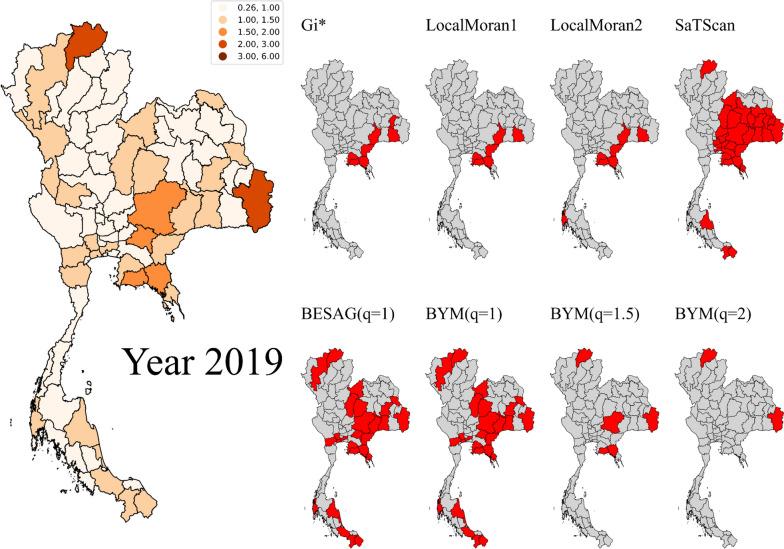
In the simulation study, Getis Ord [Formula: see text] and Local Moran had similar performance, with most misdetections occurring at cluster boundaries and isolated hotspots. SaTScan showed better precision but was less effective at detecting inner outliers, although it performed well on large outbreaks. Bayesian convolution modeling had the highest overall precision in the simulation study. In the dengue case study in Thailand, Getis Ord [Formula: see text] and Local Moran missed most disease clusters, while SaTScan was mostly able to detect a large cluster. Bayesian disease mapping seemed to be the most effective, with adaptive detection of irregularly shaped disease anomalies.
CONCLUSIONS
Bayesian modeling showed to be the most effective method, demonstrating the best accuracy in adaptively identifying irregularly shaped disease anomalies. In contrast, SaTScan excelled in detecting large outbreaks and regular forms. This study provides empirical evidence for the selection of appropriate tools for dengue surveillance in Thailand, with potential applicability to other disease control programs in similar settings.
背景
登革热是一种由蚊子传播的疾病,每年在全球导致超过 3 亿例感染,目前尚无特效治疗方法。需要有效的监测系统来发现疫情并分配资源。空间聚类检测方法通常用于此目的,但对于登革热监测最适合的方法尚无普遍指导意见。因此,需要进行全面研究来评估不同的方法,并为登革热监测计划提供指导。
方法
为了评估不同的聚类检测方法在登革热监测中的有效性,我们选择并评估了常用的方法:Getis-Ord [Formula: see text]、局部 Moran、SaTScan 和贝叶斯建模。我们进行了一项模拟研究来比较它们在检测聚类方面的性能,并将所有方法应用于 2019 年泰国登革热监测的案例研究,以进一步评估它们的实际应用。
结果
在模拟研究中,Getis-Ord [Formula: see text]和局部 Moran 的性能相似,大多数误报发生在聚类边界和孤立的热点处。SaTScan 具有更好的精度,但在检测内部异常值方面效果较差,尽管它在大爆发时表现良好。贝叶斯卷积建模在模拟研究中具有最高的整体精度。在泰国的登革热案例研究中,Getis-Ord [Formula: see text]和局部 Moran 错过了大多数疾病集群,而 SaTScan 则能够检测到一个大型集群。贝叶斯疾病映射似乎是最有效的方法,能够自适应地检测不规则形状的疾病异常。
结论
贝叶斯建模显示是最有效的方法,在自适应识别不规则形状的疾病异常方面表现出最佳的准确性。相比之下,SaTScan 在检测大爆发和规则形状方面表现出色。本研究为泰国登革热监测工具的选择提供了经验证据,也可能适用于类似环境中的其他疾病控制计划。


 Zotero 插件