
运动计划对社区居住的体弱和非体弱老年人身体机能的影响:系统评价与荟萃分析
Effect of Exercise Programs on Physical Performance in Community-Dwelling Older Adults with and without Frailty: Systematic Review and Meta-Analysis.
作者信息
Flores-Bello Cristina, Correa-Muñoz Elsa, Sánchez-Rodríguez Martha A, Mendoza-Núñez Víctor Manuel
机构信息
Research Unit on Gerontology, FES Zaragoza, National Autonomous University of Mexico, Mexico City 09230, Mexico.
Postgraduate Master's and Doctorate in Nursing, National Autonomous University of Mexico, Mexico City 09230, Mexico.
出版信息
Geriatrics (Basel). 2024 Jan 8;9(1):8. doi: 10.3390/geriatrics9010008.
BACKGROUND
The measurement of physical performance constitutes an indicator of the physical functional capacity of older adults with and without frailty.
AIM
To present a synthesis of knowledge on the effect of exercise programs on physical performance in older adults with and without frailty in the community.
METHOD
A systematic review was carried out in accordance with the PRISMA-2020 criteria. The search for articles was made until 4 May 2023 in PubMed, Scopus, Web of Science, Cochrane Library, SciELO and LILACS. The outcome variable was physical performance, measured through the SPPB (Short Physical Performance Battery). The mean difference (MD) was estimated to evaluate the effect.
RESULT
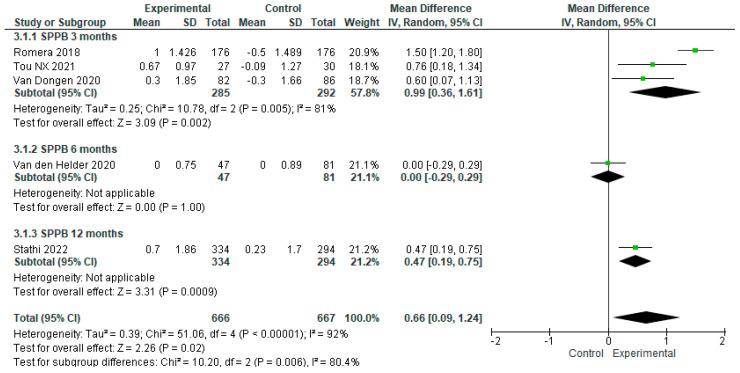
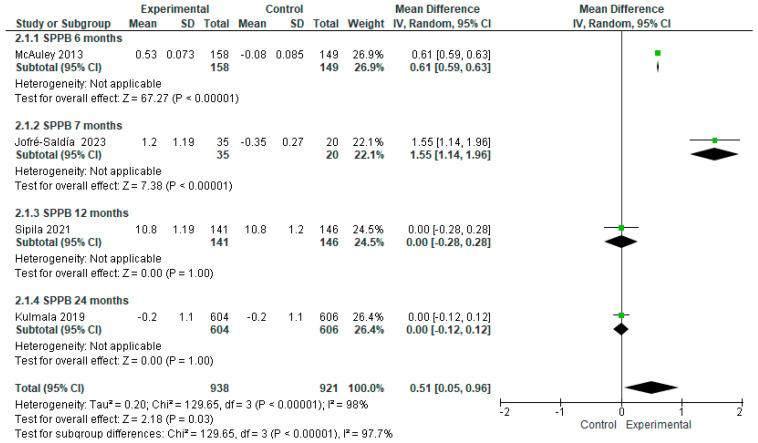
We found 2483 studies, of which 12 met the eligibility criteria for the systematic review and 9 for the meta-analysis. The effect of exercise on SPPB scores was significantly higher in the exercise group compared to control in non-frail older adults with MD = 0.51 [95% CI, 0.05 to 0.96, < 0.05]. Likewise, in older adults with frailty, the effect of exercise on the global SPPB score was significantly higher in the exercise group compared to the control with MD = 0.66 [95% CI, 0.09 to 1.24, < 0.05].
CONCLUSION
Our findings suggest that exercise programs are effective in increasing and/or maintaining physical performance in older adults with and without frailty, whose effect is more evident in older adults with frailty, probably due to the greater margin of recovery of intrinsic capacity. This systematic review shows the differentiated effect of exercise training on physical performance in older adults with and without frailty. Scientific evidence reinforces the importance of implementing physical exercise programs in all older adults, including those who are frail. However, it is necessary to specify the types and doses (duration, frequency and intensity), for individualized groups, previously grouped according to the SPPB score.
背景
身体机能的测量是有或没有衰弱的老年人身体功能能力的一个指标。
目的
综述关于运动项目对社区中有或没有衰弱的老年人身体机能影响的知识。
方法
按照PRISMA - 2020标准进行系统综述。截至2023年5月4日,在PubMed、Scopus、科学网、考科蓝图书馆、SciELO和LILACS中检索文章。结局变量是身体机能,通过简短身体机能测试电池(SPPB)进行测量。估计平均差(MD)以评估效果。
结果
我们找到2483项研究,其中12项符合系统综述的纳入标准,9项符合荟萃分析的纳入标准。在非衰弱的老年人中,运动组与对照组相比,运动对SPPB评分的影响显著更高,MD = 0.51 [95%置信区间,0.05至0.96,P < 0.05]。同样,在衰弱的老年人中,运动组与对照组相比,运动对整体SPPB评分的影响显著更高,MD = 0.66 [95%置信区间,0.09至1.24,P < 0.05]。
结论
我们的研究结果表明,运动项目对于有或没有衰弱的老年人提高和/或维持身体机能是有效的,其效果在衰弱的老年人中更明显,这可能是由于内在能力的恢复空间更大。这项系统综述显示了运动训练对有或没有衰弱的老年人身体机能的不同影响。科学证据强化了在所有老年人中,包括衰弱老年人,实施体育锻炼项目的重要性。然而,有必要针对先前根据SPPB评分分组的个体群体,明确运动类型和剂量(持续时间、频率和强度)。
 Zotero 插件