
2009年至2018年间美国成年人类胡萝卜素摄入量及主要食物来源的变化
Changes in Intake and Major Food Sources of Carotenoids among U.S. Adults between 2009-2018.
作者信息
Kim Kijoon, Madore Matthew P, Chun Ock K
机构信息
Department of Nutritional Sciences, University of Connecticut, Storrs, CT 06269, USA.
Department of Food and Nutrition, Sookmyung Women's University, Seoul 04310, Republic of Korea.
出版信息
Metabolites. 2023 Dec 24;14(1):13. doi: 10.3390/metabo14010013.
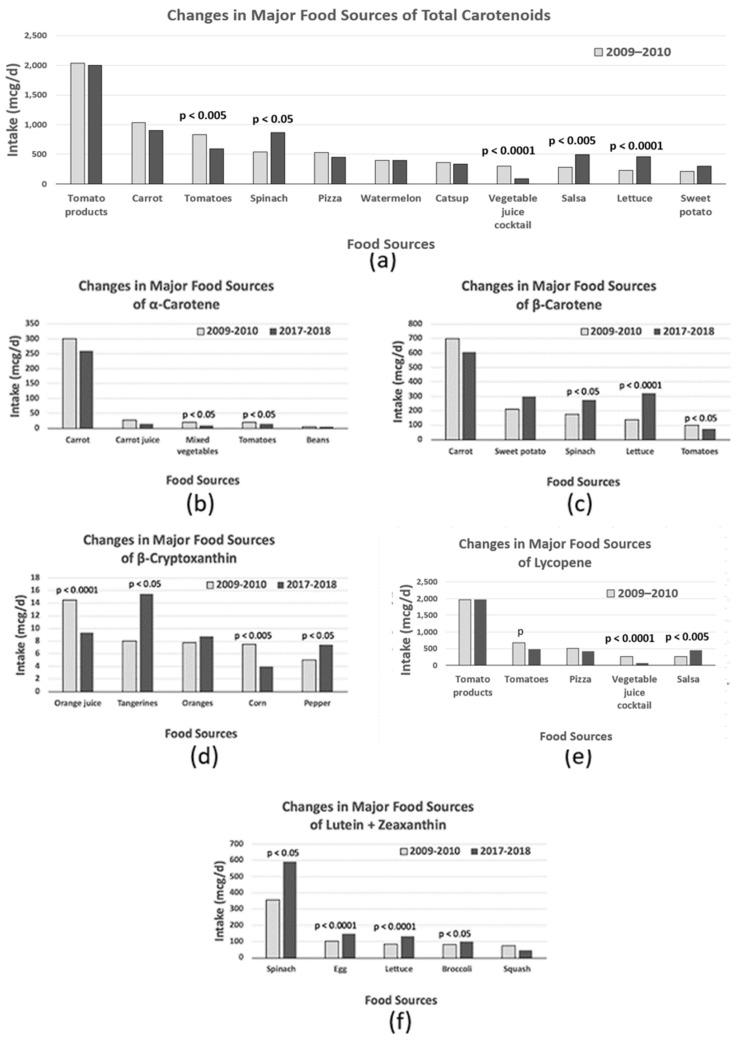
Large epidemiologic studies suggest that diets rich in total or specific carotenoids are associated with a reduced risk of many chronic diseases. However, there are few studies characterizing trends in dietary carotenoid sources and intake among subgroups of the US adult population in the previous decade. This study aimed to assess these trends using data from 22,339 adults who participated in NHANES 2009-2018 cycles. Carotenoid intake and major food sources were calculated by linking food consumption data from the 24 h diet recall to an FNDDS 2009-2018 and the USDA's National Nutrient Database for Standard Reference (Release 28). Among US adults, mean (SE) dietary carotenoid intake was 9687.1 (158.0) mcg/day, and total intake was highest in men, non-smokers, moderate alcohol consumers, supplement users, and those with normal BMI, a PIR ≥ 1.85, and whose physical activity level was considered vigorous ( < 0.05). Carotenoid intake has gradually decreased over the past decade (-trend: 0.097), especially among White adults (-trend < 0.05), males (-trend: 0.062), and those with a PIR of 1.0-1.3 (-trend: 0.051), as have estimated rates of vitamin A adequacy. Tomatoes, carrots, and spinach were major food sources of carotenoids, and consumption of carrots and tomatoes decreased, while the consumption of lettuce, spinach, and salsa increased from 2009 to 2018. Our results warrant further studies investigating the consequences of the decreased tendencies of carotenoid intake on chronic disease risk, especially focusing on population subgroups exhibiting low or decreasing trends of carotenoid intake status.
大型流行病学研究表明,富含总类胡萝卜素或特定类胡萝卜素的饮食与多种慢性病风险降低有关。然而,在前十年中,很少有研究描述美国成年人群亚组中膳食类胡萝卜素来源和摄入量的趋势。本研究旨在利用参加2009 - 2018年美国国家健康与营养检查调查(NHANES)的22339名成年人的数据评估这些趋势。通过将24小时饮食回忆中的食物消费数据与2009 - 2018年的食品和营养数据库系统(FNDDS)以及美国农业部的标准参考营养数据库(第28版)相链接,计算类胡萝卜素摄入量和主要食物来源。在美国成年人中,膳食类胡萝卜素平均(标准误)摄入量为9687.1(158.0)微克/天,男性、非吸烟者、适度饮酒者、补充剂使用者以及体重指数正常、贫困收入比(PIR)≥1.85且身体活动水平被认为剧烈的人群总摄入量最高(P<0.05)。在过去十年中,类胡萝卜素摄入量逐渐下降(-趋势:0.097),尤其是在白人成年人(-趋势<0.05)、男性(-趋势:0.062)以及PIR为1.0 - 1.3的人群(-趋势:0.051)中,维生素A充足率的估计值也呈下降趋势。西红柿、胡萝卜和菠菜是类胡萝卜素的主要食物来源,从2009年到2018年,胡萝卜和西红柿的消费量下降,而生菜、菠菜和莎莎酱的消费量增加。我们的研究结果值得进一步研究,以调查类胡萝卜素摄入量下降趋势对慢性病风险的影响,特别是关注类胡萝卜素摄入状况呈低水平或下降趋势的人群亚组。

 Zotero 插件