
埃塞俄比亚西南部一家三级护理中心儿童青光眼特征:一项回顾性研究。
Childhood glaucoma profile in a Southwestern Ethiopia tertiary care center: a retrospective study.
机构信息
Department of Ophthalmology, Institute of Health, Jimma University, Jimma, Ethiopia.
出版信息
BMC Ophthalmol. 2024 Jan 22;24(1):31. doi: 10.1186/s12886-023-03268-7.
BACKGROUND
Childhood glaucoma is a major cause of childhood blindness worldwide. The profile of childhood glaucoma has not been well characterized in sub-Saharan Africa. Thus, this study was designed to describe demographics, clinical features, managements of childhood glaucoma, and improvements in visual acuity (VA) and intraocular pressure (IOP) from baseline to final visit.
METHODS
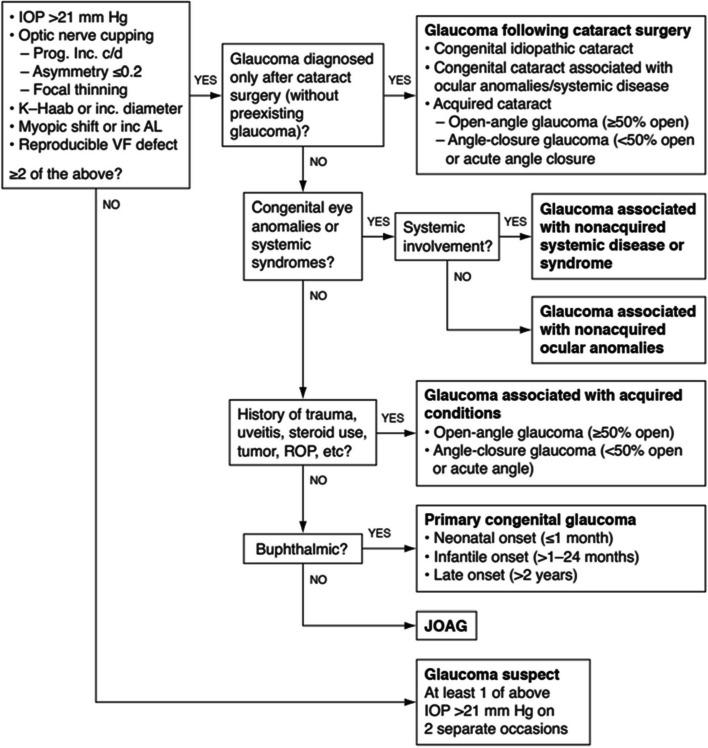
This retrospective study included glaucoma patients below 18 years old who were diagnosed between September 2019 to August 2022. Childhood glaucoma diagnosis and classification was made as per the Childhood Glaucoma Research Network Classification (CGRN).
RESULTS
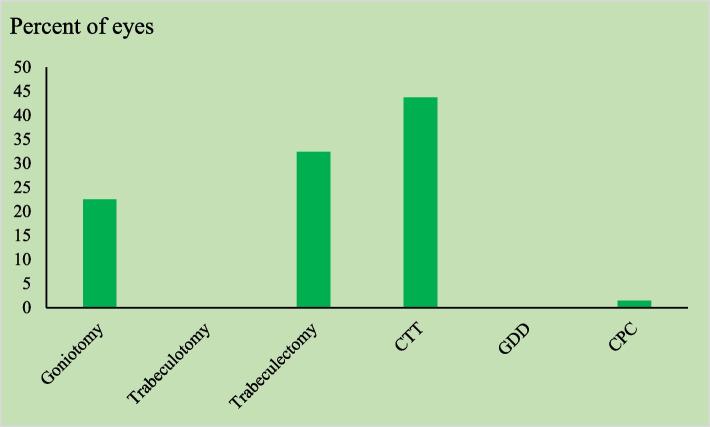
A total of 105 children (181 eyes) were diagnosed with glaucoma. The most common type of childhood glaucoma was primary congenital glaucoma (PCG) constituting (42%, n = 76 eyes, 95% confidence interval (CI), 34.7-49.5%; P = 0.037), followed by glaucoma suspect (22.1%, n = 40 eyes, 95% CI, 16.3-28.9%; P < 0.001) and juvenile open-angle glaucoma (JOAG) (15.5%, n = 28 eyes, 95% CI, 10.5-21.6%; P < 0.001). While the most common type of secondary glaucoma was steroid-induced glaucoma, followed by glaucoma following cataract surgery. Bilateral glaucoma was found in 72.4% (n = 76 children, 95% CI, 62.8-80.7%; P < 0.001) of children. In both primary and secondary glaucoma, boys were affected more than girls, in ratio of 2:1 and 2.7:1, respectively. The mean age at presentation for patients with PCG was 2.7 years. Close to 93.4% (71) of PCG eyes were managed surgically, of which majority underwent combined trabeculotomy and trabeculectomy (CTT). Most of secondary glaucoma cases were treated medically. Overall, 85.3% (111) of eyes had successful control of IOP ≤ 21 mmHg.
CONCLUSION
PCG was the most common type of childhood glaucoma. One of a well-recognized challenge in developing countries, late presentation of patients with PCG, was also observed in our study. Which highlights, the need of increasing access to eye-care service and awareness of childhood glaucoma as a major public health issue. Steroid-induced glaucoma was the most common type of secondary glaucoma; appropriate measures should be taken to prevent this preventable glaucoma.
背景
儿童青光眼是全球儿童失明的主要原因。在撒哈拉以南非洲,儿童青光眼的发病情况尚未得到充分描述。因此,本研究旨在描述儿童青光眼的人口统计学特征、临床特征、治疗方法,以及从基线到最终随访时视力(VA)和眼内压(IOP)的改善情况。
方法
本回顾性研究纳入了 2019 年 9 月至 2022 年 8 月期间诊断为儿童青光眼的 18 岁以下患者。儿童青光眼的诊断和分类依据儿童青光眼研究网络分类(CGRN)进行。
结果
共诊断出 105 名儿童(181 只眼)患有青光眼。最常见的儿童青光眼类型是原发性先天性青光眼(PCG),占 42%(n=76 只眼,95%置信区间(CI),34.7-49.5%;P=0.037),其次是青光眼疑似(22.1%,n=40 只眼,95%CI,16.3-28.9%;P<0.001)和青少年开角型青光眼(JOAG)(15.5%,n=28 只眼,95%CI,10.5-21.6%;P<0.001)。继发性青光眼最常见的类型是类固醇诱导性青光眼,其次是白内障手术后青光眼。72.4%(n=76 名儿童,95%CI,62.8-80.7%;P<0.001)的儿童患有双眼青光眼。在原发性和继发性青光眼患者中,男孩的患病比例均高于女孩,分别为 2:1 和 2.7:1。PCG 患者的平均发病年龄为 2.7 岁。接近 93.4%(71 只眼)的 PCG 眼接受了手术治疗,其中大多数接受了小梁切开术联合小梁切除术(CTT)。大多数继发性青光眼病例采用药物治疗。总体而言,85.3%(111 只眼)的眼内压(IOP)成功控制在≤21mmHg。
结论
PCG 是最常见的儿童青光眼类型。在发展中国家,患者就诊较晚是一个公认的挑战,在本研究中也观察到了这种情况。这突显了增加获得眼保健服务的机会以及认识到儿童青光眼是一个主要公共卫生问题的必要性。类固醇诱导性青光眼是最常见的继发性青光眼类型;应采取适当措施预防这种可预防的青光眼。

 Zotero 插件